
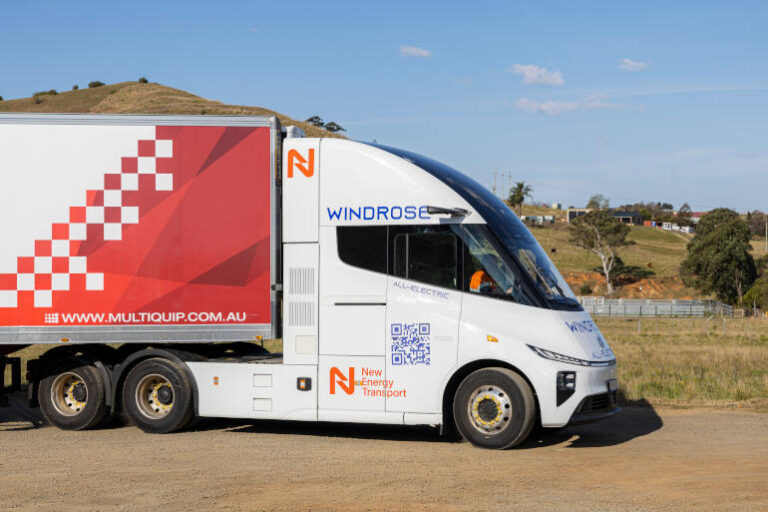
Australia’s heavy-vehicle industry just reached a new milestone. New Energy Transport (NET) has completed the country’s longest single-charge delivery by an electric truck — a 480-kilometre round trip hauling 36 tonnes between Picton and Beresfield — proving that the technology is no longer confined to short-range urban operations.
The demonstration, completed in partnership with Multiquip and Windrose, comes as NET announces plans to build Australia’s largest heavy-electric-truck depot near Wilton in south-west Sydney, a site that will anchor future zero-emission freight corridors across the eastern seaboard.
Setting new expectations for heavy-duty performance
For transport operators, the standout result wasn’t just the range — it was the speed. TheWindrose electric prime mover maintained an average of 98 km/h, completing the journey 40 minutes faster than Multiquip’s diesel trucks that typically average 85 km/h on the same route.
David Muir, National Compliance Manager at Multiquip, said the result surprised his team.
“Timing is a huge factor for any business, particularly a just-in-time business like ours. It was very surprising to see how much time our driver was able to save with the electric truck able to maintain a high speed over the distance.”
For heavy-vehicle operators, that difference translates to more deliveries per shift and better asset utilisation, challenging the assumption that electric trucks sacrifice productivity for sustainability.
Building Australia’s first electric freight corridor
NET’s Wilton facility will support up to 50 electric prime movers, with high-capacity charging designed for fast turnarounds on regional and interstate routes. Positioned near key freight corridors linking Sydney, Wollongong, and Canberra, the site is intended to become a launch point for electric line-haul services between Sydney and Melbourne.
Daniel Bleakley, Co-CEO of NET, said the company’s goal is to combine renewable energy, high-speed charging, and electric powertrains into a cost-competitive freight model.
“New Energy Transport is a new kind of trucking company. By combining low-cost renewable energy, high-speed charging and electric prime movers, New Energy Transport offers zero-emission road freight at diesel-based prices,” he said.
Technology built for line-haul
While some early electric trucks in Australia have been converted diesel chassis, the Windrose prime mover is a ground-up EV design. According to James Walmsley, Director Business Development at Windrose Australia, that design advantage changes what’s possible in a heavy-duty application.
“There’s no more range, payload or road-access compromises as you’d see in a diesel chassis converted to electric,” Walmsley said. “With 1,400 horsepower and 68-tonne B-double capability, the Windrose truck matches diesel counterparts on payload and exceeds them on performance.”
The truck’s 860 kWh charging capability allows a full recharge in about an hour, making it practical for back-to-base or line-haul operations supported by depot-based charging.
Local jobs, local emissions cuts
The Wilton site has strong backing from Wollondilly MP Judy Hannan, who says the development will benefit both the community and the transport sector.
“It is wonderful to see heavy road transport becoming more environmentally friendly,” she said. “The testing of the trucks shows there are alternatives that are not only better for the environment but also better for the driver and the business owner.”
The depot will create long-term regional jobs and reduce noise and emissions in the growing south-west Sydney freight corridor — a significant step as road freight accounts for40 percent of Australia’s transport emissions and is projected to become the nation’s highest-emitting sector by 2030.
The next stage: scaling electric freight networks
NET’s next move is to secure investment and formalise agreements with major transport buyers. Six Memoranda of Understanding have already been signed to accelerate fleet deployment and charging network construction.
Fredrik Pehrsson, NET’s Co-CEO, says the company’s long-term goal is to build a national zero-emission freight network.
“We’re building our own charging infrastructure to support our own electric heavy prime movers for our customers,” he said. “There’s a lot of possibilities coming with electrification and we’re excited about what is to come.”
What it means for the heavy-vehicle industry
For Fleet and Operations Managers, the trial is a signal that heavy-electric transport has arrived — not as a pilot concept but as a viable business model. High-torque electric drivetrains deliver better hill performance, lower energy costs per kilometre, and reduced driver fatigue thanks to quieter cabins and smoother acceleration.
With the combination of fast charging, purpose-built trucks, and strategic depot planning, New Energy Transport’s model demonstrates how operators can begin to transition long-haul freight without waiting for hydrogen or future-state technologies.
The message from Wilton is clear: electric road freight isn’t coming — it’s already here.