
Australia’s off-road truck market presents a particular engineering challenge.
Vehicles can be expected to move between highways, regional roads, mine sites, fire trails, construction zones and remote service locations, often while carrying specialised bodies, equipment or crews.
For Isuzu, those conditions have not simply influenced how trucks are specified for Australia. They have helped shape the trucks themselves.
During the launch of Isuzu’s latest AWD and 4×4 range, the company highlighted the role Australian customers have played in the development of products such as the NPS, NQS, FSS and FTS.
The result is a range that reflects decades of feedback from emergency services, mining companies, councils, utilities and other vocational fleets operating in some of the most demanding environments in the country.
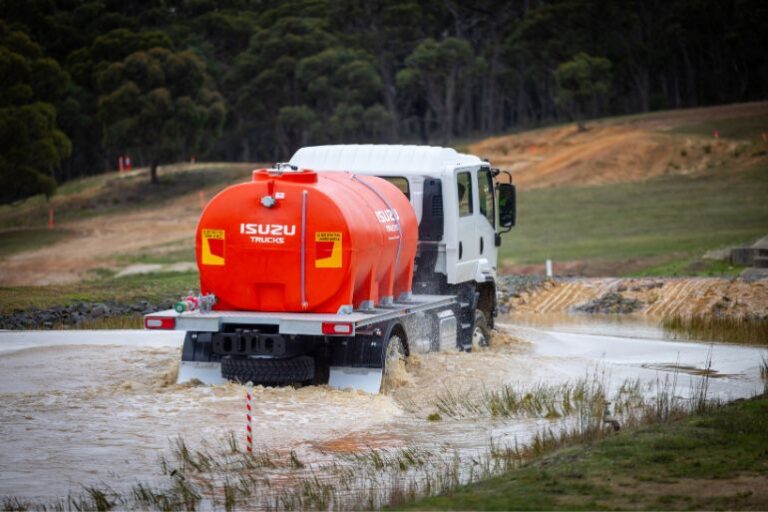
The NPS started with an Australian requirement
One of the clearest examples is the Isuzu NPS.
Isuzu Trucks Head of Product Management & CV Chief Engineer Simon Humphries said the NPS was originally developed specifically for the Australian market.
In Japan, all-wheel-drive trucks were generally designed to deal with slippery road conditions rather than the type of genuine off-road work commonly encountered in Australia. Australian customers wanted something different.
“The NPS was actually developed for Australia,” Humphries said.
He explained that local operators required features such as greater ground clearance, low-range gearing and larger wheels to handle more demanding terrain.
That requirement helped create a truck that would go on to become a familiar sight across rural fire services, SES fleets, mining operations and remote-area support work.
Emergency services became an important proving ground
Emergency services have played a particularly significant role in the development of Isuzu’s off-road range.
Isuzu Trucks Head of Sales Craig White said the sector has long been central to the company’s 4×4 business.
“The backbone of what we have achieved is emergency services,” White said.
Rural fire services and SES organisations can place unusual demands on a vehicle.
A truck may sit idle for periods before being expected to operate immediately in difficult terrain, often with a volunteer or occasional driver behind the wheel.
That combination has influenced both mechanical design and the way newer Isuzu models are being specified.
White said reliability remains critical because these are vehicles that may be called upon at exactly the moment when failure is least acceptable.
“If you’re relying on a product for a particular moment to do its job, it is crucially important that this product is reliable and does what it says it’s going to be doing every single time,” he said.
Ease of operation became part of the specification
The changing needs of emergency service fleets are also helping influence transmission choices.
The new NQS 4×4 uses Isuzu’s nine-speed dual-clutch transmission, creating a two-pedal truck aimed particularly at emergency services, mining and other multi-driver applications.
For fleets relying on volunteers or rotating driver pools, ease of operation can be just as important as outright off-road capability.
White said Isuzu wanted the vehicle to be easier for occasional drivers to operate.
“The purpose of what we want to achieve out of this product is to make it user-friendly, make it easy to operate for the volunteers,” he said.
That has helped create a split within the range.
The NPS remains available as a more traditional manual 4×4, while the NQS provides an eight-tonne GVM platform with a two-pedal transmission and a broader safety package.
Rather than forcing every customer into the same specification, Isuzu has effectively created different products around different Australian use cases.
Mining and field-service fleets have also influenced the range
Mining and remote field-service customers have presented another set of challenges. Vehicles operating in those environments need to carry tools, service bodies and equipment while still maintaining enough payload capacity to remain productive and compliant.
White said chain-of-responsibility requirements and concerns about vehicle overloading have increased the importance of payload. That is one reason the new NQS moves to an 8,000kg GVM.
For emergency services, Humphries said that extra capacity could translate into hundreds of kilograms of additional water.
For mining and field-service operators, it can mean greater flexibility around service bodies, equipment and tools.
The same thinking extends further up the Isuzu range.
The new FTS 4×4 moves to a 15-tonne GVM, providing additional capacity for applications such as emergency response, mining support and specialist remote-area operations.
Australian engineering goes beyond the 4×4 range
The influence of Australian applications is not limited to off-road models.
Isuzu’s local product development operation has also created or refined products for construction, waste, service and trade applications.
Its Australian engineering work has included the FYJ Agitator and FYX 10×4, along with application-specific products such as Dual Control waste vehicles and the Ready-to-Work range.
The company says its local capability now extends across product planning, engineering, specification development and second-stage manufacturing.
That allows customer feedback to flow back into the vehicle-development process.
Instead of simply taking an overseas truck and adapting it after arrival, Isuzu has been able to develop configurations around the demands of local operators.
The FTS shows how that development continues
The latest FTS 4×4 is another example of that process.
The new model receives a strengthened chassis, increased front axle capacity, upgraded braking technology, an engine compression brake and a broader suite of driver-assistance systems.
Humphries said the aim was to improve capability without losing the qualities that had already made the platform successful with Australian fleets.
“The F Series 4×4 range has built an extremely strong reputation in Australia because it delivers where operators need it most — reliability, capability and long-term durability in very demanding conditions,” he said.
The latest version is therefore more evolution than reinvention.
The basic job remains the same, but expectations around safety, payload, driver comfort and body integration have changed.
Fleet requirements are still shaping the product
The interesting part of Isuzu’s off-road story is that development has not been driven by one type of customer.
Emergency services have influenced reliability, payload and ease of operation. Mining and field-service fleets have pushed requirements around durability, capacity and remote-area capability.
Councils and utilities have helped create demand for vehicles that can move between sealed roads and less demanding off-road environments.
And specialist and recreational customers have helped keep the NPS relevant as a more configurable, traditional 4×4 platform.
That diversity helps explain why Isuzu now offers AWD and 4×4 trucks across several different GVM points rather than trying to create one vehicle for every application.
For Fleet Managers, it is also a reminder that many of the features appearing in the latest generation of commercial vehicles have been shaped by years of operational experience.
Australian fleets have not just been buying Isuzu’s off-road trucks. They have helped define what the next generation needs to be.