
Australia’s Hume Highway has become the focal point for one of the country’s most ambitious freight decarbonisation initiatives — not because it is easy, but because it is hard.
Connecting Sydney and Melbourne, the Hume is the nation’s busiest truck corridor, carrying an estimated 4,800 trucks every day. It has no meaningful rail alternative, supports a wide mix of freight tasks, and operates under tight delivery schedules. If zero-emission trucking can work here, it can work almost anywhere.
That reality sits at the heart of the Hume Zero project, a new industry-led initiative bringing together fleet operators, infrastructure providers, energy specialists and government stakeholders to tackle the commercial and operational barriers holding electric freight back. 2512 Rainer Knobloch – For an i…
Why the Hume matters
Unlike many other freight routes, the Hume is not just a transport corridor — it is also a renewable energy corridor. Large-scale wind and solar projects are already operating, under development or planned along the route, creating the opportunity to link low-cost renewable generation with high-volume freight demand.
Rainer Knobloch, Chief Operating Officer of NewVolt, says this combination is what makes the Hume uniquely important.
“The Hume is the busiest highway in Australia for trucks… and it is a renewable energy corridor. That is the real opportunity we have on that corridor — unlocking the economics using Australian energy.”
The challenge is that freight operations on the Hume are unforgiving. Long distances, strict driver hours, delivery windows and vehicle productivity requirements mean there is little tolerance for disruption or inefficiency.
This is not just a charging problem
One of the key messages behind Hume Zero is that heavy vehicle electrification is not simply a matter of installing chargers at regular intervals.
While modelling suggests around six charging locations would provide sufficient coverage along the corridor, those sites are not about stopping six times per trip. Instead, they create optionality for different routes, return legs, and freight patterns branching off the main highway.
More critically, the limiting factors are operational and economic.
“The reality is the trucks and the duty cycles are more complex. The complexity is around the operational bits — how do you get the techno-economics right and the operations right to make electric freight sellable on the highways?”
For fleets, decisions hinge on total cost, vehicle utilisation, driver hours, residual value risk and contract structures with customers. Even with generous subsidies, those factors do not automatically stack up.
“You can throw all the money you like at truck subsidies… but fleets still have to make the decision to do this. You really need to drive the economics and the simplicity of operations.”
Why Hume Zero is a collective approach
Rather than positioning itself as a single infrastructure rollout, Hume Zero is being framed as a collaborative program. NewVolt is acting as a consortium organiser, working alongside the global Drive to Zero initiative led by CALSTART.
The intent is to bring competing infrastructure providers, fleets, OEMs and governments into the same conversation — including the possibility of roaming agreements between charging networks, a model already used in Europe.
“This isn’t NewVolt trying to own all of this. It’s about creating a collective body to figure this out — infrastructure, energy, operations, and economics — together.”
Government support still plays a role, particularly through organisations such as Australian Renewable Energy Agency, but the project is deliberately focused on reducing reliance on long-term subsidies.
Vehicles are only part of the equation
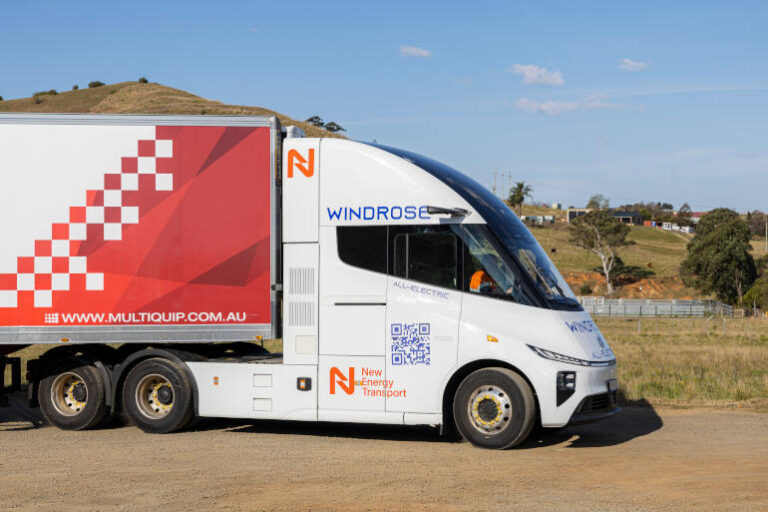
Trials have already shown that electric trucks can physically operate on the Hume. Vehicles from OEMs including Volvo, Daimler and Windrose have completed runs along the corridor.
The remaining barriers are less about capability and more about timing and efficiency.
There is a narrow “sweet spot” for long-haul electric freight, typically around 10–12 hours total journey time. Push beyond that, and fleets risk tipping into additional driver shifts, higher labour costs and operational complexity.
That is why the Hume Zero project is concentrating on techno-economic modelling before large-scale infrastructure commitments are made.
An energy story as much as a transport story
A recurring theme in the project is reframing zero-emission freight as an energy challenge.
Electricity pricing varies significantly by time of day, while many long-haul trucks travel overnight — when power can be more expensive. Battery energy storage is emerging as a key tool to smooth that mismatch, allowing cheaper daytime renewable energy to be stored and used later.
“Our goal is to get the cheapest possible electrons into trucks. That means looking at generation, storage and charging together — not in isolation.”
As battery storage costs continue to fall, that equation is changing rapidly, influencing when and how charging infrastructure should be deployed.
Why success on the Hume matters
Hume Zero is not about mandating electric trucks or declaring an overnight transition. It is about proving whether zero-emission freight can be commercially viable on Australia’s most demanding corridor.
If it cannot work on the Hume, it will struggle elsewhere. If it can, it provides a blueprint for other freight routes across the country.
“This isn’t going to be solved by one party stepping up and doing everything. Everyone has to lean in — fleets, energy, infrastructure, OEMs and government — if this is going to work.”
Over the next 12 months, Hume Zero is expected to release further details, including consortium partners, modelling outcomes and next steps. For fleet operators watching from the sidelines, the Hume is becoming the place where theory meets reality.
- Downer’s Hino Choice Starts with the Driver
 Downer Group has added another Hino 700 Series to its fleet, selecting an FY 3248 8×4 chassis for a specialised Bergkamp feeder unit used in road preservation and microsurfacing. The purchase followed an extensive evaluation of different truck manufacturers, with Downer assessing how each chassis would meet the demands of the application. Driver comfort, low
 - Hino 500 Series Means BusinessHino is putting Australian operating experience at the centre of its 2027 medium-duty 500 Series, highlighting an established driveline alongside standard safety technology and connected fleet support. Since the platform’s introduction in 2019, the 500 Series has worked across applications ranging from freight and construction to council services and towing. For fleet managers assessing replacement
- Three risks behind more than a third of major truck incidentsInattention, inappropriate speed and inadequate following distance accounted for 38% of major heavy vehicle incidents in 2025, according to new research that gives fleet managers a clear starting point for reviewing their safety priorities. The 2026 National Truck Accident Research Centre (NTARC) Major Incident Investigation Report found human factors contributed to 54.7% of all major incidents analysed.
- MAN TGS wins 2026 Fleet Truck of the Year – Heavy DutyThe MAN TGS has been named the 2026 Fleet Truck of the Year – Heavy Duty, taking the top spot in the Fleet News Group Best Value Analysis with an overall score of 7.730 out of 10. The MAN finished ahead of the Hino 700 Series, which scored 7.600, and the Volvo FH16, which recorded 7.495, making the Heavy Duty category one of
- IVECO Daily wins 2026 Fleet Truck of the Year – Light DutyThe IVECO Daily Cab Chassis 50C has been named the 2026 Fleet Truck of the Year – Light Duty, finishing on top of the Fleet News Group Best Value Analysis with an overall score of 6.010 out of 10. The Daily finished ahead of the Isuzu NPR , which scored 5.741, and the Hino 300 Series, which recorded 5.030. While all three finalists