

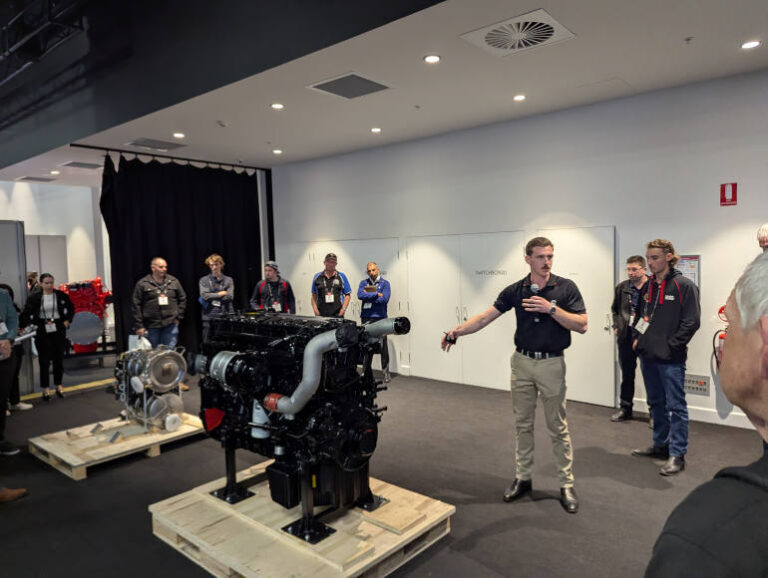
At the Australian Trucking Association’s Technology and Maintenance Conference (TMC) 2025, Cummins’ Liam Heidrich, unpacked the design and servicing details of the new Cummins X15D engine — a next-generation power unit that blends performance, durability, and service simplicity.
Heidrich explained that the X15D represents a significant evolution from the familiar X15 Euro V and Euro VI platforms. “Most of you are probably aware that PACCAR has introduced the DAF XG fitted with the PX15, jointly developed with Cummins. Make no mistake, that is definitely very much a Cummins engine — it’s the X15D,” he said.
The 14.5-litre inline-six engine meets Euro VI and OBD D standards, delivering 660 PS at 1800 rpm and 3200 Nm of torque between 900 and 1400 rpm. With a new rear gear train and 23:1 compression ratio, the X15D achieves greater efficiency and responsiveness.
Lighter and stronger
One of the standout features is the new sculpted block design, which Heidrich described as “quite different to our X15 product … very sculpted, with strengthening ribs through here to reduce flex.” Combined with a composite sump and rocker cover, the X15D saves 225 kilograms compared with the previous-generation X15 Euro V and VI engines. “That’s a significant weight saving,” he said.
The latest-generation XPI common-rail fuel system improves efficiency by around 8 percent, while a waste-gated turbocharger replaces the variable-geometry unit used on earlier EGR engines. “We’re staying away from VGTs for now — our Australian fleets have had some dramas with those — although in the US they’ve come a long way,” Heidrich explained.
Aftertreatment system: designed for uptime
The aftertreatment system is a major focus of the X15D’s design. “We’ll follow our exhaust flow through the system,” Heidrich told delegates. “The first thing the exhaust gases encounter is the DPF section … essentially the same as our X15 E6 product, just housed in a new module.”
The unit integrates the Diesel Oxidation Catalyst (DOC), Diesel Particulate Filter (DPF), and Selective Catalytic Reduction (SCR) components in a compact module. Regeneration begins when “we inject a little bit of diesel that goes through the exhaust throttle valve and into the DOC. The diesel reacts with the substrate and increases heat — up to excess of 600 degrees when we’re doing a regen and burning off the DPF,” he said.
Once particulates are burnt off, trace ash remains and accumulates gradually over the life of the engine. “When that builds up to a point, we will need to replace the DPF — it is a serviceable part eventually,” he noted.
Downstream of the DPF, the SCR system manages nitrogen oxides using diesel exhaust fluid (DEF). Heidrich said the new UL 2.2 dosing system is “quite robust, as long as you’re feeding your DEF correctly.” The system is simplified compared with earlier designs: “There’s no integration between air and DEF — it really does save a lot of issues with crystallisation.”
Maintenance made simple
For fleets and technicians, Cummins has placed a strong emphasis on accessibility and clear guidance. Heidrich directed attendees to QuickServe Online, the company’s public service information portal. “You can all get free accounts … everything you need for these engines is in here,” he said. “If you remember nothing else from this presentation, remember this — it’s your Bible.”
Within QuickServe, the operation and maintenance manual details service intervals based on duty cycle.
- Light-duty cycles (over 2.8 km/L) can extend oil drains up to 80,000 km.
- Normal duty (2.8 – 1.8 km/L) also allows 80,000 km intervals.
- Severe duty (heavy B-double or road-train work) reduces intervals to 40,000 km.
Heidrich explained that each engine features two sump plugs — a front and rear drain point. “You have to remove the back one first and use that as your tool to insert into the other one … it enforces us to make sure we actually do drain all of the oil out, because it does dip down at the front for increased oil capacity.”
That extra capacity supports the longer drain intervals — a practical example of design meeting maintenance efficiency.
DEF system care and filtration
The DEF filtration system requires attention every 160,000 km, typically every two oil services. “There are three types of filters potentially in the aftertreatment system,” Heidrich explained. “An in-tank filter, a small cartridge filter inside the DEF dosing pump — which comes as a kit from Cummins — and an inline DEF filter that’s chassis-mounted.”
He emphasised the importance of DEF quality and handling. “Make sure your DEF supplier is using demineralised, deionised water — not tap water with calcium. And make sure your DEF is stored correctly; excessive heat will evaporate the water and mess with the concentration and dosing.”
He likened DEF management to fuel quality control: “Start to think of it like your fuel — you don’t want contaminants in there. Make sure your DEF environment is clean with pre-filtration before it goes into the tank.”
Built for reliability and fleet productivity
By combining a lighter, more efficient block with advanced aftertreatment and accessible maintenance procedures, the X15D is positioned to reduce downtime and operating costs while meeting the most stringent emissions standards.
As Heidrich concluded, the focus for fleets is simple: “Understand what makes it unique, and how you can maximise durability and reliability in your fleets.”
For fleet managers and technicians planning for Euro VI adoption, the Cummins X15D represents a tangible step toward cleaner, more efficient, and service-friendly heavy-duty power.