

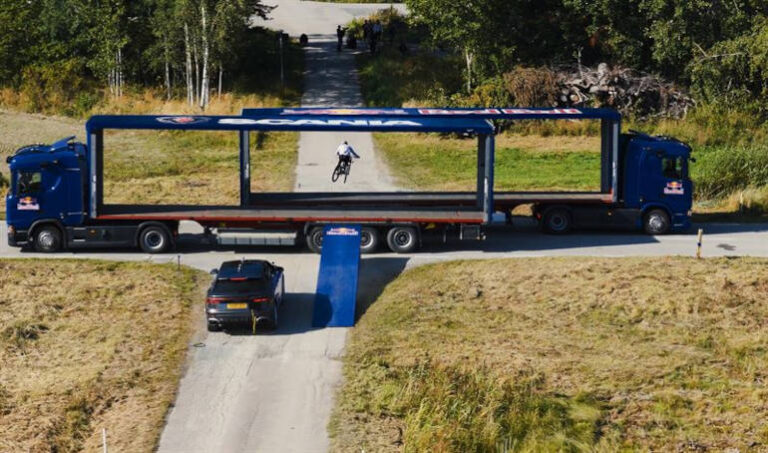
Scania has demonstrated the accuracy and control of its autonomous truck technology with a world-first stunt involving two self-driving vehicles and Red Bull athlete Matt Jones. The challenge required two autonomous trucks to drive towards each other in perfect sync, creating a gap of less than one second for the professional mountain biker to jump through. Jones successfully completed the jump, marking a bold milestone for both Scania and its technology partners.
The project brought together teams from Scania, Red Bull and PlusAI, combining software engineering, safety planning and months of controlled practice. While visually spectacular, the stunt was designed to highlight how advanced autonomous systems can deliver repeatable, predictable vehicle behaviour — a capability that transport operators see as critical for future freight applications.
Demonstrating the Precision of Autonomous Control
Scania says the achievement reinforces the reliability and accuracy required for autonomous transport to operate safely in real-world logistics environments.
“Transport is a cornerstone of our daily lives, and with that comes enormous responsibility to get goods to the right person or company in the most safe and efficient way. This challenge was a glimpse of what’s possible when breakthrough autonomous technology delivers precision and safety you can count on,” says Peter Hafmar, Head of Autonomous Solutions at Scania.
The company frames autonomy as a key element in its sustainability and safety roadmap, supporting a gradual shift towards transport systems that can improve operational efficiency while reducing environmental impact.
Mining and Hub-to-Hub Operations Moving Ahead
Autonomous operations are already part of Scania’s commercial offering, particularly in mining environments where repeatable routes and controlled conditions allow for quicker deployment. These solutions aim to lift safety standards, reduce operating costs and help address labour shortages that continue to affect heavy vehicle industries worldwide.
Scania’s next step is highway-based, hub-to-hub freight transport. Trials are already underway on European roads with safety drivers, supported by Scania’s partnership with Silicon Valley–based PlusAI. Scania’s vehicles combined with PlusAI’s software architecture are expected to provide “safe, scalable and factory-built autonomous solutions for the road.”
What It Means for Fleets
While the Red Bull stunt is a dramatic headline, the underlying message for fleet operators is practical: autonomy is moving out of the conceptual phase. For mining fleets, the technology is already available; for on-road freight, commercial deployment is getting closer.
The core benefits being developed include:
- Consistent vehicle behaviour for safer operations
- Operational efficiency, especially on predictable long-haul routes
- Lower operating costs through optimised driving patterns
- Mitigation of driver shortages, particularly in remote or repetitive tasks
As manufacturers push towards autonomy, the heavy vehicle sector is starting to see use cases that go beyond trials and into early commercial availability.