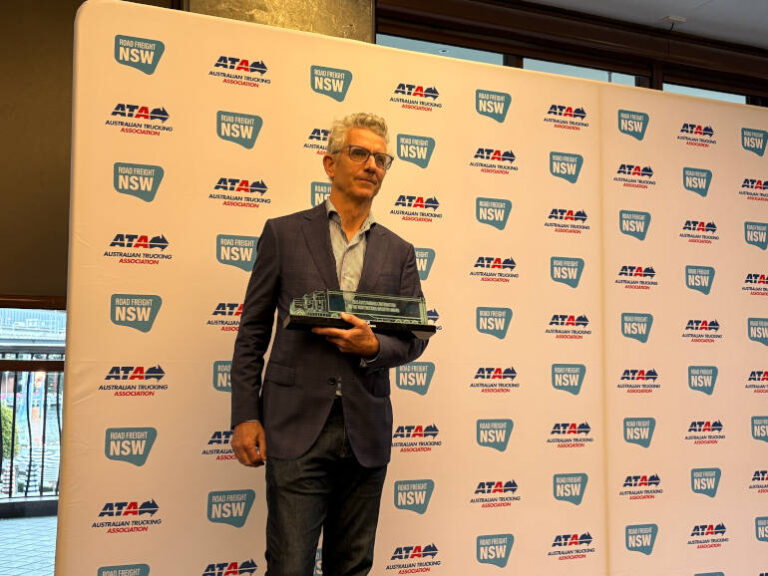
The Road Freight NSW 2025 Conference and Awards recognised one of the industry’s most influential figures, with Max Luff, founder of Border Express, named the recipient of the Outstanding Contribution to the Industry Award.
While Max was unable to attend the ceremony due to health reasons, his son Mark Luff accepted the award on his behalf and shared the extraordinary story of his father’s journey — from a young truck driver on dirt roads to the leader of a nationally recognised freight company.
A Different Path from the Classroom to the Cabin
Max’s career in transport began almost by chance. As Mark explained, his father was initially training to become an English and History teacher and worked casual driving jobs during university holidays to earn “a bit of play money.” Those jobs turned into a passion that would define his life.
In the 1950s, compliance was loose, trucks were basic, and safety was often left to chance. Max recalled driving wagons down the Brown Mountain on unsealed roads in vehicles that “didn’t necessarily have brakes.” The reward for reaching the bottom safely, Mark joked, was that “there were a couple of beer kegs on the back to steady his nerves.”
Although teaching offered stability, Max’s entrepreneurial spirit was stronger. For just one extra pound a week, he left the classroom behind to join a local carrier full time. His first delivery was, ironically, to the very school where he had taught the previous term — marking the beginning of a career that would transform the industry.
Building Albury Border Transport
In 1958, Max joined forces with his father-in-law to establish Albury Border Transport. Based in the growing regional hub of Albury-Wodonga, the company capitalised on emerging opportunities — from construction work on the Snowy Hydro Scheme to freight growth driven by manufacturing and decentralisation programs of the 1960s and 70s.
The business even benefitted from tax structures at the time, such as transporting margarine from Melbourne to Albury to cross the state border and then back again. It was a period of rapid expansion and learning for Max, whose determination to succeed was matched by a reputation for hard work and practical solutions.
Eventually, the business was acquired by ANS in the mid-1970s. Max became a branch manager, and while he appreciated the security of a salaried role, it was clear he would soon return to running his own company.
The Birth of Border Express
That opportunity came in 1981. On his 50th birthday, Max launched Border Express with four subcontractors, six trailers, and one customer. From such modest beginnings, the company grew steadily into one of Australia’s most recognisable freight businesses.
Mark explained that much of the company’s early success came from Max’s hands-on approach and his ability to build lasting customer relationships. One story summed it up: when a major customer became frustrated dealing with another transport provider, Max stepped in, promising reliability and honesty. That customer helped form the foundation for Border Express’s growth.
A Family Effort
Mark also paid tribute to the role his mother played in supporting Max’s career. In the early years, when customers visited Albury, it was common for business to continue after the pub closed — often around the family kitchen table. While Max would share a beer with clients, his wife made toasted sandwiches to keep the conversations flowing late into the night.
It was a reminder that transport is not just about trucks and freight — it is about people, families, and communities working together to build something lasting.
Lessons from a Lifetime in Transport
Over more than six decades, Max witnessed enormous change in the industry. From the arrival of reliable brakes to the introduction of the fax machine and now to the data-driven digital age, he adapted to every new challenge.
But one thing never changed: the importance of people. Max often said that if he didn’t turn up to work, the business kept going. But if forklift drivers or linehaul operators didn’t show up, “nothing moved.” That deep respect for the workforce underpinned the culture he created at Border Express.
His guiding philosophy was also simple but powerful: be optimistic, and put yourself in a position to take advantage of opportunities. As Mark explained, Max liked to say he “got lucky,” but in reality, his luck came from hard work, smart decisions, and the ability to adapt when others faltered.
A Lasting Legacy
Reflecting on his father’s career, Mark noted that across two generations, the Luff family has contributed more than 200 combined years of service to the transport industry. Many companies have come and gone, undone by lack of succession, poor planning, or unsustainable practices. Border Express, however, has endured and thrived, leaving an indelible mark on the sector.
Accepting the award, Mark summed up the significance of the honour: “We know transport is a tough industry. Dad’s optimism carried him through, but really, it was his resilience and respect for people that built his legacy.”
Recognising a True Industry Pioneer
The Road Freight NSW Outstanding Contribution Award is reserved for those whose work has reshaped the industry and left it stronger for future generations. By every measure, Max Luff has achieved that.
From a young man driving trucks without brakes on dirt roads to the founder of a successful national freight company, Max’s story is one of vision, determination, and unwavering commitment to people.
His award is not just a recognition of past achievements but a celebration of a legacy that continues to inspire road transport operators across New South Wales and beyond.
- Scania Powers Up the Slopes
 Scania has signed a long-term agreement with Italian manufacturer Prinoth to expand the use of its industrial battery technology in electric snow groomers, taking electrification into demanding alpine operating conditions. The partnership will support Prinoth’s Husky E-Motion and newly introduced Leitwolf E-Motion, with both machines powered by Scania Core 800 battery packs. For heavy vehicle
 - HERE Connects the Missing Routes for Fire CrewsHERE Technologies and the NSW Rural Fire Service have integrated more than 60,000km of fire trails into an emergency response routing network, helping crews navigate beyond public roads to reach incidents in remote locations. The initiative combines HERE’s road network data with NSW RFS operational mapping to create a unified, routable network incorporating fire trails,
- Scania Expands Digital Tools for Heavy FleetsScania is expanding the technology around its latest truck updates, using connected services, driver coaching and maintenance support to help fleet operators turn vehicle improvements into measurable operating benefits. The company says the Scania Dynamic updates are designed to improve the driver environment, energy efficiency and everyday usability, but the broader fleet proposition increasingly relies
- Minor Bridge Strikes Are Creating a Major BillThe most spectacular bridge strikes attract the headlines, but a new economic study suggests Australia’s biggest bridge-strike bill is being generated by much less dramatic incidents. HoustonKemp Economists estimates protection beam and signage strikes accounted for 79 per cent of Australia’s approximately 1,220 bridge-strike incidents in FY2025. Despite being the lowest severity category used in
- Dash cams are becoming a driver coaching tool, not just an incident recorderDash cams have traditionally been associated with providing evidence after a collision, but Australian fleets are increasingly using video telematics as part of a broader approach to driver safety and risk management. The Geotab Report 2026: Connected Fleets in Australia found 65% of respondents using in-cab video reported improved driver safety. A further 61% reported a reduction