

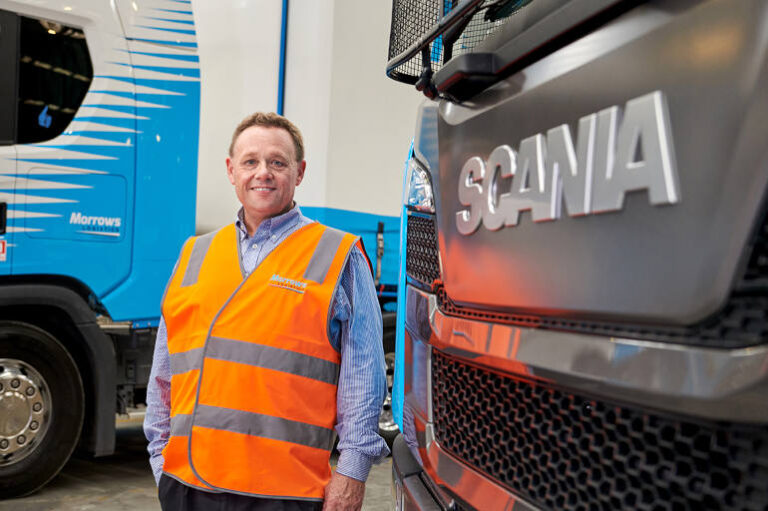
Victorian transport operator Morrow’s Logistics is moving towards a single-brand truck fleet as it expands beyond dangerous goods transport into warehousing, contract logistics and infrastructure freight.
The family-owned business, based in Melbourne’s south-east, operates more than 40 trucks across regional transport, specialised freight and dangerous goods work, with its network extending from Victoria to the outskirts of Adelaide and Sydney. Scania says it is on track to become the company’s sole truck supplier.
Morrow’s currently operates 36 Scania trucks, with additional vehicles on order as older trucks are replaced. The company has purchased more than 100 new Scanias over the course of its relationship with the manufacturer.
Founded in 1983 as Morrow’s Freightlines, the business built its reputation transporting chemicals and dangerous goods before expanding into infrastructure, energy and general freight. Its work now includes transporting transformers, cables and insulators for Victoria’s electricity network, while warehousing has become a growing part of the operation.
Founder David Morrow said reliability and safety remain central to the company’s operating model.
“One of the key things that we’ve sold our customers on is that we’re here to protect their brand, so safety and reliability have been super important in our marketing and in our service model,” Morrow said.
Standardising the truck fleet
Although the trucks perform a range of roles, Morrow’s has developed a common specification intended to give drivers a consistent operating environment.
The fleet includes prime movers and rigids, including customised vehicles designed for specialised regional work. Morrow said standardising cab layouts also makes it easier for dangerous goods drivers to move between vehicles.
“We’ve developed a template for the specification of our Scania trucks,” he said. “For me it’s about finding functionality that is durable, comfortable and safe for the drivers.”
Morrow’s typically retains its trucks for around seven years, with some vehicles travelling up to 170,000km annually. The company also maintains its own workshop with four diesel technicians, undertaking preventative maintenance along with more substantial work including turbocharger replacement and engine and gearbox refurbishment.
Morrow said some Scanias in the business had accumulated between two and three million kilometres.
Safety investment continues
Dangerous goods transport has also influenced the company’s approach to vehicle safety.
Recent trucks have been specified with Advanced Driver Assistance Systems, while Morrow’s also uses MT Data and Seeing Machines technology and monitors exception reporting. The company has progressively invested in additional systems including blind-spot monitoring and reversing cameras.
An in-house driver trainer has also been appointed to help drivers make better use of newer vehicle technology.
Morrow said the objective was less about teaching experienced dangerous goods drivers how to drive and more about improving fuel consumption, reducing wear and ensuring the business gets the maximum operating life from its vehicles.
The company has also adopted Euro 6 as its standard for new trucks, which Morrow described as part of its effort to reduce emissions despite operating in the chemicals sector.
Fuel economy becomes more important
With fuel costs rising, truck efficiency has become another major consideration.
Morrow said the latest Scanias had delivered an improvement of around seven per cent in fuel economy across the fleet.
Many loads leave Melbourne at around 40 tonnes before returning empty, but the company is looking for more opportunities to backload equipment and regional freight to improve utilisation.
At the same time, Morrow’s is expanding its logistics offering. The business now provides transport, distribution, storage and pick-and-pack services, while retaining dangerous goods as a core speciality.
General Manager of Transport and Warehousing, Valentin Teles, said the company was also considering another warehousing facility in Melbourne’s north as it looks to grow its regional customer base.
For Morrow’s, that growth means the truck fleet is increasingly part of a broader supply chain operation rather than simply a transport function — placing greater emphasis on vehicle availability, safety, fuel efficiency and consistency across the fleet.