

For Divall’s Earthmoving and Bulk Haulage, reducing emissions is not about waiting for one technology to replace diesel across every application.
It is about finding practical fuel savings across a fleet of more than 500 diesel-powered trucks and machines—and taking every available opportunity to improve efficiency.
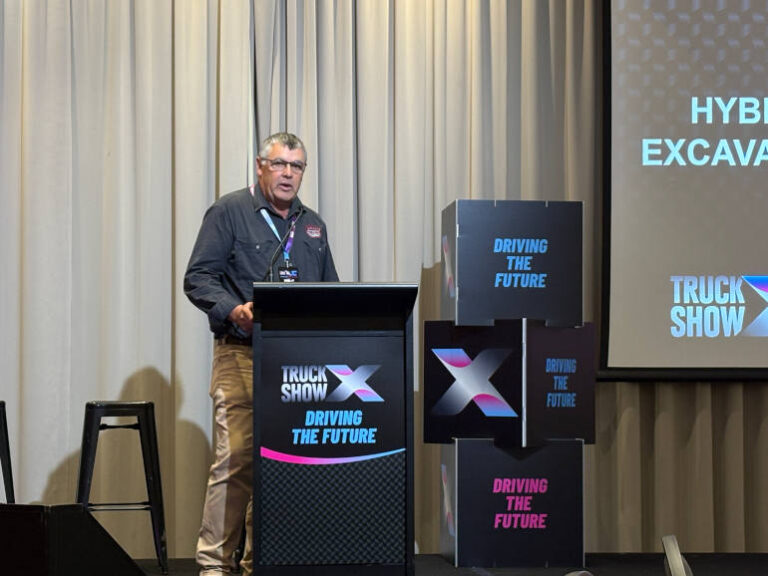
Speaking at TruckShowX, Andy Divall outlined how the company has steadily introduced hybrid and electric equipment into its operations while continuing to investigate technologies that can reduce fuel consumption in its heaviest transport tasks.
“We’ve got 500-odd diesel power units in our fleet in earthmoving use, so we’re just trying to find any savings we can in that fleet,” Divall said.

That approach has already included hybrid excavators, diesel-electric equipment, electric light vehicles and battery-electric trucks.
Divall said the business had operated hybrid excavators for more than a decade, with some applications delivering fuel savings of up to 30 per cent.
The fleet has also introduced several Ford F-150 Lightning electric utilities and a Volvo electric truck, while continuing to assess where other battery-electric vehicles could fit into its operations.
However, the technology that may offer the greatest immediate potential for the company’s bulk haulage fleet sits behind the prime mover rather than beneath it.
Divall used his TruckShowX presentation to explain the potential role of a powered trailer axle, which uses an electric drive system and battery mounted on the trailer to provide additional propulsion.
The system can support the diesel prime mover during acceleration and climbing, while recovering energy during braking and downhill travel.
For Divall’s heavy combinations, the attraction is not only lower fuel consumption. It is also the additional performance available when hauling large loads over demanding routes.
“In a double combination, we think that would be a great usage, especially to get the gradability up some hills,” Divall said. “At the moment, we’re putting bigger weights on the road and we’re going up hills pretty slowly. I think it would be a great spot for that.”
The technology could also change how fleets specify the truck at the front of the combination.
Divall suggested powered axles may eventually allow operators to use smaller diesel engines because the trailer can provide additional torque during the most demanding sections of a route.
“With these other axles coming along, we might not need that bigger motor up the front,” he said.
That could create a pathway to further fuel savings, particularly for trucks that currently require large engines to meet only a small number of peak-performance demands during each journey.
A transition technology for heavy fleets
Divall does not expect diesel to disappear rapidly from heavy earthmoving and bulk haulage operations.
Instead, he sees powered trailers as a transition technology that can reduce diesel use while preserving the range, payload and operational flexibility fleets still require.
“Diesel’s not going to go away for the next 30-odd years, so it’s going to be a good transition for us to reduce where we can,” he said.
The system may also improve the driving experience. Electric assistance can provide stronger acceleration and hill-climbing performance, while regenerative braking reduces the amount of conventional braking required.
Divall said drivers were likely to respond positively to the additional performance and the reduced need to use the brake pedal.
The potential benefits are significant, but the system must be matched carefully to each operation.
VE Motion representative Dean Panos explained during the TruckShowX question-and-answer session that the company assesses the route, current fuel consumption, trailer configuration and required battery capacity before determining whether a powered axle will suit a particular fleet.
Route modelling is used to identify where energy will be consumed and recovered, and to select a battery that can support the intended duty cycle. The electric axle must also be integrated with the trailer’s service brakes, suspension, wheel ends and control systems.
That application-specific approach is important because the business case will depend heavily on terrain, payload, distance, speed and the number of braking or regeneration opportunities available on the route.
Divall said confidence in the modelling would help operators determine whether the investment would produce a worthwhile return, particularly during periods of high or volatile diesel prices.
Payload parity remains critical
The additional mass of batteries, electric motors and control equipment remains one of the barriers to powered trailer adoption.
Divall called for regulators to consider a mass concession similar to those available for fully electric heavy vehicles.
“We’d like to see some weight concession, like a full EV, if we could aim for that,” he said.
Panos argued that powered trailers could justify a concession because the additional mass is carried across trailer axle groups with multiple tyres, while the electric drive can improve startability, gradability and acceleration.
Testing will be required to demonstrate those benefits and establish appropriate safety and performance standards.
For high-productivity fleets, payload parity may be essential. Any reduction in freight capacity could undermine the fuel and emissions benefits if additional trips are required to move the same amount of material.
Incremental improvement across a large fleet
Divall’s strategy reflects the operational reality facing many heavy fleets.
A single zero-emissions solution may not yet be available for every truck, machine, route and payload. However, operators can still lower their total fuel consumption by combining several technologies and targeting them at the applications where they deliver the strongest result.
Hybrid excavators can reduce fuel use on worksites. Electric utilities and light trucks can cover repeatable daily routes. Battery-electric trucks can serve suitable metropolitan applications. Powered trailer axles may help reduce diesel consumption in long-haul and high-mass combinations.
Divall described the company’s philosophy as pursuing steady, cumulative improvement rather than waiting for a complete replacement for diesel.
“If we can do two per cent a year for the next 50 years, we’ll achieve zero fuel,” he said.
For a business operating hundreds of diesel-powered assets, even a small percentage improvement can translate into substantial fuel, cost and emissions savings.
That makes powered trailers more than an emerging drivetrain technology. For fleets such as Divall’s, they could become another practical tool for improving productivity while steadily reducing dependence on diesel.