
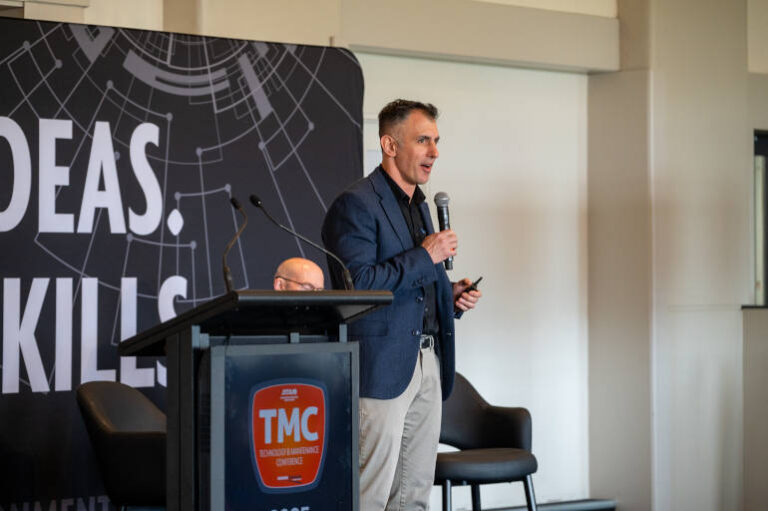
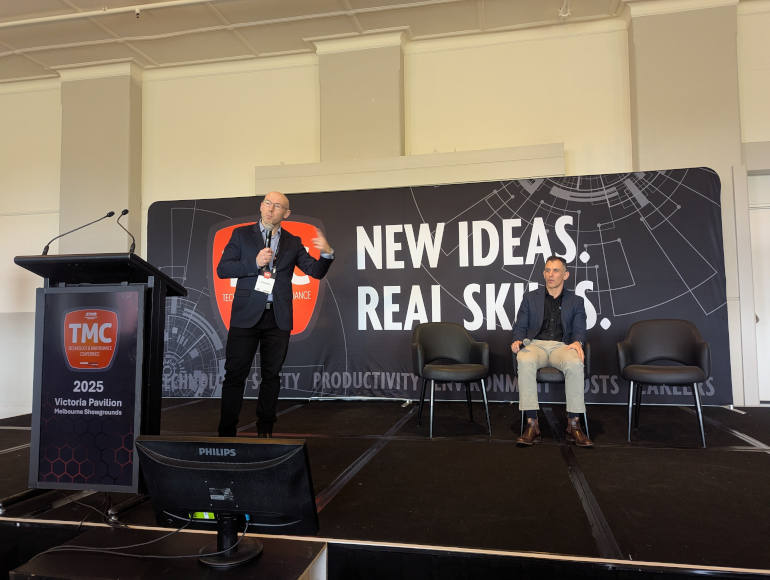
At the Australian Trucking Association’s Technology and Maintenance Conference (TMC) 2025, the focus turned to the back of the rig — the trailer — and how it could hold the key to a step-change in transport efficiency. The technical session on Using e-trailers to reduce fuel burn explored how electrified trailer axles are moving from concept to commercial reality.
Adam Ritzinger from the Heavy Vehicle Industry Australia (HVIA) opened by defining two key technologies: the regenerative energy axle, which captures braking and coasting energy and stores it in a battery, and the motive power axle, which goes a step further by delivering drive torque to assist the prime mover.
“A regenerative energy axle can recover kinetic energy from a rotating axle during braking or coasting and convert it to electrical energy,” Ritzinger explained. “A motive power axle adds an onboard motor that can assist motion — taking some of the load off the truck.”
Ritzinger said regenerative systems are already on the road in Australia, powering refrigerated trailers and other auxiliary equipment. “You can build that today and operate it legally,” he said. “But you can’t yet use an axle to provide propulsion — that’s limited by regulation, not by technology.”
HVIA has been leading the advocacy for regulatory pathways to enable powered axles. “We raised this with the Vehicle Standards Consultative Forum and have since developed industry trial guidelines to help manufacturers and operators start controlled on-road testing,” Ritzinger said. “We want to harmonise nationally so we don’t end up with a patchwork of small, inconsistent trials.”
He added that Australia should lead in this space: “We have the skills, the people, and the drive. There’s no reason to wait for another country to tell us what this technology looks like.”
Turning Concept into Reality
Dean Panos, co-founder and CEO of VE Motion, followed with details of the company’s Power Trailer System — a plug-in, parallel hybrid trailer that adds electric drive power through an e-axle.
“Effectively it’s a hybrid electric vehicle,” Panos said. “Each drive train acts independently to propel itself, unloading the prime mover and saving diesel. Our target is a 50% fuel reduction at first, with potential for more as we optimise the system.”
The prototype delivers up to 300 kW of peak power through a drive axle and uses 200–600 kWh of onboard battery storage. That’s enough, Panos said, “to halve the fuel use of a heavy combination while improving startability and gradability on steep grades.”
For operators, that means faster hill climbs and safer downhill control through regenerative braking, while capturing waste energy that would otherwise be lost as heat. “You can use that energy to power refrigeration units, hydraulic pumps, or even feed power back to the grid,” he added.
Beyond emissions reduction, Panos outlined a strong business case: “When you factor in lower maintenance, reduced brake wear, potential ACCU credits and fuel savings, the payback period is three to five years — and that’s the threshold for viability in our industry.”
Smarter, Simpler Integration
Unlike a full battery-electric truck, the power trailer is designed to fit seamlessly into existing fleets. “Our motto is Keep your Kenworth,” Panos said. “You can decarbonise at scale without disruption. There’s no range anxiety, no long charge times, and it works with the trucks you already own.”
The control system interfaces with the truck’s CAN bus to monitor accelerator input and speed, automatically blending power and regenerative braking. “The driver doesn’t need to do anything special — it should feel like driving a normal combination,” Panos explained. “It just happens to have an extra 400 horsepower helping on the hills.”
The system’s modular design means it can be retrofitted or supplied as a new build. “All the key componentry sits in a compact box under the chassis, with batteries mounted between the rails,” he said. “We can supply it as a kit to trailer builders or retrofit units ourselves.”
Battery mass ranges from 1.6 tonnes for the 200 kWh option up to four tonnes for 600 kWh. Early testing is underway in South Australia and New South Wales, including a three-axle tipper trial with Divall’s Earthmoving, moving gravel between Goulburn and Sydney — a route with ideal downhill regeneration and uphill load cycles.
Trials and Regulation
Panos confirmed further pilots are planned in New Zealand, hauling wine from Marlborough to Nelson. Each trial is being developed under HVIA’s forthcoming trial guidelines, with applications to Transport for NSW and the NHVR for vehicle modification approval.
“The componentry is mature — it’s not a technology problem, it’s a regulatory problem,” he said. “We just need to run the trials so everyone can see how it works and get comfortable.”
Ritzinger agreed, noting that clear leadership is needed to coordinate national consistency. “If we get one state doing it one way and another state doing it differently, we’ll repeat the patchwork we already have with higher-mass schemes,” he said. “We need a harmonised approach from day one.”
A Pathway to Productivity and Decarbonisation
Both speakers emphasised that electrified trailers could complement — not compete with — the move toward zero-emission trucks. “In the future, these power trailers can act as range extenders for electric trucks,” Panos said. “It’s an evolution, not a revolution.”
Australia, Ritzinger reminded delegates, has a track record of leading freight innovation. “We pioneered B-doubles and long combinations. We build for distance — and that means we have the most to gain in productivity and decarbonisation.”
With components now arriving for local assembly and trials expected to expand in 2026, e-trailers could soon shift from conference curiosity to a practical tool for fleets seeking lower emissions, higher performance, and real-world cost savings.
- Fleet Safety Maturity: Are Australian Fleets Ready for Video?
 Video telematics was one of the dominant themes at Geotab Connect 2026. Not simply as a hardware discussion, but as a maturity conversation. Australian fleets have largely embraced GPS tracking and data reporting. The next question is more complex: are they ready for inward-facing cameras, AI-driven event detection and predictive safety analytics? From Recording to
 - Technology as a Margin Defence in a Freight DownturnFreight markets move in cycles. When volumes soften and cost pressures continue to rise, transport operators are forced to look inward for efficiency gains rather than outward for price increases. According to Jonny Clarke, Director of Webfleet Australia and New Zealand, which is part of Bridgestone Mobility Solutions, that pressure is already evident among heavy
- Heavy Truck Digitalisation: The TCA Investment Is Starting to Pay OffAustralia’s heavy vehicle sector has long been complex — long distances, high productivity combinations, remote operations and increasingly stringent compliance requirements. But as regulatory settings evolve and technology matures, the digitalisation of heavy transport is accelerating. At Geotab Connect 2026, senior leaders pointed to a tipping point: years of investment in Transport Certification Australia (TCA)
- Webfleet Gains OBM Certification, Unlocks Heavy Transport Opportunities in AustraliaWebfleet has secured On-Board Mass (OBM) certification in Australia, a move that opens the door to deeper engagement with heavy transport operators and large commercial fleets. For Jonny Clarke, Director of Webfleet Australia and New Zealand, which is part of Bridgestone Mobility Solutions, the milestone marks the culmination of a long-term strategy. “For us, it’s
- Satellite, Remote Sites and the Connectivity Reality for Regional FleetsAt Geotab Connect 2026, one of the more practical discussions during the interview with the executive team focused on a challenge Australian and regional fleets understand well: connectivity beyond metropolitan coverage. For fleets operating in mining, utilities, agriculture and long-haul transport, the issue isn’t whether telematics works — it’s whether it works everywhere the vehicle