
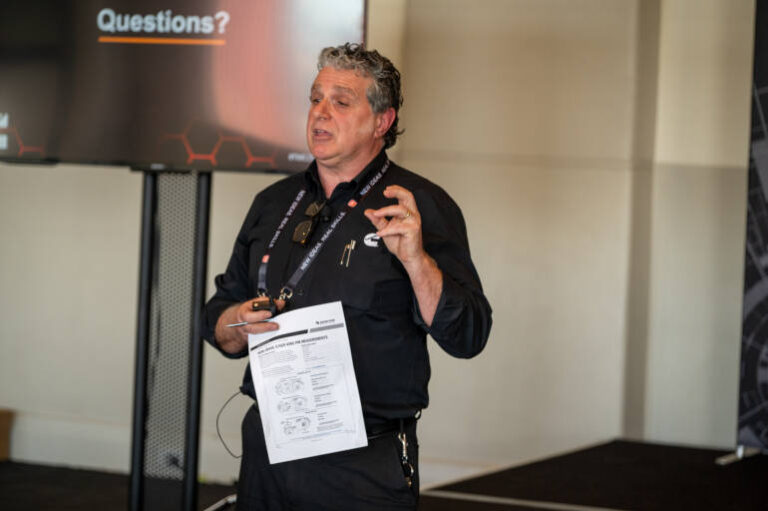
At the Australian Trucking Association’s Technology and Maintenance Conference (TMC) 2025, Renzo Barone, Territory Manager – Truck at Meritor, delivered a hands-on technical session that reminded delegates just how much safety and performance depend on getting wheel end maintenance right — from an axle manufacturer’s perspective.
Using live demonstrations and precise measurement tools, Barone broke down the fundamentals of correct wheel bearing adjustment and hub servicing, urging workshop teams to move beyond “feel” and adopt measurable, repeatable methods.
“Everybody’s got their own way of doing wheel bearing adjustment, and that’s fine,” Barone told attendees, “but the end result must always be between one and five thousandths of an inch of end play.”
Standing beside a complete hub and spindle setup, he demonstrated how to use a dial indicator to accurately check bearing end play. “While I’m doing this adjustment, I’ll spin the hub,” he explained. “I set the torque wrench to 50 foot-pounds to pre-load the nut, then back it off a quarter turn before retightening to 200 foot-pounds. Once you recheck the movement, it should fall within that one to five thousandths tolerance.”
From Theory to Practice
Barone made it clear that precision isn’t about overcomplicating maintenance — it’s about repeatability and confidence.
“If you want to continue using the procedure you’ve done for the past 20 or 30 years, that’s fine,” he said. “But every now and then, put a dial indicator on there and make sure your way gets you within that range.”
He explained that too much drag or incorrect torque during adjustment can dramatically reduce bearing life or cause premature failure. Threads must be clean and undamaged, and technicians should always be working on dry threads unless otherwise specified.
Hub and Bearing Cup Handling
Barone also discussed best practice for handling modern alloy hubs, a common area where poor technique can lead to expensive damage.
“It’s not recommended to remove a wheel bearing cup from an alloy hub by pressing or hammering it out with a drift,” he cautioned. “The chances are you’ll pick up metal and damage the hub.”
Instead, he suggested using controlled heat or weld contraction to safely release the cup. “You can put a bead of weld on the inside of the bearing cup — that’ll shrink it and it’ll fall out under its own weight,” he said. “Or heat the hub in an oven or hot water. The alloy expands faster than the steel bearing cup, so it’ll come out with a lot less effort.”
When reinstalling, Barone advised the reverse approach:
“Heat the hub, put the cup in the freezer, and it will drop straight into the bore. Give it a half turn to make sure it’s properly seated and you’re done.”
Kingpins and Compliance
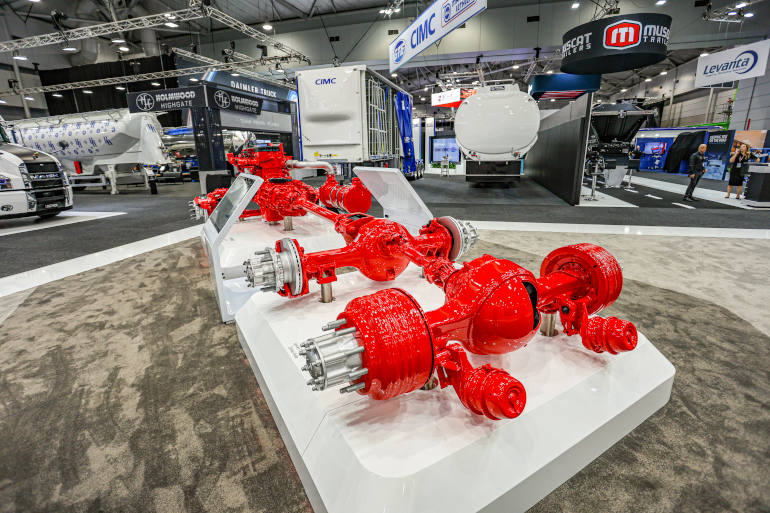
The discussion then moved beyond bearings to the broader wheel end assembly. Barone highlighted that excessive play can accumulate from multiple sources — bearings, bushes, and kingpins — and lead to compliance issues during inspections.
“We have a maximum wear limit between the bush and kingpin of fifteen thousandths of an inch,” he explained. “If you take that, plus wheel bearing play, you can easily have significant movement at the wheel end.”
Barone said it’s common for operators to be knocked back at road checks because of perceived kingpin wear when the actual measurements are still within specification.
“We get calls from people saying, ‘I just replaced the bushes four months ago and got failed at inspection.’ When you ask how much play they measured, they don’t know. The only way to be sure is to measure it.”
To help, Meritor provides a detailed check sheet outlining the correct measuring points and allowable tolerances. Barone encouraged fleet and workshop managers to use it to verify their own inspections — and to train staff to understand the numbers behind the maintenance.
Accuracy Equals Safety
Throughout the session, Barone emphasised that wheel end maintenance isn’t just about preventing downtime — it’s about ensuring vehicles stay compliant and safe on the road.
“Knowledge is key,” he said. “Share these procedures with your workshop staff. Make sure they understand what one to five thousandths of an inch really means. A few minutes with a dial indicator could be the difference between a truck passing inspection or being parked up.”
For fleet operators, his message was clear: precision matters. Whether it’s wheel bearing preload, hub installation, or kingpin clearance, measurable accuracy is what keeps vehicles productive — and people safe.