

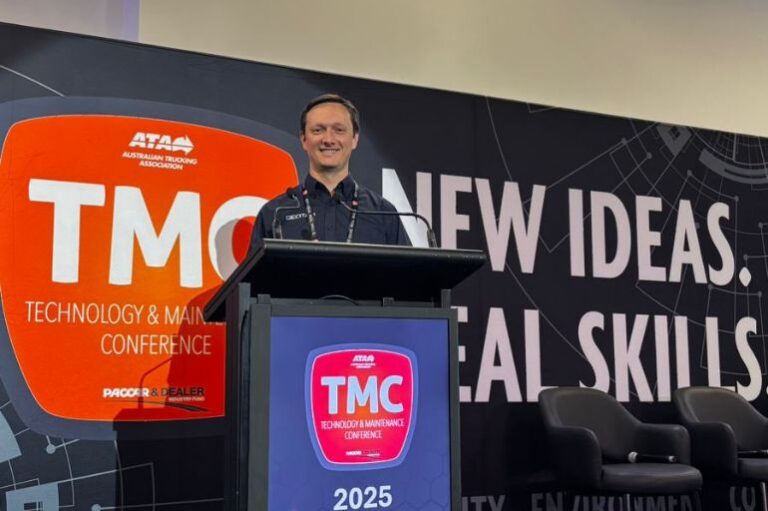
At the 2025 Technology and Maintenance Conference (TMC) in Melbourne, hosted by the Australian Trucking Association, Chris Martin, Senior Manager – Solutions Engineering at Geotab, challenged attendees to rethink how data and artificial intelligence (AI) can transform vehicle maintenance, reduce downtime, and improve fleet efficiency.
Speaking to a packed session, Martin began by acknowledging the audience’s expertise in compliance, PBS and workshop operations — before shifting the focus to what telematics and analytics can offer the modern fleet.
“As we shift to a more technologically driven environment, there’s a lot of data we’re collecting and insights we’re seeing. From a data and engineering perspective, there’s a lot of improvements we can bring in how we optimise the use of vehicles, minimise downtime, and identify issues ahead of time,” he said.
From Preventative to Predictive
Martin broke maintenance down into four categories — preventative, condition-based, reactive, and predictive — illustrating how fleets can evolve from traditional time-based servicing to data-led interventions. Preventative maintenance, while reliable, is often conservative. “You’re changing components before they fail — which is safe but inefficient,” he explained. Condition-based maintenance is better when data on component health is available, but difficult to scale across large fleets.
Predictive maintenance, Martin said, is where the industry is now heading. “This is where data starts to change things. We can use historical patterns and machine learning to predict the probability of a component failure — not just across a fleet, but for the individual vehicle.”
Machine Learning in Action
To illustrate, Martin shared Geotab’s work with a large international delivery fleet of 70,000 vehicles experiencing excessive battery failures. Using data from millions of cranking cycles across Geotab’s global network of over five million connected vehicles, the company trained algorithms to detect subtle patterns in voltage drop that preceded starter battery failure.
The result:
- 26% reduction in on-road battery failures, and
- Only a 2.7% change in the total number of battery replacements.
“The fleet already knew how many batteries they should be replacing. What they didn’t know was which ones and when,” Martin said. “That’s what predictive analytics can tell you.”
The Rise of EV Data and Battery Health
Extending the same logic to electric vehicles, Martin discussed Geotab’s recent study of 5,000 EVs which found average battery degradation of just 1.8% per year, down from 2.3% in a similar study five years earlier.
He said this demonstrates both advances in technology and the importance of monitoring State of Health (SoH). “Battery health directly influences resale values. It’s now the biggest single factor in the residual value of used EVs,” Martin said, citing discussions with auction partners.
Digitising Maintenance: Beyond Compliance
While predictive analytics captures the imagination, Martin reminded attendees that the foundation of any data-driven maintenance program is record keeping.
“Record keeping isn’t just about compliance — it’s about running an efficient system,” he said. “If you’re still on paper pre-starts or manually tracking odometers, that’s where the digital journey starts.”
He urged fleets to prioritise reliable odometer readings, digital pre-start checklists with photo capture, and fault-code reporting through telematics.
“Everyone should be getting reliable odometer data from every one of their vehicles. If you’re not, you’re making your maintenance harder than it needs to be.”
Digital records also enable better tracking of defects, service history, and downtime. “If we don’t measure downtime, we can’t reduce it,” Martin said, encouraging fleets to use geofencing or event-based data to measure how long assets spend off-road.
Integration and Open Data
Martin also emphasised the value of open APIs and system integration, highlighting that maintenance data shouldn’t exist in isolation.
“Different systems serve different jobs in your fleet. You might use Logmaster for fatigue compliance, another platform for maintenance, and Geotab for telematics. The power comes when they talk to each other,” he said.
He noted that integration between telematics, driver apps, and business intelligence tools like Power BI or Tableau allows managers to correlate utilisation, revenue, and maintenance costs — driving better business decisions.
“Use data your way — the way that makes sense for your fleet,” he said. “Just make sure your data remains yours. Security and privacy can coexist with interoperability.”
Hardware and Future Insights
Martin finished by discussing the evolving hardware ecosystem — from CAN-bus telematics to trailer and cold-chain sensors — and how richer data enables smarter maintenance.
“Telematics used to be hard to install. It shouldn’t be anymore. If you’re not getting rich engine data — odometers, faults, fuel consumption, PTO hours — you’re missing opportunities,” he said. He also pointed to the potential of tyre pressure monitoring (TPMS) and onboard mass systems to feed future predictive models.
Looking Ahead
Predictive maintenance, according to Martin, is just the beginning.
He anticipates more collaboration between OEMs, telematics providers, and fleets to share anonymised data for benchmarking downtime, efficiency, and component lifespan.
“OEMs know their engines, but when we aggregate data across millions of vehicles, we can benchmark operations and feed insights back into the industry.”
He concluded by reminding attendees that the path to predictive maintenance starts small — with digitisation, integration, and reliable data capture.
“Maintenance might not sound exciting, but the data-driven capabilities we’re seeing today — and what’s coming next — really are.”
He concluded by reminding attendees that the path to predictive maintenance starts small — with digitisation, integration, and reliable data capture.
“Maintenance might not sound exciting, but the data-driven capabilities we’re seeing today — and what’s coming next — really are.”
- Government fuel relief plan welcomed as industry warns of mounting pressure
 Australia’s peak trucking bodies have welcomed the Federal Government’s decision to fast-track changes to allow fuel costs to be passed through the supply chain, but warn that more immediate support is needed to prevent business failures across the transport sector. The move follows a dramatic surge in diesel prices, which industry leaders say has placed
 - Freight Costs Set to Rise as Diesel Prices SurgeAustralian trucking operators are warning customers to prepare for higher freight costs as diesel prices surge, according to the Australian Trucking Association (ATA). Australian Trucking Association CEO Mathew Munro said the rapid increase in global diesel prices is already flowing through to Australian retail fuel prices and will inevitably affect transport costs across the economy. The
- Fuel Tax Credit Debate ReignitesThe Australian Trucking Association has urged the Australian Government to reject a recommendation from the Productivity Commission that would phase out fuel tax credits for trucking operators, warning it would increase freight costs and place further financial pressure on the industry. The recommendation was included in the Commission’s final report on Australia’s net zero transformation
- Top Tips for Employers to Help Apprentices SucceedAt the Australian Trucking Association’s Technology and Maintenance Conference (TMC) 2025, a powerful message resonated across the room: the industry’s future depends on how well today’s employers train, mentor and retain apprentices. The panel session Working with TAFEs to Get Training Results brought together four experienced voices — Ashley Belteky, (Apprenticeship Mentor – Women in Male-Dominated Trades at
- Working with TAFEs to Get Training ResultsAt the 2025 Technology and Maintenance Conference, a packed session explored how employers, trade schools, and support organisations can collaborate to improve apprenticeship outcomes. Moderated by Ashley Belteky, (Apprenticeship Mentor – Women in Male-Dominated Trades at Apprenticeship Support Australia), the discussion featured Paul Chaseling (Head Teacher – Heavy Vehicles Automotive at Dubbo TAFE NSW), Dylan Jenkin (Service Manager at Tatiara