

Scania is extending the operating envelope for battery-electric heavy trucks, unveiling a long-haul configuration capable of delivering up to 720 kilometres of range.
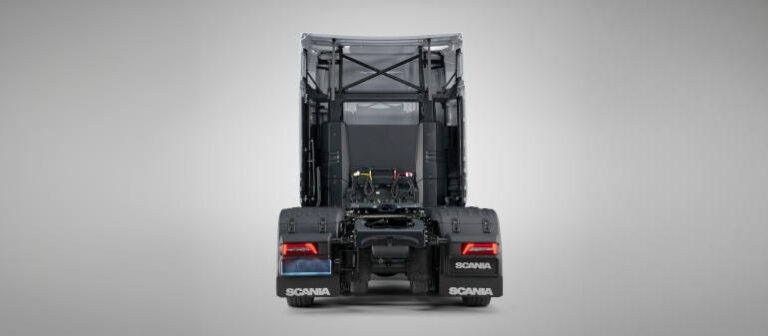
Rather than relying solely on batteries mounted within the chassis, Scania has added battery packs behind the cab, creating additional capacity for operators that need to cover longer distances without compromising the basic tractor and trailer configuration required for freight operations.
The development is significant for heavy vehicle fleets because long-haul electrification involves more than simply increasing battery size. Payload, trailer compatibility, vehicle length, charging speed and route planning all need to work together if an electric prime mover is going to perform a commercially useful task.
Scania says its latest configuration brings those elements together by combining additional battery capacity with Megawatt Charging System (MCS) capability.
“Electric trucks are already part of the transport system, but long-haul operations place very different demands on range, payload and charging,” said Lars Gustafsson, Senior Vice President, Head of Solutions Management at Scania.
“With this solution, Scania is showing how those pieces can come together in a practical way for customers who want to electrify demanding long-distance routes.”
More batteries behind the cab
In a typical configuration, two MP20 battery packs can be fitted behind the cab, adding approximately 356kWh of installed battery capacity on top of batteries positioned on the chassis and beneath the cab.
That additional capacity is what allows Scania to claim a range of up to 720 kilometres, depending on vehicle specification and operating conditions.
For fleet operators, the important part is the flexibility this creates when configuring a truck for a particular freight task.
Longer range can help reduce the number of charging stops required during a shift, while MCS charging is designed to enable much higher charging power and shorter stops when charging is required.
That combination will become increasingly important as fleets assess whether battery-electric trucks can move beyond metropolitan and regional work into longer-distance linehaul applications.
Packaging becomes part of the fleet equation
Battery placement is becoming an increasingly important design consideration in electric heavy vehicles.
Putting more batteries on the chassis can reduce the space available for other equipment or affect axle loads and payload. Scania’s approach moves some of the energy storage behind the cab instead.
“This is not only about placing batteries in a new position on the vehicle,” Gustafsson said.
“The larger point is what it enables: electric transport over distances that have traditionally been among the hardest to electrify, with range, payload and charging considered together from the start.”
Scania says the layout can support selected 6×2*4 long-haul tractor configurations while retaining compatibility with standard European trailer combinations.
Aerodynamics also matter
Scania is also pairing the battery configuration with its Increased Vehicle Dimension, or IVD, front design.
The company says the revised front can reduce energy consumption by up to three per cent on battery-electric vehicles, depending on specification and operation.
That may appear modest compared with the gains achieved by adding more battery capacity, but for fleets running high annual kilometres, small improvements in energy efficiency can have a meaningful impact on usable range, electricity consumption and operating costs.
The IVD front also allows the overall vehicle length to exceed 16.5 metres while maintaining the trailer configuration and turning performance required for long-haul operations.
Long-haul electrification becomes a systems problem
The bigger story for fleet managers is that electric truck development is moving away from a simple discussion about battery size.
A long-distance electric truck has to be treated as an operating system involving vehicle specification, payload, route design, charging infrastructure, driver breaks and depot or public charging availability.
A claimed 720km range does not mean every fleet will need — or should specify — the maximum battery configuration.
Some operators may find a lower-capacity truck with strategically located charging delivers a better payload and whole-of-life cost outcome. Others may need maximum range because of limited charging availability or tightly scheduled routes.
Scania’s latest configuration demonstrates how manufacturers are starting to offer more flexibility around that equation.
For Australian heavy vehicle fleets, the technology is also a reminder that the next stage of truck electrification will increasingly focus on the harder applications.
Urban delivery and return-to-base operations remain the most straightforward starting point for battery-electric trucks, but greater battery capacity and megawatt charging are progressively extending the types of routes that can be considered.
The challenge for fleets will be matching those increasingly capable vehicles with the charging infrastructure and operational planning required to make them productive.