

Switching from diesel to electric removes tailpipe emissions, but BetterFleet says that is only the beginning of the emissions and efficiency story.
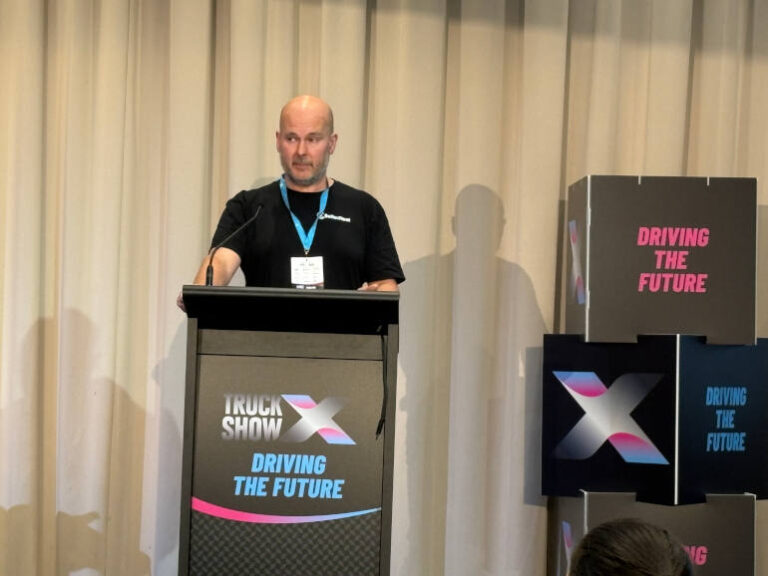
Speaking at TruckShowX, BetterFleet Vice President APAC Markets Russ Yell said the way energy is managed after it enters a depot can have a significant impact on operating costs, carbon performance and the number of vehicles a site can support.
“The story actually matters now for how you run a depot, how you report and how you scale,” Yell said.
“It’s what happens to the electron after it crosses your gate, because electrons aren’t free — not in cost, not in carbon and not in the pressure they put on your operations and the grid.”

Global data exposes depot performance differences
BetterFleet analysed anonymised operational data covering approximately 5,000 heavy electric vehicles operated by 45 organisations around the world.
The dataset included around 100 gigawatt hours of energy delivered over approximately one million charging sessions.
While much of the data came from electric transit fleets, Yell said the findings were also relevant to truck operators because buses and trucks face many of the same depot challenges.
“The truck operator’s problem in 18 months is the transit operator’s problem today,” he said.
BetterFleet used unsupervised data clustering to identify four distinct electric depot operating profiles.
According to Yell, the factors separating the highest and lowest-performing depots were not vehicle brands, battery chemistry, vehicle age or even duty cycles.
Instead, the differences were largely driven by factors within the operator’s control, including charge scheduling, charging session discipline, vehicle and charger commissioning, and the way vehicles were dispatched against available infrastructure.
“The gap that you’re looking at between these archetypes — that’s not a gap in the trucks,” Yell said.
“It’s the same trucks. It’s a gap in operations, and a gap in operations is something you can close.”
Energy losses can triple between operators
BetterFleet’s data indicated that the best-performing operators lost around five per cent of energy between the depot boundary and the vehicle.
At the other end of the scale, some operators experienced losses of up to 15 per cent.
These losses can be caused by failed charging sessions, communications faults, charging acceptance problems, thermal restrictions, battery management system issues and vehicles running auxiliary systems while connected.
Depot inefficiency can also occur when chargers sit unused while other vehicles are waiting elsewhere for access.
Yell said the threefold difference between the best and worst performers had little to do with the vehicles themselves.
“It has nothing to do with what’s in the battery or whose badge is on the truck,” he said.
Renewable energy does not fix poor charging operations
Many fleets are investing in renewable power purchase agreements, green energy tariffs and behind-the-meter solar generation.
Yell said these measures were important, but they did not solve operational problems inside the depot.
“A PPA does not recover a failed charge session,” he said. “Rooftop solar does not fix a charger acceptance mismatch. A green tariff does not reclaim the energy your vehicle bled while it was plugged in.”
Poor charging performance still consumes real energy, uses available grid capacity and creates additional operating costs, regardless of how that electricity is sourced or reported.
Yell said this highlighted the importance of treating energy efficiency as a depot management issue rather than simply an electricity procurement exercise.
Reporting must start with operational data
As emissions disclosure requirements become more detailed, fleets will increasingly need to defend the accuracy of their electric vehicle reporting.
Yell said reliable reporting should be built from individual charging sessions, vehicle performance, kilometres travelled and charging faults.
Depot efficiency, charging orchestration, infrastructure utilisation, electricity procurement and network coordination can then be layered on top.
“The reporting sits on top — a view of a system, not a quarterly scramble,” he said.
Operators that rely only on electricity bills and annual averages may struggle when customers, auditors or regulators ask more detailed questions about fleet performance.
“With the ASRS commitments and the direction disclosure is heading over the next five years, someone will absolutely ask you a second question,” Yell said.
Start collecting data from the first vehicle
For operators introducing their first electric trucks, Yell said the highest-value step was establishing a reliable operational data system from the beginning.
Vehicles and chargers should be commissioned together rather than assuming they will communicate and operate correctly.
“The habits you bake in with the first vehicle become the template for the next 50,” he said. “Retrofitting discipline onto a growing fleet is painful, and we’ve seen it.”
This includes capturing charging reliability, energy consumption, vehicle availability and infrastructure utilisation from the first day of operation.
Charging orchestration determines fleet capacity
As electric fleets grow, unmanaged charging can produce what Yell described as “peak creep”.
The fleet’s maximum electricity demand can rise faster than operators expect, potentially triggering expensive network upgrades or the need for additional substations.
Yell said charging orchestration should not be treated as an optional premium feature once a fleet begins to scale.
“It’s the difference between ‘we can add more vehicles’ or ‘we need another substation’,” he said.
Better use of existing chargers and grid capacity can allow operators to add electric vehicles without immediately investing in major infrastructure upgrades.
Clean data opens future revenue opportunities
Once fleets have reliable operational data and well-managed charging systems, they may also be able to participate in emerging energy markets.
Potential opportunities include vehicle-to-grid services, demand response, network support and other forms of grid participation.
However, Yell said these opportunities would only be available to operators that could demonstrate predictable vehicle availability, charging demand and energy performance.
“They only open up if your operational data is clean enough to participate,” he said. “If it isn’t, that door will stay shut.”
The central message from BetterFleet’s analysis is that electric fleet performance is not determined by the vehicle alone.
The operators that extract the greatest value from electrification will be those that actively manage every electron from the depot boundary through to the wheels.