

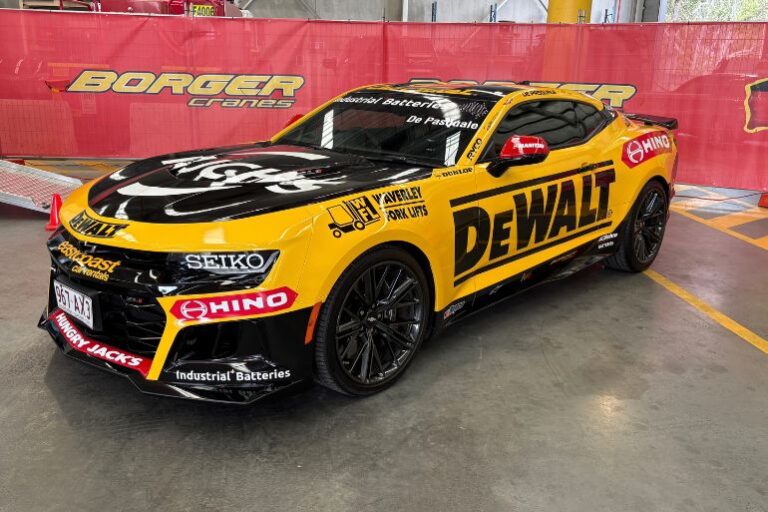
Team 18 is heading to Mount Panorama for the Bathurst 1000 with months of preparation behind it, extensive data analysis completed and one of Australian motorsport’s most experienced drivers helping the team prepare for Supercars’ biggest race.
Speaking at a special event marking the delivery of the 100th Hino truck to Borger Cranes by City Hino, Craig Lowndes and Anton De Pasquale provided an insight into how Team 18 prepares for the Bathurst 1000 — and just how much that preparation has changed over the past three decades.
For Lowndes, who has made more than 30 trips to Mount Panorama, the contrast with his early Bathurst appearances is significant.
“I think the difference back then is we had less races during the year,” Lowndes said. “We didn’t have the science to what we have today, like the cool suits or the ice baths. We didn’t really have that sort of technology back then.”
Lowndes recalled arriving at Mount Panorama in 1994 believing his sporting background had prepared him for the demands of the race, only to discover how physically demanding a Supercar could be.
Today, driver preparation, vehicle ergonomics, safety systems and sports science are substantially more sophisticated. But Lowndes believes the fundamental challenge of Bathurst remains remarkably similar.
“At the end of the day, 161 laps, 1,000 kilometres, drivers — and it takes a team to get the result,” he said.
“I think that’s why I’ve really been attracted to this race, because it’s a team element. I’ve been there with fast cars. I’ve been there with slow cars. And any given day, as soon as you start that race on Sunday afternoon, everyone’s got an opportunity to win it.”
Strategy, weather, reliability and a little luck can still turn the race upside down.

Bathurst preparation starts before the cars arrive
For De Pasquale, preparation for the 2026 race is increasingly driven by engineering, simulation and data.
With limited opportunities to physically drive the Supercar before arriving at Mount Panorama, Team 18 has to make extensive use of the information available away from the circuit.
“Preparing for the race now, it’s very engineering-based, very computer-based,” De Pasquale said. “We don’t have the ability to drive the car until we get there.”
That means engineers and drivers work through previous data, video footage, potential weather conditions and likely setup directions before the transporter reaches Bathurst.
De Pasquale said the team had already spent several hours in a dedicated Bathurst meeting working through those scenarios.
“We’re going through all the previous data, all the footage and all the information we’ve got,” he said.
The aim is to arrive at Mount Panorama with a strong baseline rather than spend valuable practice laps searching for the right direction.
“Bathurst is one of those places where, if you roll up there and the car’s quite nice to drive, you’re generally quick all week.”
Modern sports science is another important part of the preparation. Drivers now have access to cooling technology and specialist support designed to ensure they can remain physically and mentally sharp deep into the 1,000-kilometre race.
“We have a couple of people travel with us that look after us, and chefs, and all these people supplying us drinks and stuff,” De Pasquale explained.
“A lot of the responsibility of surviving just as a human is sort of taken away, and we can focus just on driving.”
Lowndes brings another layer of experience
For De Pasquale, having Lowndes inside the Team 18 operation provides another valuable resource.
Lowndes’ Bathurst experience stretches back to an era before simulators, sophisticated driver cooling and today’s level of data analysis, but he is now working within those modern systems to help the team prepare.
“Having him in our stable and to lean on, and just that extra resource is awesome,” De Pasquale said.
Lowndes said the preparation now extends to anticipating problems before they occur.
The team considers how it will respond if the expected setup direction doesn’t work, how strategy could develop and what it will do when Bathurst inevitably presents something unexpected.
“It’s just attention to detail,” Lowndes said. “People always ask me what’s the difference between teams. It’s those little, minute sort of things.”
Lowndes said Team 18’s Bathurst debrief lasted almost two-and-a-half hours, with the group examining its approach to the weekend and preparing alternative responses.
“If we don’t expect that, what are we going to do about it? So we’re implementing some changes already. We’re forecasting what we’re hopefully going to see.”
For Lowndes, that planning reinforces why Bathurst remains a team race despite the attention naturally falling on the drivers.
“It’s the 20 or 30 people behind us in each team that makes us who we are. Strategy plays a massive part. Thinking on your feet — if we get a flat tyre, how do we combat that?”
Bathurst can stand alone
Team 18 also heads to Bathurst having achieved an important objective earlier in the Supercars season.
De Pasquale explained that the team wanted to secure its place in the Finals before Bathurst, allowing the 1000-kilometre race to be approached as an objective in its own right rather than having championship qualification hanging over every decision.
“The second goal on top of that was to make the finals before Bathurst, so then we can sort of seclude Bathurst from the results,” he said.
“We can focus on that race, win or lose or bust. We can put everything into it without the consequence of getting knocked out of the finals.”
With that objective achieved, De Pasquale sees Bathurst and the championship finale as the two defining targets remaining in the season.
“Realistically, the only two important parts of the year is winning the last race of the year and winning Bathurst.”
Months of work for one weekend
Team owner Charlie Schwerkolt provided another perspective on the scale of preparing for Bathurst.
Team 18 is taking three cars to the event for the first time, creating a major logistical exercise encompassing drivers, engineers, mechanics, sponsors, accommodation and corporate activities.
Schwerkolt said approximately 60 people would travel with the team for the three-car campaign, while the operation had secured 18 houses in Bathurst to accommodate team members and partners.
“We’ve been preparing this for months and months and months to get this run,” Schwerkolt said.
It underlines the point made repeatedly by Lowndes throughout the discussion: while Bathurst ultimately comes down to two drivers and one car crossing the finish line, getting there requires an entire organisation.
Technology has transformed how Team 18 prepares. Simulators, engineering data, sports science and detailed scenario planning allow the team to arrive at Mount Panorama far better prepared than teams could have imagined when Lowndes first raced there.
But the essential ingredients have not changed.
As Lowndes put it, Bathurst remains 161 laps and 1,000 kilometres where strategy, reliability, weather, driver performance and teamwork all have to come together.
And according to De Pasquale, despite everything that has changed around the race, its appeal remains intact.
“The passion — you see the same people there every year. They’ve been going for 50 years straight,” he said. “I think that’s something that hasn’t changed, and hopefully it never will.”