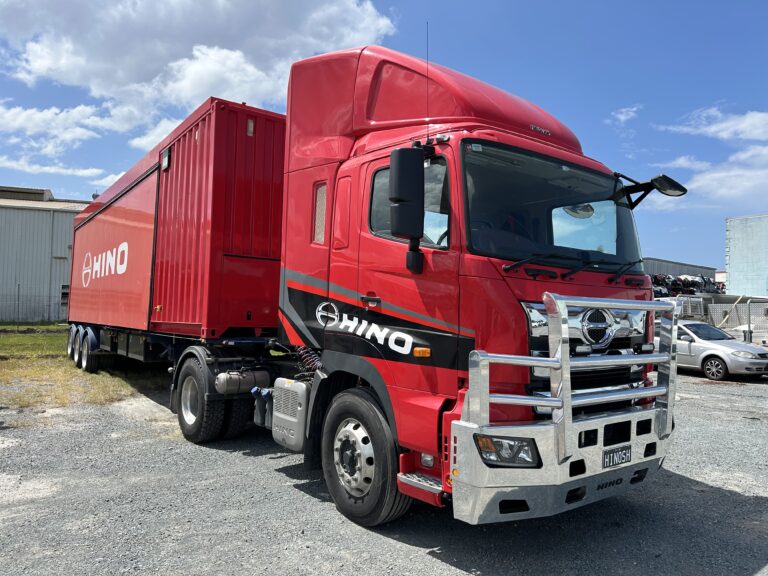
The long-planned merger between Toyota and Daimler Trucks is now moving from concept to execution, with the newly formed truck holding company Archion set to begin operations on 1 April 2026.
Speaking at a media briefing late in 2025, Richard Emery, President and CEO of Hino Motor Sales Australia, provided an update on the structure, timing and implications of the merger, particularly for the Australian market.
A new company: Archion
The merger will be formalised through Archion, a newly created business established by Toyota Motor Corporation and Daimler Truck, alongside a group of long-term institutional investors.
Each parent company will hold a 25 per cent shareholding, with the remaining equity held by those institutional investors. Archion will be listed on the Tokyo Stock Exchange and will own 100 per cent of Hino Motors Ltd.
“This started two years ago, and there’s been work done in the background obviously between Daimler Trucks and Toyota,” Emery said, noting that the operational foundations are now in place ahead of the April start date.
What it means for Australia: no operational change
For Australian fleet buyers, the most important message from the briefing was continuity.
“From a corporate structure perspective, nothing changes for us,” Emery explained. “We’re still going to be 100 per cent owned by Hino Motors Ltd. They just have some different people to answer to than they have today.”
He added there was “certainly no indication of anything that will change on April the first in terms of how we go about our business… or how we operate in Australia.”
In practical terms, the ownership structure above Hino changes, but local operations, dealer networks and customer relationships remain the same.
Regulatory hurdles now cleared
Emery said one reason the merger appeared quiet for a period was the need to clear anti-trust and competition approvals in multiple regions.
Regulatory approvals have now been secured in Japan, the United States and Australia, including engagement with the ACCC around potential changes in market power.
“Those antitrust topics had now been dealt with, and that’s why they went out… with further announcements,” he said.
Leadership structure takes shape
The leadership team for Archion blends senior experience from both parent organisations.
- Karl Deppen, a Daimler Trucks executive with more than 35 years in the truck industry, will lead Archion as CEO.
- Hetal Laligi, formerly CFO of Fuso globally, will take on the CFO role.
- Satoshi Ogiso, who has served as CEO and President of Hino Motors Ltd for the past six years, will lead product, technology and R&D activities across the group.
Emery noted Ogiso’s deep understanding of Hino’s global operations and the Australian market, describing the appointment as positive for local stakeholders.
At the Hino level, Ogiso-San will transition from his current role to Archion, with a new CEO appointed to continue leading Hino Motors Ltd.
Why Hino Australia matters in the new structure
Emery positioned Hino Australia as a strategically important business within the new Archion group.
“We believe we will be viewed by Archion and through Hino Motors Ltd as a foundation business,” he said. “We believe our relationship going forward will be only strengthened.”
As a mature right-hand-drive market with strong safety, emissions and compliance requirements, Australia is seen as a stable reference point for the broader group rather than a peripheral market.
What fleet buyers should take away
For Fleet Managers, Fleet Coordinators and Procurement Managers, the key points are clear:
- The Toyota–Daimler truck merger is confirmed and will formally commence under Archion from April 2026.
- There are no expected short-term changes to Australian operations, product support or dealer arrangements.
- The strategic intent of Archion is long-term scale, shared technology and product development, not local brand disruption.
As Emery concluded, the expectation is that the new structure will enhance product and technology outcomes over time, while allowing established brands such as Hino to continue operating with their own identity and local focus.
- Geotab adds mass management to heavy vehicle telematics
 Geotab has expanded its Australian heavy vehicle compliance offering by adding Smart On-Board Mass capability through a certified integration with Airtec Corporation, allowing heavy haulage operators to manage telematics and mass data through a single platform. The certification means Geotab can now support Telematics Monitoring Application schemes both with and without Smart OBM requirements, as
 - Bridge Strikes Start Before the Truck Reaches the BridgeA bridge strike may happen in seconds, but the circumstances that lead to it can develop much earlier in the journey. That is one of the key fleet-management implications to emerge from HoustonKemp Economists’ report, The economic costs of bridge strikes in Australia, prepared for HERE Technologies and the Australian Logistics Council. The report estimates
- Electric Trucks and Vans Join the Spotlight at Everything Electric SydneyThe transition to electric transport is moving beyond passenger cars, and fleet operators will get a closer look at the growing range of electric trucks, vans and commercial vehicles when Everything Electric returns to Sydney in September. The three-day event, held at Sydney Showground from 18–20 September 2026, is expected to attract more than 40,000
- Truck Access, PBS and EV Rules Targeted in Major Reform ReportAustralia’s road freight productivity has stalled for more than a decade, and the Productivity Commission says regulatory reform is needed if the industry is to capture the benefits of safer, more productive and lower-emission heavy vehicles. The Commission’s Impacts of heavy vehicle reform study examines five areas where changes to road access, permits, zero-emission vehicle rules, charging
- Active safety: what fleet buyers should ask for when purchasing trucksWhen buying trucks, it is easy to focus on engine output, payload, cab comfort, service intervals and price. But one of the most important procurement decisions is the active-safety specification. Active safety technologies are designed to prevent a crash or reduce its severity before impact. They use cameras, radar, sensors, braking systems, steering assistance and