
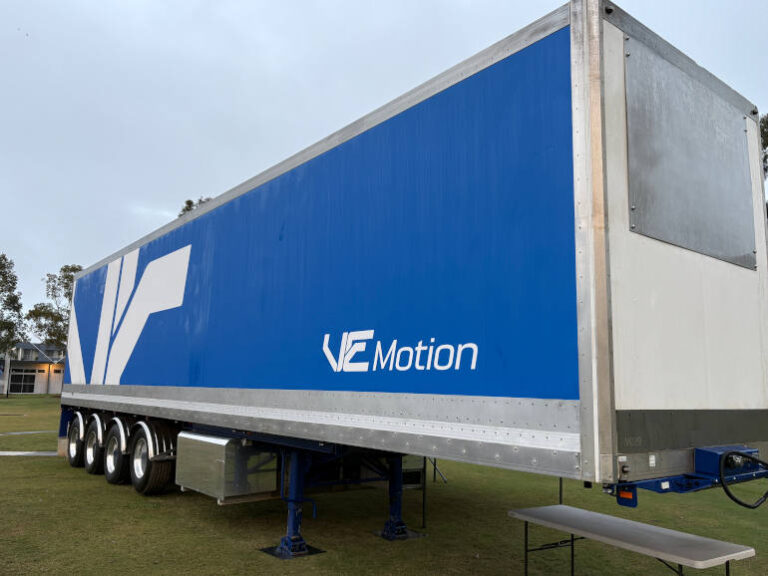
Australian technology company VE Motion believes the trailer could become one of the most practical tools for reducing heavy-vehicle fuel consumption while improving productivity on demanding freight routes.
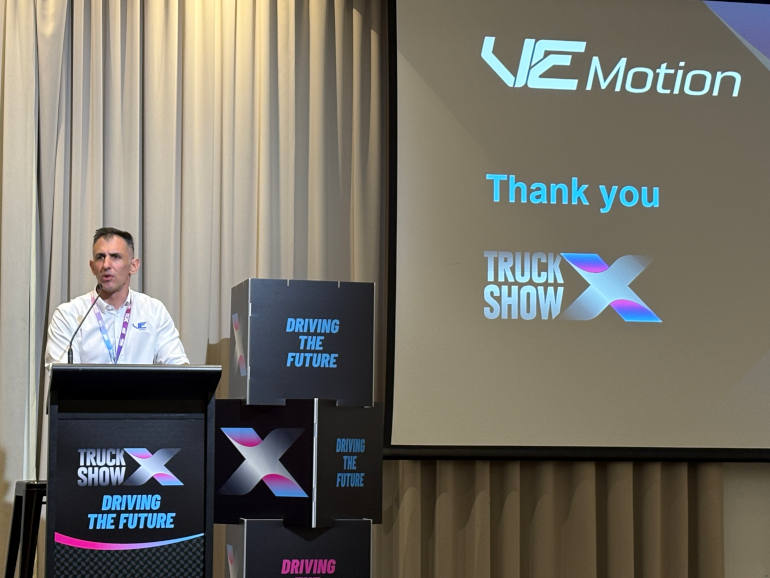
Speaking at TruckShowX, VE Motion Co-founder and CEO Dean Panos outlined how the company’s locally developed power trailer uses a battery-electric axle to provide additional propulsion when climbing, recover energy during descents and reduce the workload placed on the truck’s diesel engine.

The system has been designed to reduce diesel consumption by as much as 50 per cent under suitable operating conditions, while allowing operators to retain their existing prime movers and refuelling arrangements.
“The aim is to halve diesel consumption through the extra power and torque provided by the e-axle,” Panos said.
The powered axle can deliver approximately 400hp of additional propulsion and up to 295kW of regenerative braking. Rather than requiring the driver to control the system independently, it receives information including accelerator position, vehicle speed, load and gear selection to determine when propulsion or regeneration is required.
When the driver lifts off the accelerator, the trailer begins recovering energy. The system can also reduce regenerative braking progressively as the battery approaches a high state of charge, avoiding sudden changes in braking performance.
Panos said the operating experience was intended to remain familiar for drivers.
“There’s very little driver intervention required,” he said.
Drivers can adjust the level of regenerative braking and propulsion through an in-cab screen, while a selectable launch mode can provide assistance below 5km/h.
Feedback from VE Motion’s demonstration program suggested the most noticeable benefits were stronger hill-climbing performance, smoother descents and less reliance on the service brakes.
According to Panos, experienced heavy-vehicle drivers who tested the system were particularly impressed by how naturally the trailer integrated with the vehicle.
“You don’t often see grown men giggle, especially in the transport industry, but we certainly did on that drive day,” he said.
Fuel savings are only part of the business case
Although the power trailer was initially developed as a decarbonisation technology, VE Motion is increasingly positioning its operational benefits as an equally important part of the investment case.
These benefits include faster uphill speeds, shorter cycle times, improved startability and gradability, reduced brake wear and potentially lower engine power requirements.
Panos said an operator may eventually be able to specify a lower-output prime mover because the powered trailer can provide additional assistance during periods of high demand.
Dropping from a larger engine to a lower-powered model could reduce the initial cost of the prime mover, while the electric axle carries more of the load on steep sections.
VE Motion is targeting a payback period of less than five years, although the result will depend on the duty cycle, diesel price, electricity cost and the amount of regenerative energy available on the route.
The strongest applications are likely to be predictable routes with regular elevation changes, consistent payloads and access to charging at a depot or loading point.
VE Motion’s controlled testing has recorded fuel consumption falling from approximately 20 litres to 10 litres over a selected test circuit when the powered axle was operating.
Panos said route-specific modelling was essential because the savings would not be identical across every fleet or application.
“We have to have a discussion with the fleet operator about what the route is, what type of freight, what fuel usage they get at the moment and what size battery is needed to make sure it is suitable,” he said.
The company models each proposed application to estimate energy consumption, regeneration, fuel savings, battery capacity and potential cycle-time improvements before recommending a system.
Blue Mountains route shows productivity potential
One proposed application modelled by VE Motion involves a B-double operating between the NSW Central Coast and Oberon, crossing the Blue Mountains and reaching an elevation of approximately 1,100 metres.
VE Motion estimated the additional electric propulsion could reduce the trip’s cycle time by 34 minutes, primarily through higher climbing speeds.
The company also forecast a 56 per cent reduction in diesel consumption for the cycle, supported by the significant opportunity to recover energy during the return descent.
Another proposed New Zealand operation includes an elevation change of about 400 metres. VE Motion expects regenerative braking could recover between 15 and 25 per cent of the energy required for the trip, with charging completed once per day.
Panos said several projects that began as emissions-reduction exercises were now being assessed just as closely for their productivity benefits.
The technology could be particularly attractive for operators that cannot replace an entire fleet with battery-electric prime movers because of range, payload, charging or route limitations.
“We don’t want to disrupt. We want to transform and bring the industry on a journey,” Panos said.
“The transition to full electric trucks on every route would give me anxiety as a fleet operator. Our trailer, on the other hand, is part of the transition.”
Retrofit first, production integration later
The VE Motion system consists of an electric axle, battery modules, control equipment and an in-cab display.
Battery capacity can range from approximately 200kWh to 600kWh, with total system mass varying from about 1.6 tonnes to 4.5 tonnes depending on the configuration.
The batteries are generally installed between the trailer chassis rails. VE Motion is initially developing retrofit packages but plans to create standardised kits that could eventually be installed by trailer manufacturers during a new build.
The company is building a library of designs for different trailer types and freight tasks. Each installation currently requires work to integrate the battery brackets, control boxes, suspension, braking system and axle into the specific trailer design.
“The product we are selling is the control box, the batteries and the e-axle,” Panos said.
“The aim is that we can retrofit them, but we would like to do it in new builds over time and supply the trailer manufacturer with a complete kit.”
The battery can also provide electricity for trailer-mounted equipment through a 25kW bidirectional AC charger.
Potential applications include refrigeration systems, pumps and other equipment traditionally powered by a truck’s engine or power take-off. This could reduce idling and engine hours while giving fleets another source of operational savings.
The system can also support solar charging, shore power and, potentially, vehicle-to-grid services.
Panos said a large fleet of power trailers could eventually form a significant distributed energy resource, with operators choosing to retain battery power or export electricity when wholesale prices are high.
Regulation remains the next hurdle
There is currently no dedicated Australian vehicle category or Australian Design Rule for power trailers.
VE Motion is progressing its initial applications through the HVIA power trailer trial guidelines and the vehicle-modification provisions of the Heavy Vehicle National Law.
The approval work includes brake testing, electrical safety assessments, functional safety analysis and Performance Based Standards evaluation, as well as engagement with the National Heavy Vehicle Regulator, the Department of Infrastructure and state road managers.
Panos said the international development of UNECE braking regulations for powered trailers would be important in establishing a longer-term regulatory pathway.
He also argued that power trailers should receive a mass concession similar to the concessions available for some zero-emission heavy vehicles.
The additional axle propulsion can improve acceleration, startability and gradability while distributing weight across a trailer axle group with multiple tyres. The powered axle may also reduce horizontal pavement forces under some operating conditions.
Despite the remaining regulatory work, Panos said VE Motion had completed eight years of development and was ready to move from prototype testing into early commercial fleet trials.
“We’ve developed the first power trailer system in Australia for the local market, ready for production now,” he said.
For fleets facing pressure to reduce fuel use but unable to replace diesel trucks across every route, the powered trailer offers a different transition pathway: electrify part of the combination, recover energy that would otherwise be lost and use electric torque where it creates the greatest operational value.