

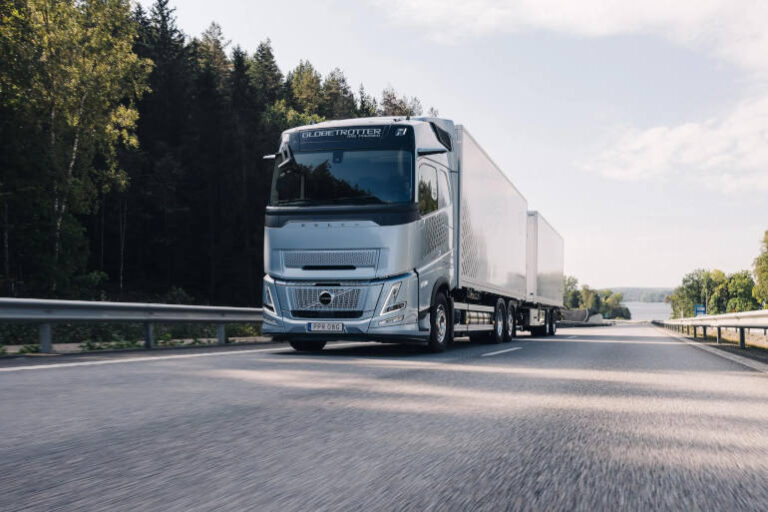
Volvo Trucks has delivered more than 10,000 gas-powered trucks globally since introducing the technology in 2018, marking a milestone as operators increasingly turn to alternative fuels to reduce CO₂ emissions.
According to the manufacturer, 2025 was its strongest year for gas-powered truck sales, supported by product development and improving availability and pricing of fuel in key markets. The UK is currently Volvo’s largest market for gas trucks, followed by Germany, Sweden, the Netherlands, Norway and France. Demand is also building in India and Latin America.
Volvo offers its gas engines across the heavy-duty FM, FH and FH Aero ranges. The trucks can operate on liquefied natural gas (LNG) or bio-LNG produced from organic waste. In markets where bio-LNG supply is well established, operators may achieve substantial well-to-wheel CO₂ reductions compared with conventional diesel.
“Volvo’s gas engine technology is a leading solution in terms of power, torque, engine response, and fuel efficiency, and our customers also appreciate the strong performance, drivability, and overall comfort of our gas-powered trucks,” said Jan Hjelmgren, Head of Product Management at Volvo Trucks. “We see substantial potential for gas-powered trucks as an important step on the journey toward zero-emission transport.”
The company said its gas-powered trucks can travel up to 1,000 kilometres on a single tank, positioning them for long-haul freight, regional distribution and certain construction applications. The gas engine platform is derived from Volvo’s D13 powertrain, aiming to deliver diesel-like performance while reducing emissions when paired with renewable fuel options.
While battery-electric and hydrogen technologies continue to develop, gas-powered trucks are being positioned in some markets as an interim solution, particularly where fuelling infrastructure and policy settings support their uptake.




