
For decades, trailers have largely been viewed as freight-carrying assets: engineered to maximise payload, withstand demanding operating conditions and remain on the road for as long as possible.
But that definition is changing.

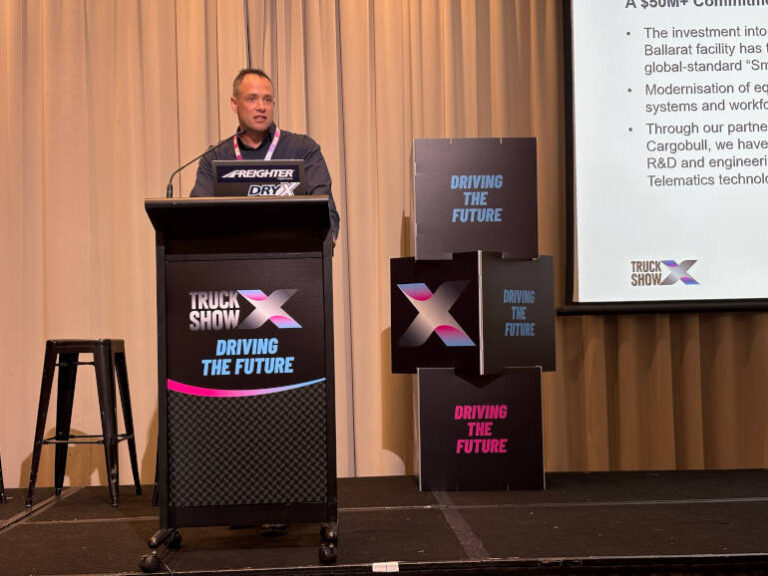
Speaking at TruckShowX, Freighter Group General Manager – Sales Excellence & Marketing Brad Lane said trailers are increasingly becoming connected fleet assets that can provide real-time information on their location, technical condition, cargo environment and operating performance.
“The industry is moving away from guesswork and towards real-time data and unified intelligence,” Lane said.
For fleet operators, the opportunity is not simply to know where a trailer is. It is to use trailer data to reduce downtime, protect cargo, simplify compliance and give dispatch, maintenance and operations teams a clearer picture of the assets moving through the network.
The challenge of fragmented fleet data
Lane said mixed fleets often operate across multiple trailer brands, telematics providers and refrigeration systems, creating isolated pools of information that can be difficult to use operationally.
“Most fleets are a mix of different brands and ages, leading to fragmented silos where nothing communicates,” he said.
“The ability to see the entire fleet operation through one lens, regardless of the trailer manufacturer or telematics provider, is where the real value starts.”
That is a significant shift for transport businesses. Rather than treating trailer telematics as a separate tracking tool, Lane argued it should become part of the wider fleet-management data environment.
Freighter Group is positioning Trailer Connect as a platform that can combine trailer, telematics and refrigeration-unit information through a single communication gateway.
“Instead of juggling different service providers or logins, you have one point of entry and one source of truth for the entire asset,” Lane said.
Beyond location tracking
Trailer location has been a standard telematics feature for years. But Lane said the next stage is live technical and cargo-condition information that enables fleets to respond before a problem becomes a disruption.
“This is not just about knowing where the trailer is,” he said. “It is about live data from the vehicle and the cooling units. By monitoring health and temperature in real time, fleets can increase uptime and make day-to-day transport easier to plan.”
That is particularly relevant for temperature-sensitive freight, including food, pharmaceuticals and other high-value cargo.
Lane said real-time temperature and location data can give operators stronger evidence that a load has been transported within the required conditions.
“Total transparency means you can prove the integrity of the load every second of its journey,” he said. “This is not just about tracking it. It is about protecting the value of the cargo.”
A move from reactive repairs to predictive management
The practical fleet benefit of connected trailers may be strongest in maintenance planning.
Trailer systems can generate data from components ranging from brakes and running gear through to refrigeration equipment. When that data is visible and integrated with fleet systems, it can help identify emerging issues before they create an unplanned roadside event, missed delivery or workshop disruption.
“We are moving away from reactive fixes towards a model of constant technical oversight,” Lane said.
He said connected-trailer technology can support predictive maintenance by providing real-time component diagnostics and helping fleet teams identify mechanical issues before they become critical.
The objective is not to replace maintenance expertise, but to improve the timing and quality of maintenance decisions.
For transport operators facing workshop capacity constraints, driver shortages and increasingly tight delivery expectations, the ability to plan interventions rather than react to failures could have a material effect on uptime.
Compliance without the paperwork burden
Lane also highlighted the administrative value of digital trailer data, particularly for operators managing sensitive loads or highly regulated supply chains.
Manual documentation and compliance reporting can be time-consuming and vulnerable to human error, he said.
“By automating compliance logs, operators can reduce administration overheads and make sure they are audit-ready,” Lane said.
For fleets operating in food, pharmaceutical and other controlled environments, this could mean digital records of trailer location, temperature and load conditions are captured as part of normal operations rather than assembled after an incident or audit request.
That changes telematics from a visibility tool into an evidence platform.
Connectivity designed into the trailer
Freighter Group used TruckShowX to preview its upcoming Dry X dry-freight trailer range, which Lane said will include Trailer Connect as a standard integrated feature.
He described the approach as a move away from treating connectivity as an optional add-on.
“Connectivity is not an afterthought for the Dry X,” Lane said. “By having connectivity straight from the factory, you gain immediate access to the location, security and technical health of your trailer.”
Lane said the new trailer has been designed around both freight capacity and information capability, reflecting a broader change in how fleets assess trailer performance.
“This is not just a new model,” he said. “It represents the shift in how we think of trailer performance, moving away from hauling towards moving intelligence.”
Start with the operational problem
Lane acknowledged that established fleets cannot move to a connected-trailer environment overnight.
His recommendation was for operators to begin with a clear audit of the data gaps and operational issues they are trying to solve, whether that is temperature variation, unplanned maintenance, poor asset visibility or inefficient reporting.
“We do not just install and hope,” Lane said. “We define clear objectives based on fleet performance and identify exactly where the data gaps exist.”
From there, fleets can trial the technology on a smaller scale, integrate the data with existing transport management or ERP systems, and then expand the program once the operational value has been proven.
For operators, the larger message is that trailers are no longer passive assets at the end of the supply chain.
They are becoming a source of operational intelligence — helping fleets protect freight, improve maintenance planning, reduce administrative effort and make better decisions across the transport task.