
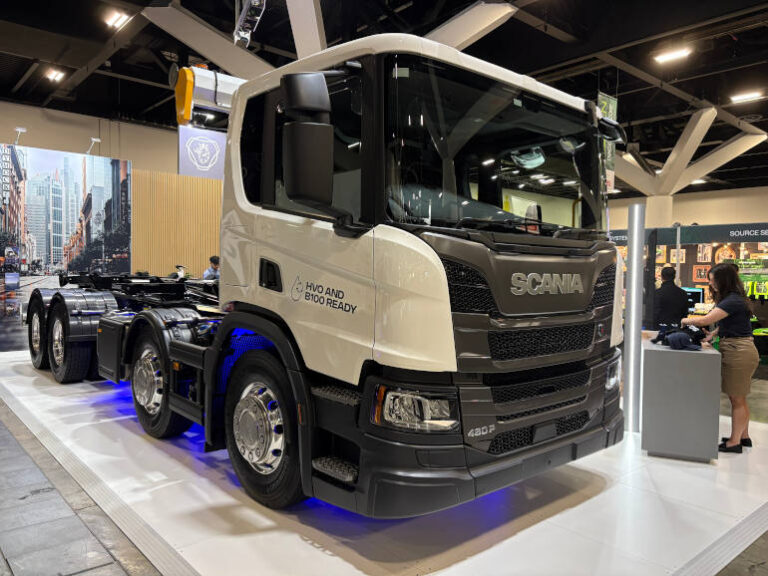
From Scania’s perspective, 2026 is shaping up as a year where fleet decision-making becomes more cautious, more financially disciplined, and more focused on asset value over the full lifecycle. After several years of disruption and inflated purchasing conditions, the market is now working through the consequences of decisions made during the COVID period.
Ben Nye, Sales Director – Truck at Scania Australia, says uncertainty is influencing how fleets approach both new vehicle purchases and existing assets.
“I’ve seen a lot of people trying to extend financing, extending maintenance contracts… a lot of people don’t want to jump in the deep end anymore and just buy new trucks.”
Living with the legacy of the COVID market
One of the most significant challenges facing fleets in 2026, according to Nye, is the legacy of vehicles purchased during the peak of the market.
“We’re entering this period now that we’ve got a lot of people where the payout versus resale value has become a very real problem.”
Vehicles bought at inflated prices are now operating in a market that has normalised, creating tension between book values and real-world resale outcomes. This is driving fleets to hold onto assets longer and reassess replacement timing.
“A lot of customers are looking at what they bought two or three years ago and realising the numbers don’t stack up the way they expected.”
A more conservative investment mindset
Nye says this environment is pushing fleets toward more conservative decision-making. Rather than expanding fleets or committing to large orders, many operators are prioritising stability.
“There’s still uncertainty out there. People are nervous about where the market’s heading, so they’re trying to reduce risk rather than add to it.”
That caution is evident in the way fleets are managing capital expenditure, maintenance and financing.
“Extending contracts and sweating assets a bit longer is becoming more common, because people want clarity before making the next move.”
Emissions ambition versus commercial reality
While emissions reduction remains an important objective, Nye was clear that cost pressure continues to be the dominant constraint for transport operators.
“Customers want to reduce emissions, but no one wants to pay the bill.”
He noted that sustainability commitments often falter when additional costs are passed down the supply chain.
“The moment you ask the end customer to pay more, the appetite disappears.”
From Scania’s perspective, this tension will remain a defining feature of fleet decision-making in 2026, particularly for operators working on thin margins.
Focus on value, not just technology
Nye emphasised that fleets are increasingly evaluating vehicles through a commercial lens rather than a technology lens. Decisions are less about chasing the latest solution and more about proven performance, reliability and cost control.
“It’s not about jumping at every new thing. It’s about understanding what actually delivers value over the life of the truck.”
This mindset aligns with broader industry trends toward whole-of-life cost analysis, even if purchasing behaviour remains cautious in the short term.
What fleets should expect in 2026
From Scania’s perspective, 2026 will not be defined by rapid growth or aggressive fleet expansion. Instead, it will be shaped by:
- Heightened sensitivity to capital and operating costs
- Greater scrutiny of resale values and asset depreciation
- Slower, more deliberate purchasing decisions
- Ongoing tension between emissions goals and commercial constraints
As Nye summed up, the industry is recalibrating after an extraordinary period.
“People are just trying to get their footing again. There’s a lot more thinking going on before decisions are made.”
For fleet managers, Scania’s message is clear: 2026 will reward caution, realism and a strong understanding of asset value — not just at purchase, but at disposal as well.
- More Bays, Less Downtime: TRUCK TECH Expands in Victoria
 TRUCK TECH has opened a new heavy vehicle workshop in Sunshine West, expanding maintenance capacity for fleets operating across Melbourne’s western freight corridor. The 5,000 sqm facility targets fleets with 50 or more assets and includes 14 service bays, a 10-tonne crane, a wash bay, and diagnostic and brake-testing technology. It also provides A-double access
 - Daimler Truck Crowns Top TechniciansDaimler Truck Australia Pacific has named its 2026 Freightliner and Mercedes-Benz Trucks Technicians of the Year, putting a spotlight on the technical capability required to keep increasingly complex heavy vehicles operating reliably. The national finals were held at the Daimler Truck Training Academy in Mulgrave, Victoria, where leading technicians completed technical theory assessments, real-world diagnostic
- Penske Crowns 2026 Master TechniciansPenske Australia & New Zealand has named Luke Andrew and Luke Reid as its 2026 Penske Guild Master Technicians, recognising technical excellence across the company’s on-highway and off-highway operations. Andrew, a leading hand at Penske’s Perth branch, claimed the on-highway title, while Darwin-based Reid took out the off-highway category. The biennial Penske Guild competition brings
- WABCO Air Dryer Range Targets Heavy Vehicle UptimeZF Aftermarket has highlighted its WABCO air dryer cartridge range for Australian commercial vehicle operators, with the products designed to protect compressed-air systems from moisture, oil and other contaminants. The range was showcased at the recent Australasia Bus & Coach Expo, where ZF demonstrated the role air treatment can play in maintaining the reliability of
- Five-year warranty becomes part of Hino’s aftersales retention strategyHino Australia is positioning its five-year warranty as part of a broader aftersales package designed to give fleet buyers more certainty over vehicle ownership costs. At the company’s recent business briefing, Hino Australia President and CEO Richard Emery said the warranty extension was one element of a wider focus on the customer lifecycle after delivery.