




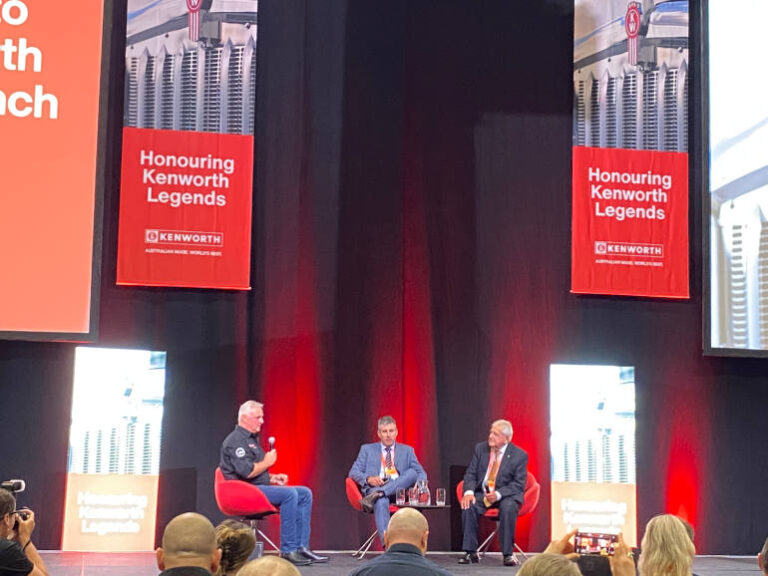
The Kenworth Legends Lunch at Trucking Australia 2025 in Adelaide delivered more than a hearty meal—it delivered heartfelt stories, industry insight and a powerful sense of legacy. Hosted by well-known trucking identity Bruce Gunter, the lunch is a long-standing tradition of the Australian Trucking Association’s annual event, celebrating operators whose commitment to the Kenworth brand mirrors their deep roots in Australian transport.
This year, the spotlight was on the Riordan family, recognising Jim Riordan as the 25th Kenworth Legend, while paying tribute to his father Robert’s legacy in both fuel distribution and transport.
“I just started with one truck, and I just kept doing miles,” said Jim Riordan in a reflective video shown at the lunch. “One truck’s led to where we are today… we sell (grain) to Japan and all parts of the world.”
From Humble Beginnings to Global Reach
Jim Riordan’s story began with a single Louisville truck and a TEFCO trailer, hauling grain through central New South Wales. Through persistence and innovation—including pioneering mobile ship loading systems—his business evolved into a leading exporter of grains, moving nearly two million tonnes of products annually.
“I didn’t have $50 million to build a silo at the port,” Jim explained. “So I started looking at how we could drive trucks over big docks and load ships… Last year we loaded over the side just over a million tonnes.”
Kenworth Trucks: The Backbone of the Business
Today, Riordan Grain Services runs 85 Kenworth trucks, and Jim’s pride in the brand was clear.
“Kenworths have been a massive part of what we’ve done. They’re as good as the day they were purchased… You’d be hard pressed to find anything else on the front of our trailers.”
Jim’s first Kenworth came in the early 2000s—a T604 with a Caterpillar engine. His now-signature “Riordan Red” colour scheme was actually born from a mistake when two Freightliners arrived in the wrong shade.
“They were supposed to be Coca-Cola red, but they were this orangey colour… Baz at Fleet Imaging put some stripes on it and said, ‘Leave it with me’. That’s how the colour was born.”
A Family Story: Robert Riordan’s Legacy
The lunch also honoured Robert Riordan, who built the family’s foundation in fuel distribution. After being approached by Shell in 1965, Robert returned home to manage the distributorship, eventually building it into a network of 18 service stations and handling 100 million litres of fuel annually.
“I was more of an administrator than a driver,” said Robert. “But I made sure the business side of the business was running properly.”
Robert’s recollections of heating oil deliveries—complete with weekend call-outs—highlighted how much the industry has changed, and how much effort was once required behind the scenes.
Strong Women Behind the Wheel
A recurring theme of the conversation was the vital role of women—wives, mothers, daughters—in transport businesses. Bruce Gunter acknowledged the sacrifices and support given by the Riordan women, with both Jim and Robert echoing that sentiment.
“You can’t run these businesses without that sort of loyalty and support,” said Jim. “From Mum, from my wife Kate, from all the employees and their families—it’s a team.”
Focus on the Next Generation
Jim is passionate about bringing young people into the industry. Each Saturday, a group of kids—up to ten at a time—visit the depot to clean trucks and learn about machinery. Some have already taken up apprenticeships.
“They kick off on a bike, just like me. And now three of them are apprentices. It’s just fantastic,” said Jim.
He also shared Riordan Grain Services’ efforts to lower the average driver age in the fleet from 49 to 45 over the next two years and increase female participation to 10%.
“We’re trying to make it easier for women to get into the industry—automatic trucks, better facilities, and a culture that welcomes them.”
A Legacy of Relationships
Jim credited the company’s success not just to great trucks, but to great people and long-term partnerships with suppliers like Lusty Trailers and dealers who understand the business.
“The drivers want Kenworths. They’re reliable. But it’s the relationship with the dealer that makes the difference.”
Final Words
As the lunch wrapped up, Bruce Gunter paid tribute to both Jim and Robert:
“You started off with a truck and built an empire. You’ve both stayed humble, and the loyalty from your staff shows what kind of people you are.”
The Kenworth Legends Lunch once again did what it does best—celebrating not just trucks, but the people behind them. It was a poignant reminder that the strength of the Australian transport industry lies in family, hard work, and pride in doing things the right way.
- Volvo Takes the Next Step in Electric Long Haul
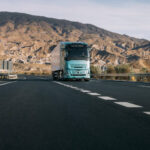
 Volvo Trucks has started series production of its latest generation of electric heavy trucks, bringing models with ranges of up to 700 kilometres into regular manufacturing. The first trucks have now rolled off the production line at Volvo’s Tuve plant in Gothenburg, Sweden, following the global launch of the new electric range in April 2026.
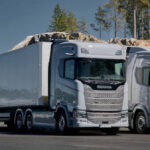
 - Scania Dynamic Improves Efficiency and ComfortScania has revealed a major update to its R- and S-series trucks, with the new Scania Dynamic package targeting lower energy consumption, improved aerodynamics and a more comfortable working environment for drivers. The changes apply across both battery-electric and combustion-engine powertrains, with Scania claiming total energy consumption can be reduced by around 2 per cent, depending on vehicle
- Dash cams are becoming a driver coaching tool, not just an incident recorderDash cams have traditionally been associated with providing evidence after a collision, but Australian fleets are increasingly using video telematics as part of a broader approach to driver safety and risk management. The Geotab Report 2026: Connected Fleets in Australia found 65% of respondents using in-cab video reported improved driver safety. A further 61% reported a reduction
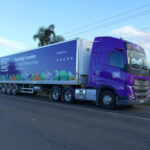
- Foodbank Expands Regional Delivery Network with VolvoA Volvo FH I-Save prime mover has helped Foodbank NSW & ACT expand its transport capacity, reduce reliance on outsourced freight and reach more regional communities during its first year in operation. The truck, paired with a Vawdrey refrigerated trailer, joined the Foodbank NSW & ACT fleet in 2025 and has since travelled almost 15,000
- BetterFleet data reveals the hidden efficiency gap inside electric truck depotsSwitching from diesel to electric removes tailpipe emissions, but BetterFleet says that is only the beginning of the emissions and efficiency story. Speaking at TruckShowX, BetterFleet Vice President APAC Markets Russ Yell said the way energy is managed after it enters a depot can have a significant impact on operating costs, carbon performance and the