

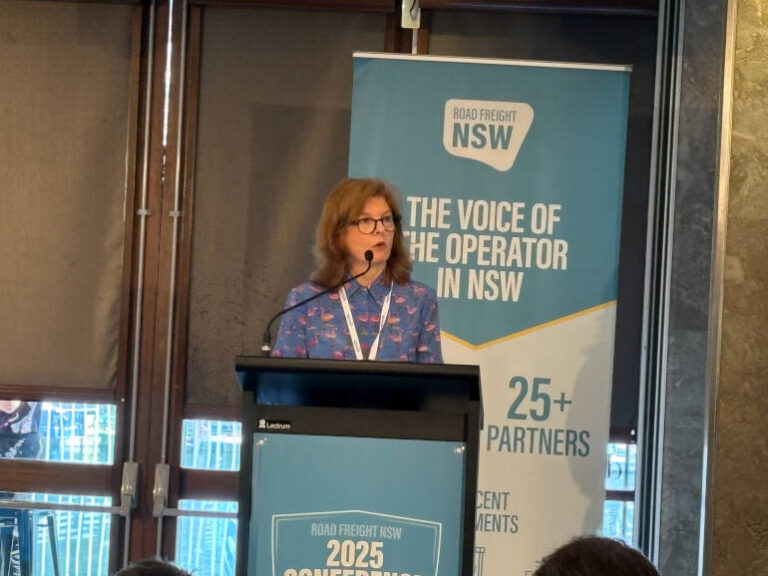
Last month, at the Road Freight NSW 2025 Conference and Awards, Sally Webb, Deputy Secretary of Safety, Policy, Environment and Regulation at Transport for NSW, delivered a wide-ranging address on the challenges and opportunities facing the road freight industry. Her focus was clear: building a safer, more sustainable, and more inclusive industry through strong collaboration between government and operators.
Safety as the First Priority
Webb emphasised that safety remains the central priority for Transport for NSW. Her team leads the state’s multi-modal safety and decarbonisation policy agenda, with road safety front and centre. “One of the most important things that my team works on is making sure that every journey—yours included—is as safe as it can be, whether it’s people or freight moving across our network,” she said.
She acknowledged the increasing pressure on drivers, noting fatigue, limited rest facilities, and unsafe behaviour by light-vehicle drivers as growing concerns. “Your drivers tell us the way light vehicle drivers behave creates risks and real stress, which they then carry for long hours,” she said.
Addressing Workforce Challenges
The freight industry is facing a critical driver shortage, with 28,000 heavy vehicle positions unfilled nationally. Webb highlighted the scale of the challenge: nearly half of drivers are aged over 55, while only 5.4% are under 25. Women remain significantly under-represented, making up just 3% of the heavy vehicle workforce.
To tackle this, Transport for NSW is supporting reforms to simplify driver entry pathways. “Entry pathways are unclear, inconsistent, and frustrating for applicants,” Webb admitted. She pointed to upcoming national reforms that will introduce experience-based progression, structured supervision, and competency-based training—piloted in 2025 and rolled out nationally from 2026.
Webb also called for cultural change within the industry. Clean, secure rest facilities, proper lighting, and a respectful workplace culture, she said, are essential to attracting new drivers, particularly women and younger workers.
Freight Reform and Future Initiatives
Looking beyond licensing, Webb outlined the NSW Freight Policy Reform Program. This includes:
- A new online hub with clear information on driver pathways, licence classes, and training options.
- A targeted workforce attraction program developed in partnership with industry.
- Investment in corridors, hubs, and network upgrades through the Freight Master Plan.
- A new heavy vehicle access policy to encourage safer, more productive vehicles on the network.
- Expanded rest stop facilities and support systems for drivers.
She also underlined the importance of aligning licensing and vocational training, stressing that while licensing ensures safe drivers, vocational training and employer support prepare them for the diversity of roles across the freight industry.
Partnership with Industry
Webb closed her presentation by highlighting the importance of collaboration. “Lasting change demands strong and open government and industry partnership,” she said. She acknowledged the success of initiatives like Transport Women Australia scholarships and NSW operators’ buddy systems for new drivers, noting they provide models for the kind of industry-led innovation that can drive progress.
“Together, we’ll attract new talent, retain experienced drivers, and secure a safer, more sustainable future,” Webb concluded.
- Scania’s New Testing Ground for Tomorrow’s Trucks
 Scania has opened a new SEK 975 million research and development proving ground in Sweden, expanding its ability to test heavy vehicle safety systems, electric drivetrains and autonomous transport technology. The 85-hectare facility in Södertälje adds 13 kilometres of paved roads and four kilometres of gravel roads to the TRATON GROUP’s development capabilities. It will
- Better Support for Women Behind the WheelTransport employers are being urged to recognise menopause as a potential contributor to driver fatigue, as New Zealand’s trucking industry works to attract and retain more women. Fleet safety specialist AutoSense has launched a workplace education seminar exploring how perimenopause and menopause can affect sleep, energy and concentration, and what businesses can do to support
- Waste truck deaths demand a closer look at council transport safetyWaste collection is one of local government’s most visible services. It also brings heavy vehicles into residential streets, close to pedestrians, driveways and people putting out their bins. Three fatal incidents reported in 2026 highlight the potential consequences when something goes wrong. For council leaders, waste managers and fleet teams, they should prompt a fresh
- MOTUM Puts Heavy Vehicle Drivers to the TestAustralian simulation technology company MOTUM has completed a heavy vehicle driver training platform that allows operators to practise challenging manoeuvres and hazardous situations in a controlled virtual environment. The platform supports vehicle configurations ranging from rigid trucks and semi-trailers to B-doubles, livestock combinations and oversized vehicles. It also captures performance data, giving instructors a consistent
- Three risks behind more than a third of major truck incidentsInattention, inappropriate speed and inadequate following distance accounted for 38% of major heavy vehicle incidents in 2025, according to new research that gives fleet managers a clear starting point for reviewing their safety priorities. The 2026 National Truck Accident Research Centre (NTARC) Major Incident Investigation Report found human factors contributed to 54.7% of all major incidents analysed.