




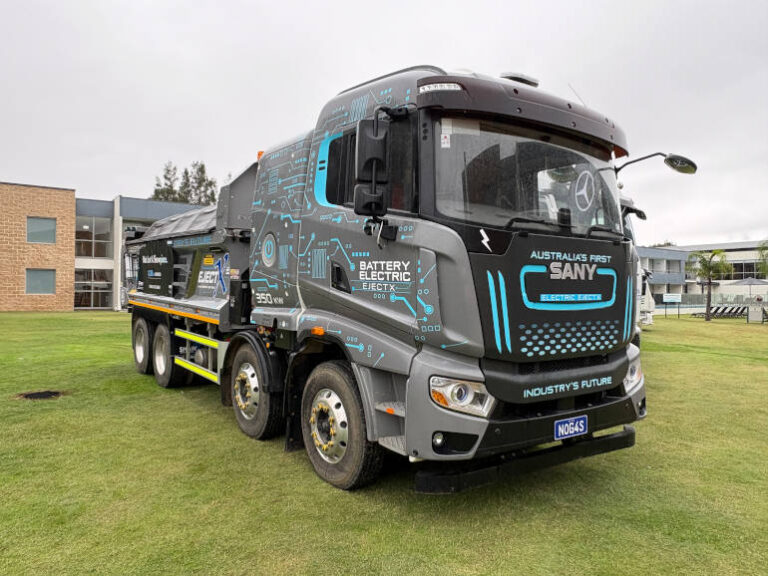
Battery-electric trucks are starting to move beyond the trial phase and into the day-to-day work of Australian construction fleets, with Fleet Plant Hire and Vertu Group using TruckShowX 2026 to showcase a Sany electric tipper designed for real-world site conditions.
Speaking at the event in the Hunter Valley, Chris West, Managing Director at Fleet Plant Hire, said the company had already sold eight Sany electric trucks and was looking to bring in around 150 next-generation vehicles as demand builds across the construction sector.

Rather than targeting one large fleet order, West said the early market was coming from smaller operators.
“Individual operators, so small to medium operators,” West said. “It’s the best way to make inroads into the market in the heavy vehicles, rather than say a one-off fleet purchase of 30, 40, 50.”
For West, the opportunity is not only about decarbonisation. He said the electric truck offers a better experience for drivers while also reducing exposure to diesel costs, which remain a major pressure point in civil construction and transport operations.
“We’re finding more so that they are better for driver fatigue,” West said. “Obviously, your running costs after a period of time are much cheaper, and most drivers are looking at it as being an alternative to what has been around.”
He said diesel remains a prime operating cost in the applications Fleet Plant Hire works in, and electric trucks offer a way to remove that exposure from the operating model.
“It’s not just the fact that it’s new energy and that it’s green,” West said. “The main driver has been they’re a better outcome for the driver themselves.”
Jonathon Griffiths, Managing Director at Vertu Group, said the project was significant because it was taking electric heavy vehicles into one of the more traditional and difficult-to-transition sectors.
“I think one of the great things as well about this project is we’re sort of revolutionising one of the most traditional industries being construction,” Griffiths said. “Construction is sort of the last mile when it comes to actually transitioning.”
Griffiths said the model being developed by Fleet Plant Hire was important because it was not simply a top-down fleet procurement exercise. Instead, it was making the technology available to individual drivers and operators.
“What Fleet’s doing in particular is revolutionising that industry, but also flowing it down to individual drivers,” Griffiths said. “It’s not just one particular fleet buy.”
A key part of the business case is the lower upfront cost of the Sany vehicle compared with some European electric truck options. West said that when he first started assessing electric heavy vehicles several years ago, the numbers did not work.
“Two, three years ago, when I started this journey checking against the European vehicles, it just didn’t stack up financially,” West said. “It wasn’t there, regardless of the funding that was available through ARENA.”
He said the arrival of new models, including vehicles from China and other markets, had changed the equation.
“Now a couple of years on, the new models coming in, and some of the other OEMs coming in from China and from other countries, it more than stacks up,” West said.
West acknowledged that some European models may offer higher levels of finish and refinement, but said construction operators ultimately focus on uptime, reliability and the ability to make money from the asset.
“For what we do in our application, they get paid the same, whether they are running a $50,000 10-year-old truck or a $450,000 brand new vehicle,” West said. “For them, value for money comes out of the reliability, which comes back to the servicing and the after-sale support, and the ability to keep the truck on the road.”
The Sany truck on display was a Gen One 8×4 model with a 350kW battery. West said Fleet Plant Hire had been using the truck since January in normal construction work, without asking clients to limit its duties or keep it on easy site-based runs.
“We have used that truck since basically January on normal construction sites,” West said. “We don’t ask the client who’s using it to put it on particular parts of a job, so it doesn’t sit on site all day.”
West said if the truck needed to travel off site to a disposal point 50 kilometres away, it did so as part of the normal work cycle.
“In general, it completes around 250 to 300 kilometres a day,” West said. He added that it had not needed to be charged during the day, except once when there was an overnight charger issue.
Griffiths said the focus from the beginning had been on proving the truck could perform in operational conditions.
“Our whole mandate from Fleet, or the whole mandate working together, has been making sure these things work in the real world,” Griffiths said.
The vehicle is fitted with an EjectX body designed and built in Queensland by ShawX. Instead of raising the body to tip material, the system pushes the load out the back while the truck remains flat.
West said this was important because rollover risk remains a serious safety issue in tipping operations.
“There’s been a lot of rollovers, which have caused deaths, where a load has either become stuck at the top or down at the tailgate or on uneven ground when their body’s raised to tip,” West said. “They developed this EjectX body, so the truck stays flat all the time. Centre of gravity is low.”
The combination of an electric automatic truck and simplified body operation also creates a potential training pathway for new drivers at a time when the industry continues to face labour shortages.
“There’s a driver shortage in Australia,” West said. “Having the electric automatic truck with the system for the body, where the driver doesn’t need to engage anything other than press one button on a screen, it means that we can bring in effectively new drivers to the industry.”
West said those drivers could gain experience in a safer environment before progressing to more complex truck and trailer combinations.
“We can actually run them through a training module for a year, and it’s completely safe to everyone around them,” he said.
Fleet Plant Hire is also developing an EjectX trailer, with West saying the next-generation electric truck is expected to deliver greater range and operate at around 52 to 54 tonnes.
The truck uses a fixed battery rather than a swappable battery system. West said that decision reflected the lack of battery-swap infrastructure in Australia and the harsh conditions of construction work.
“We don’t have the infrastructure currently for swappable batteries in Australia,” West said. “More moving parts for us in our industry creates quite an intense industry to work in. So you’re on dirt, you’re on sites bouncing around.”
With more vehicles expected in Victoria and Queensland, the project suggests electric construction trucks are moving closer to commercial reality. For fleet operators, the message from TruckShowX was clear: the next phase of electrification will not be judged only on emissions, but on uptime, safety, driver acceptance and whether the vehicle can complete a normal day’s work.