

A trial between Multiquip and New Energy Transport has demonstrated that battery-electric trucks are capable of handling demanding regional freight tasks while delivering productivity and driver comfort benefits.
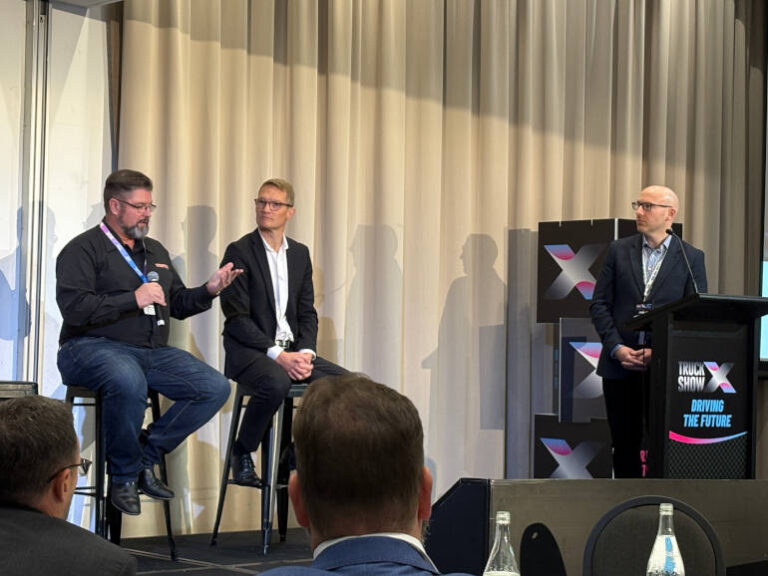
Presented at TruckShowX, the case study brought together David Muir, National Compliance Manager at Multiquip, and Fredrik Pehrsson, Co-CEO and Co-Founder of New Energy Transport, to share lessons from one of Australia’s longest heavy electric truck demonstrations.
The trial involved an electric truck operating between Multiquip’s site at Wilton, south of Sydney, and Beresfield near Newcastle. The route covered approximately 240km each way, with a total return journey of around 480km while operating at a 36-tonne combination mass.
According to New Energy Transport, the truck completed the return journey on a single charge while also outperforming the equivalent diesel operation in travel time.

Diverse fleet operation
While Multiquip describes itself as a family business, its operations are substantial. The company employs around 1,300 people and operates a fleet of approximately 500 trucks across Australia.
The business primarily services the poultry industry but also transports bulk feed, live birds, eggs, day-old chicks, aggregates, cement and refrigerated freight.
Multiquip runs a highly specialised fleet, including 38 different Performance Based Standards (PBS) combinations supported by around 100 permits nationally. Its operations range from 85-tonne refrigerated A-doubles to feed transport combinations, tippers and live-bird transport vehicles operating in regional and rural environments.
Muir explained that the complexity of the business means it has always embraced technology to improve safety and efficiency.
The fleet has used fatigue and distraction monitoring systems since 2018, operates almost entirely on electronic work diaries and provides customers with live dashboards showing vehicle locations and estimated arrival times.
Getting started with electrification
Pehrsson said the relationship between the two organisations began simply because they became neighbours.
New Energy Transport is developing a major charging hub at Wilton and approached Multiquip to discuss potential opportunities.
“Multiquip is located next door to where we’re building our depot down in Wilton,” said Pehrsson.
“We basically rocked up and knocked the door and wanted to talk to other companies that were in the region.”
For Multiquip, the trial provided an opportunity to move beyond discussions and gain practical experience with battery-electric freight transport.
“I guess we’re not quite as advanced as a lot of the people who were here in terms of BEVs, but it was just, yeah, we definitely needed to get started, and having the right partner was the way to go,” said Muir.
He encouraged other operators to begin their own electrification journey rather than waiting for perfect conditions.
“You can put it off and put it off and put it off, and there’s no benefit to it. You need to get in there now. The momentum is there.”
Productivity benefits surprise operators
One of the most significant findings from the trial was the impact on productivity.
Pehrsson said the electric truck completed the return journey around 40 minutes faster than the diesel equivalent.
“I think it was also the time saving that was significant, so we shaved off 40 minutes on this return trip,” he said.
The improvement came largely from the truck’s ability to maintain speed on steep grades and accelerate more effectively than conventional diesel vehicles.
“This truck has around 920 horsepower, and obviously that makes a difference uphill, and it also has better torque,” said Pehrsson.
Those gains translated into higher average speeds across the route and improved overall efficiency.
A different driver experience
For Muir, one of the biggest surprises was the reaction from drivers.
Rather than focusing solely on emissions reductions, drivers were attracted to the quieter, cleaner and more modern driving experience.
“What we saw, and across the industry, is we need to have something that’s potentially going to attract younger and newer drivers in the industry,” said Muir.
“The truck was clean, quiet, powerful, and it may be the image of the industry that we need to be looking at and bringing more people in.”
He said feedback from younger drivers had been particularly positive.
“The feedback I’ve been getting from our guys, particularly the younger ones, going, ‘Yeah, get me into one of them.’”
Infrastructure remains critical
A key part of New Energy Transport’s model is the development of dedicated charging infrastructure alongside transport operations.
Rather than focusing on depot charging at customer sites, the company is building high-capacity charging hubs on major freight corridors. The Wilton facility is designed to support routes between Newcastle and Canberra, providing flexibility across a wide operating area.
Pehrsson said future megawatt charging technology would further improve the commercial viability of heavy electric freight by reducing charging times to less than an hour for long-range trucks.
Part of the future
While Multiquip is continuing to evaluate battery-electric vehicles, Muir made it clear that the technology remains firmly on the company’s radar.
“Certainly this is part of our future,” he said.
The trial demonstrated that electric trucks can do more than reduce emissions. For operators moving high payloads across regional freight corridors, the technology is beginning to show practical advantages in productivity, driver appeal and operational efficiency.
As more charging infrastructure comes online and vehicle technology continues to improve, trials like the one conducted by Multiquip and New Energy Transport are providing the real-world evidence fleet operators need to plan their next steps.