

The transition to electric trucks is no longer about proving the technology works. According to industry leaders speaking during a TruckShowX Q&A session, the next challenge is removing regulatory barriers, expanding charging infrastructure and helping operators of all sizes adopt the technology.

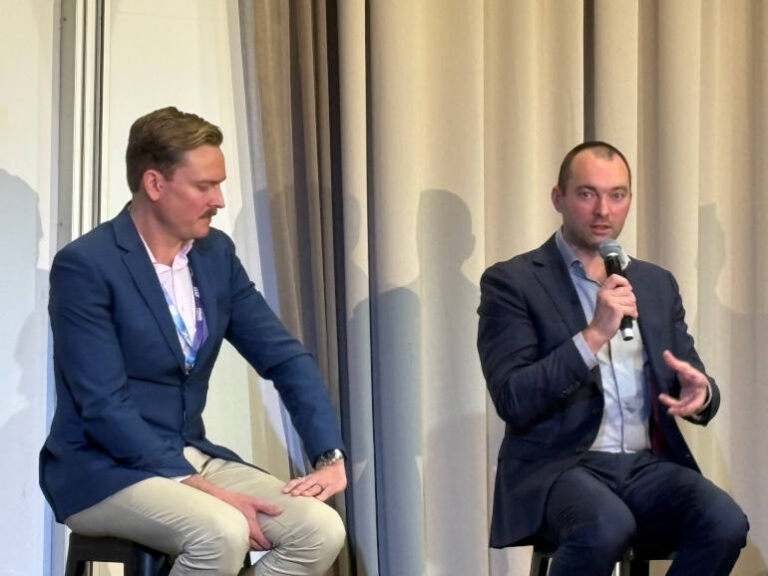
The discussion featured Alex Grant, Director at, ARENA and Wayne Schoenauer, Electric Vehicle Implementation Manager at Toll Group, following a presentation on Toll’s electric truck deployment experience. The session was moderated by Aaron Johnstone and explored lessons from ARENA-funded projects, industry readiness and the barriers preventing broader adoption.
A recurring theme throughout the discussion was the need for greater alignment between regulation and the realities of operating battery-electric trucks.
Asked about the Productivity Commission’s interim report and its recommendations around zero-emission transport, Grant said the report highlighted many of the regulatory issues that operators have already identified through real-world trials.
“I think it lays out quite clearly, and Wayne’s the lived experience of this, where some of the disjointed regulatory elements add cost, add time, just stop progress,” Grant said.
“It’s a very expensive way to advance the energy transition if you don’t affect regulatory change.”
Schoenauer agreed, arguing that regulatory reform needs to keep pace with the capabilities of today’s vehicles rather than focusing solely on future technologies.
“We’re missing the big opportunity with their current capabilities, where they are at the moment,” he said.
“From my perspective, it’s all around alignment, just get the regulations done and sorted, so these vehicles can operate to their full capacity and align that across the board as much as we can.”
The discussion also turned to how smaller transport operators can participate in the transition. Grant acknowledged that many funding programs have traditionally been easier for larger operators to access because they have dedicated resources to manage complex applications and projects.
With most transport businesses operating at a much smaller scale, ARENA is looking for ways to support broader participation.
“With the structure of the market, where 98% of operators aren’t at the big end, that’s a real issue that we’re grappling with now,” Grant said.
He noted that lessons learned from early adopters are helping reduce the burden for the rest of the industry and said ARENA is interested in working with organisations that can aggregate solutions and services for smaller operators.
Reflecting on Toll’s electric truck rollout, Schoenauer said one of the biggest learnings has been that desktop modelling can only go so far.
“The proof is in the operation,” he said.
After deploying electric trucks across multiple customer operations, Toll has gathered valuable data on vehicle suitability, charging behaviour and route selection. The company has also learned that charging strategies often differ from initial assumptions.
“It’s not about spending two hours having it plugged in to get to a full charge,” Schoenauer said.
“It’s about being able to top that up in a reasonable amount of time to get you from where you need to go.”
Driver acceptance and training have also emerged as critical factors.
While feedback from drivers has been overwhelmingly positive, Schoenauer said scaling from a pilot fleet of a few dozen vehicles to several hundred will require a stronger focus on education and change management.
“We’ve, in some instances, done a bit of re-coaching as well to get better range out of our vehicles, because we see the energy consumption drop quite rapidly just from that on-the-job coaching,” he said.
The audience also heard how Toll worked with customers including major industrial and consumer goods companies to integrate charging infrastructure into existing sites.
Schoenauer said success depended on bringing the right stakeholders together early and physically walking through site layouts and operational requirements.
“The best thing to do is get out on the site and walk through all these people,” he said.
“I don’t think you can do everything on a Teams call. The face-to-face interactions of being out on site, physically looking at this new technology, was the biggest part of it.”
When asked what posed the biggest risk to widespread freight electrification this decade — vehicle availability or charging infrastructure — both speakers pointed to charging as the more significant challenge.
Schoenauer said vehicle technology is advancing rapidly and is unlikely to be the limiting factor.
“I really don’t think it’s going to be an issue from a vehicle technology capability point of view,” he said.
“It’s going to be definitely how we roadmap that charging infrastructure from a public rollout.”
Grant agreed, noting that Australia faces a significant ramp-up in heavy vehicle electrification over the coming decade and that the industry must use current pilot projects to establish scalable models.
“Now’s the time to get the structure right, so that we can scale and ramp up appropriately,” Grant said.
The discussion highlighted a shift in focus for the industry. Early projects have largely proven that electric trucks can perform in commercial operations. The next phase will depend on coordinated regulation, practical charging solutions and collaboration between operators, customers, infrastructure providers and government agencies to enable broader adoption across the freight sector.