
Heavy transport operators do not buy drivetrains. They buy reliability, payload, uptime and economics.
That was the central message from Gareth Wishart, General Manager Technology and Innovation at Change Fuel Tech, during his presentation at TruckShowX.
Change Fuel Tech is part of New Zealand-based HW Richardson Group, a privately owned organisation comprising 49 companies across Australia and New Zealand. The group operates around 1,300 heavy trucks across fuel distribution, concrete, aggregates, construction, cartage and heavy transport.
This operational scale has provided Change Fuel Tech with a real-world testing ground for hydrogen-diesel dual-fuel technology across some of the most demanding freight tasks.
“Transport companies don’t buy drivetrains,” Wishart said. “They buy reliability. They buy payload, uptime and they buy economics.”

Preserving payload and range
Wishart said the challenge for heavy transport was not simply reducing emissions, but doing so without compromising the productive task.
He used the example of a 58-tonne combination carrying approximately 30 tonnes of payload over a 600-kilometre route through New Zealand’s South Island.
A diesel-powered truck might require around 350 litres of fuel to complete that work. A battery-electric equivalent could require approximately 1,800kWh of battery capacity, together with access to extremely high-powered charging.
Dual-fuel technology provides another option by retaining the diesel engine while introducing hydrogen through the air intake system.
The Change Fuel Tech configuration typically adds around 1,200kg to the vehicle and carries approximately 20 to 25kg of hydrogen, together with the truck’s normal diesel supply.
The hydrogen is stored at 350 bar, regulated down to approximately 10 bar and injected through a manifold controlled by a dedicated electronic control unit. The system reads vehicle data, including engine speed and torque demand, to determine how much hydrogen can be introduced.
Diesel remains available at all times, allowing the truck to maintain its normal performance and continue operating if the hydrogen supply is exhausted.
“You’ve still got the range, but your hydrogen can run out and you just carry on,” Wishart said. “There’s no range anxiety.”
Diesel displacement of up to 50 per cent
Change Fuel Tech currently has approximately 15 dual-fuel vehicles operating in different applications.
Wishart said diesel displacement had generally ranged from 15 to 50 per cent, depending on vehicle configuration, engine load, route and operating conditions.
Across much of the fleet, average displacement had been between 30 and 40 per cent. One kilogram of hydrogen had typically replaced approximately 3.3 litres of diesel.
The lowest displacement occurred when trucks were heavily loaded and climbing steep gradients, because diesel continued to provide the majority of the power under high torque demand.
On flatter routes or where the engine was operating below its maximum torque requirement, a greater proportion of hydrogen could be used.
Wishart said drivers generally could not detect when the vehicle was operating in dual-fuel mode.
“You do not notice when you’re using hydrogen in dual-fuel mode or not,” he said.
The system was deliberately designed not to increase engine output beyond the manufacturer’s specification. The aim was to replace diesel rather than encourage drivers to use the alternative fuel to generate additional performance.
Real-world fleet trials
The first Change Fuel Tech truck entered operation in April 2023, transporting milk between a transfer station and processing plant in New Zealand.
Operating at a gross combination mass of around 50 tonnes through hilly terrain, the truck achieved average diesel displacement of approximately 27 per cent.
With around 23kg of usable hydrogen on board, it could operate for approximately 612 kilometres in dual-fuel mode before reverting to diesel. Wishart said each operating cycle saved approximately 200kg of carbon emissions.
A Volvo FM used to transport aggregates to concrete plants achieved displacement of approximately 30 to 33 per cent. Its 20kg hydrogen system provided around 390 kilometres of dual-fuel operation and saved approximately 165kg of carbon per fill.
Another milk tanker, which had completed approximately one million kilometres before being retired from its original service, achieved average displacement of approximately 27 per cent in hilly terrain.
On flatter roads, Wishart said the same truck achieved displacement rates of around 45 per cent.
Larger engines had generally produced stronger displacement results because they could complete the task at a lower proportion of their available torque.
A smaller hydrogen system was also fitted to a concrete-related application where payload was particularly important. The installation carried approximately 5.5kg of hydrogen and added around 200kg to the vehicle.
It had averaged approximately 30 per cent diesel displacement, while reaching up to 50 per cent under suitable operating conditions.
The customer must help fund the transition
Wishart said the commercial case for alternative fuels could not rely entirely on the transport operator absorbing additional costs.
Across the HW Richardson fleet, the capital cost of the dual-fuel technology was calculated at approximately six to 12 cents per kilometre over the vehicle’s operating life.
Depending on the source and price of hydrogen, additional fuel costs had ranged from approximately 29 to 48 cents per kilometre.
However, some customers had been willing to pay five to 10 per cent more for lower-emission transport services. In some cases, access to dual-fuel technology had also helped the operator win or retain contracts.
“We’ve got to find these pockets where we can actually monetise the differences and use it for its benefit,” Wishart said.
The ability to switch between hydrogen and diesel also allowed operators to reserve hydrogen for specific customers, contracts, locations or high-priority tasks.
This could include operating in lower-emission mode at a customer site while using diesel for other sections of the journey.
A niche for dangerous goods transport
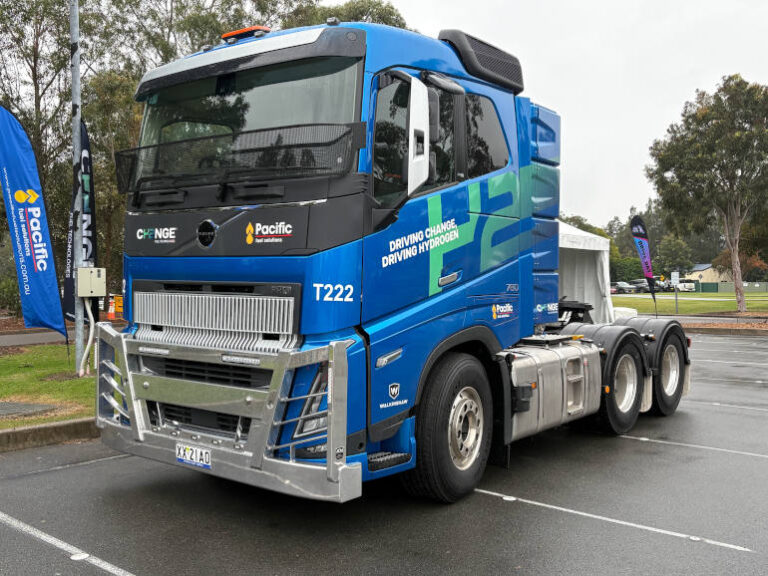
Change Fuel Tech also used TruckShowX to display a newly converted 780hp truck developed for Pacific Fuel Solutions.
The vehicle was built to transport flammable liquids in Australia and had already been driven to the event following its first hydrogen refuelling in Melbourne.
Wishart said dual fuel could provide a particularly useful pathway for fuel and dangerous-goods transport.
Because the vehicle retains a conventional diesel engine and does not depend on a high-voltage electric drivetrain, it may be more suitable for entering fuel terminals, operating beneath loading gantries and transporting flammable products.
“This technology has found a bit of a niche in fuels and flammable liquids cartage,” he said.
The truck achieved hydrogen displacement of approximately 58 per cent while running without a trailer, although Wishart acknowledged that its real performance would need to be assessed under normal freight conditions.
Building fuel resilience
Beyond emissions, Wishart said hydrogen could help improve fuel security by providing fleets with access to an additional energy source that could potentially be produced domestically.
HW Richardson Group is already investigating hydrogen refuelling, electrification and alternative-fuel infrastructure through its network of approximately 125 fuel stops in New Zealand.
Dual-fuel trucks could help build demand for that infrastructure while giving drivers, technicians and operators experience with hydrogen storage and refuelling.
Wishart said the future of heavy transport would not be based on a single technology.
Battery-electric, fuel-cell, renewable diesel, hydrogen dual fuel and conventional diesel could all have a role depending on the payload, route, infrastructure and commercial requirements.
“The future of freight probably won’t be one technology,” he said. “It will be the operators selecting the right tools for the job.”
The immediate opportunity, he argued, was to deploy technologies that could reduce emissions without sacrificing fleet productivity.
“Reduce emissions, maintain productivity and strengthen resilience,” Wishart said. “You can do all three.”