

Artificial intelligence has been a popular topic in fleet management over the past two years, but many fleet operators have struggled to understand how it can deliver practical benefits beyond generating reports faster.
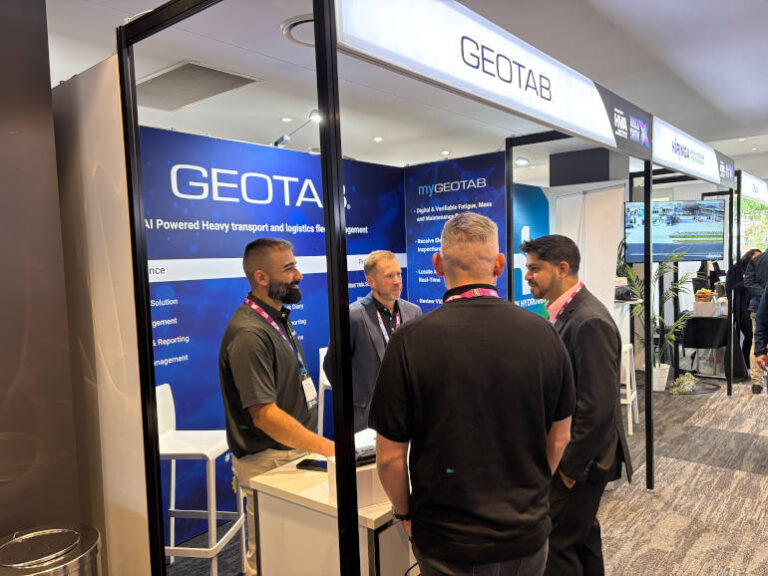
At Geotab Connect 2026, the conversation shifted from AI as a future concept to AI as a tool that is already changing the way transport operators interact with their fleet data.
According to Andrew Hintz, AVP, Heavy Transport, APAC Region at Geotab, the biggest change is that fleet managers no longer need to be experts in reporting systems to find the answers they need.
“I think what you’re seeing there with Geotab Ace and that generative AI side of it, and giving the customer, empowering the customer to actually talk to their data to get the results. I think that’s the future,” said Hintz.
“That is the future, but you’re seeing it now.”
The concept is simple. Rather than building reports, exporting spreadsheets and manually analysing data, fleet managers can ask questions in plain language and receive answers immediately.
The shift could have significant implications for an industry that generates enormous volumes of operational data every day but often lacks the time or resources to analyse it effectively.

Finding Fuel Theft in Minutes
One example highlighted by Geotab is fuel theft detection.
Traditionally, identifying suspicious fuel activity across a large fleet would require significant manual analysis of fuel and vehicle records. With AI, that process can be automated.
Alkan Ciftci, Business Development Manager at Geotab, described a recent use case where AI was tasked with identifying unusual fuel tank activity.
“An interesting use case, not too long ago, just a couple of weeks ago, where Geotab Ace was used to look for drops in the fuel tank of 10 per cent or more in less than a 10 minute range,” said Ciftci.
“Filtering through that data manually would be a mammoth task. By the AI doing it, they’re able to find any instances of siphoning.”
For fleet operators dealing with rising operating costs, the ability to quickly identify potential fuel theft could deliver immediate financial benefits.
Turning Vehicle Data into Action
Maintenance is another area where AI is helping fleets move beyond traditional reporting.
Modern trucks generate vast amounts of diagnostic information, but understanding which faults require immediate action can be challenging.
Through Geotab’s maintenance tools and AI capabilities, operators can quickly identify issues that may lead to vehicle downtime.
“Customers can ask in natural language, did any of my trucks have a fault code overnight, and be directed straight to which truck might be needing some work done,” said Ciftci.
Instead of waiting for a scheduled report or manually reviewing fault codes, maintenance teams can immediately focus on vehicles that require attention.
For transport operators where vehicle uptime is critical, faster access to information can mean the difference between a planned repair and a roadside breakdown.
Demurrage Reporting Without the Spreadsheet
Another emerging application is demurrage management.
Calculating loading and unloading delays has traditionally required transport businesses to combine geofence data, reports and spreadsheets before generating customer invoices.
According to Ciftci, AI is dramatically reducing the time required.
“Geotab Ace has cut down the time to the resolution in terms of invoicing the customer for your additional time from potentially an hour down to minutes,” he said.
“We have customers who are using this going straight to Geotab Ace, saying, ‘Can you calculate the demurrage time for customer X?’ and getting a report instantly that they can then use to invoice their customers.”
For transport businesses operating on tight margins, recovering detention and demurrage charges more efficiently can have a direct impact on profitability.
The Next Evolution of Telematics
The heavy transport sector has spent the past decade adopting telematics to collect data. The next challenge is extracting value from that information.
Historically, that required specialist knowledge, report writing skills and significant administrative effort. AI is beginning to remove those barriers.
Rather than spending time searching for information, fleet managers can focus on making decisions based on the answers they receive.
Hintz believes this represents a fundamental shift in how transport operators will interact with fleet technology.
“Operators that have taken the opportunity to come across and try Geotab, MyGeotab and Geotab Ace, they are now seeing how much easier it can be and how much better the data is,” he said.
For an industry under constant pressure to improve safety, reduce costs and maximise vehicle uptime, the ability to simply ask questions of fleet data may prove to be one of the most significant developments in fleet technology since the introduction of telematics itself.