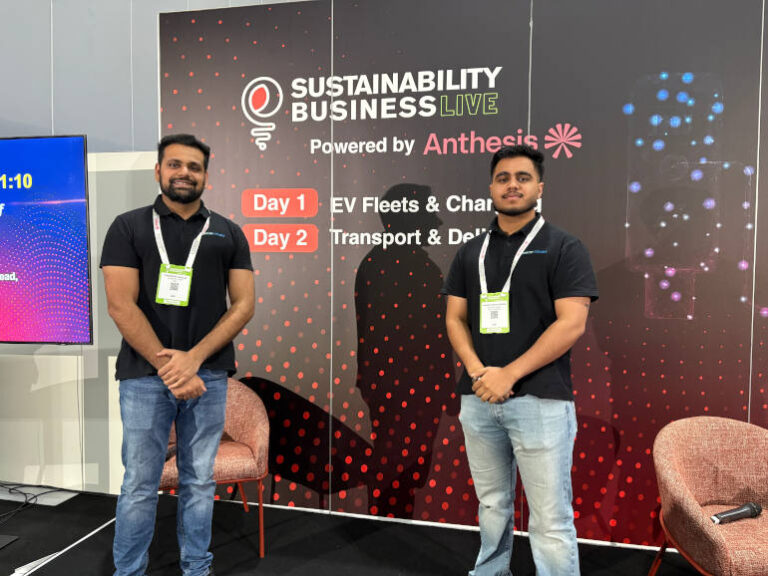
One of the strongest insights from a conversation with the Co-Founders of Country Fleet at Sustainability Live Business was the tip that payload often matters more than range in last-mile delivery applications.
Fleet Managers frequently focus on battery size and driving range when evaluating electric trucks. However, operators like Country Fleet spend their days dealing with something much more practical: how much product the truck can legally carry.

The company operates electric vehicles across a variety of delivery tasks including furniture, appliances, whitegoods and retail freight. Through operating multiple electric truck brands, the founders have learned that small differences in tare weight can have a major impact on productivity.
“We’ve got Fotons, we’ve got JAC Motors, we’ve got LDV vans, Ford E-Transits,” said Lakshay Ahuja, Cofounder of Country Fleet.
The business has also trialled other electric truck brands and continues evaluating new models entering the market.
Rather than simply comparing range figures, Country Fleet looks at how each vehicle performs in a real delivery operation.
“If you get a truck for a car licence, you’ll get a payload of almost 1.2 or 1.3 tonne,” explains Jaskirat Singh Ghuman, Cofounder at Country Fleet. “That carries almost many sectors’ payloads.”
The founders contrasted that with some other electric truck options where battery weight and vehicle design can significantly reduce available payload.
“If you get a car licence truck with only 250 kilograms of payload, you can’t do deliveries with it,” Ghuman said.
For Country Fleet, the issue is not which brand is best. The lesson is that Fleet Managers need to understand the relationship between Gross Vehicle Mass, tare weight and usable payload before making purchasing decisions.
A truck may have sufficient range to complete a route, but if it cannot carry the required load, it is not fit for purpose.
The same challenge applies across different delivery sectors. A vehicle delivering flat-pack furniture may have very different payload requirements to one delivering parcels or consumer electronics.
According to the founders, these are the kinds of lessons that are difficult to discover from spreadsheets alone.
Theoretical route assessments may show that an electric vehicle can complete the distance required, but they rarely reveal how operational requirements such as payload, licensing categories, loading characteristics and driver preferences affect productivity.
That knowledge has come from operating electric trucks every day, speaking with drivers and matching vehicles to specific customer tasks.
As Country Fleet continues expanding its electric fleet, the founders remain focused on selecting vehicles based on practical outcomes rather than headline specifications.
“Looks good on paper, but we really need to see, drive and feel how it is,” confirms Ghuman.
That approach may explain why Country Fleet has been able to deploy electric trucks successfully across multiple states and delivery applications while many organisations are still analysing whether the transition is possible.