
Fuel efficiency is often discussed through the lens of engine technology, aerodynamics, telematics and maintenance. All of these matter. But one of the biggest variables in any fleet is still the person behind the wheel.
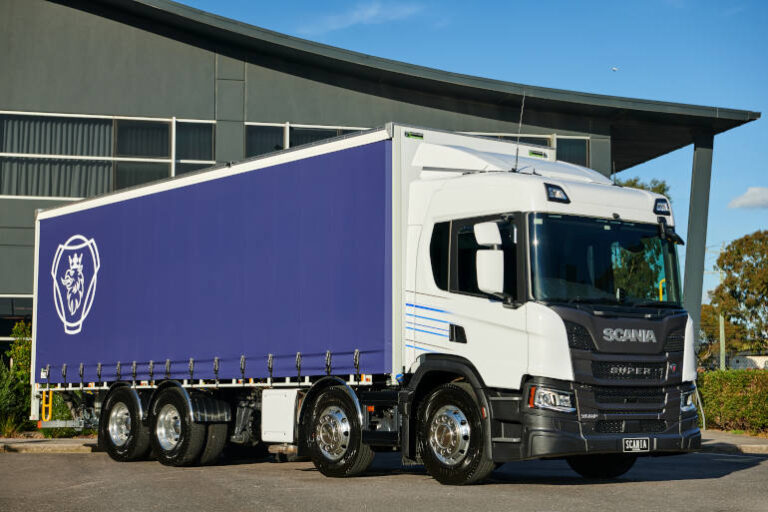
During a first drive of Scania’s new Super 11-litre truck range, a Scania driver trainer explained that the goal of driver training is not to teach experienced drivers how to drive. It is to help them identify safer and more efficient ways to use the vehicle.
“For us as driver trainers at Scania, we’re not looking to teach people how to drive,” the trainer said. “We’re just trying to perhaps show them that there’s a safer, more efficient way of driving.”
That distinction is important for fleet operators. Many drivers already have years of experience, but small changes in behaviour can still reduce fuel use, lower wear and tear, improve safety and reduce stress.

The best drivers are still willing to learn
The trainer said the difference between a good driver and a less effective driver is often attitude.
“Generally, a good driver is one who’s still willing to learn,” the trainer said.
For fleet managers, this is a useful starting point. Driver development should not be positioned as criticism. It should be framed as a professional skill improvement program, similar to refreshing safety procedures or learning how to use new vehicle technology.
Modern trucks are fitted with advanced braking systems, automated transmissions, driver assistance technology and fuel efficiency tools. Drivers who understand how these systems work will usually get better results than drivers who continue to operate every vehicle the same way they did 10 or 20 years ago.
Drive proactively, not reactively
One of the key messages from the Scania trainer was the need to move from reactive driving to proactive driving.
Reactive driving is when the driver accelerates, brakes, reacts late and constantly responds to what is immediately in front of the truck. Proactive driving means looking further ahead, reading the traffic, anticipating traffic lights, and reducing the number of unnecessary inputs.
“Being more efficient is being more proactive in your driving behaviours rather than reactive,” the trainer said.
In practice, this means asking simple questions all day:
- How long has that traffic light been green?
- Is the traffic ahead already slowing?
- Is there a roundabout, pedestrian crossing or intersection coming up?
- Can I back off now instead of braking harder later?
- Can I keep the truck rolling instead of stopping completely?
For operators, proactive driving should be treated as both a fuel-saving and safety practice. The same behaviour that saves fuel often increases following distance, reduces harsh braking and gives the driver more time to respond.
Do not accelerate towards a red light
The simplest fuel-saving tip from the drive was also one of the most powerful: do not accelerate towards a red light.
“If this light up here was red, my suggestion would be to take your foot off the accelerator,” the trainer said. “You don’t accelerate towards a red light, because that’s unnecessary acceleration. You can’t go anywhere anyway, because the light’s red.”
This habit is common in passenger cars and trucks. Drivers keep accelerating until the last moment, then brake heavily. In a heavy vehicle, the cost of that behaviour is much higher because more energy is required to build speed and more braking effort is required to slow the mass.
The better approach is to back off early, let the truck roll, and keep momentum where possible. If the light changes before the truck arrives, the vehicle may already be moving and can accelerate again more smoothly.
For fleets, this is a practical coaching point that can be reinforced with telematics data, driver scorecards and in-cab training.
Coasting creates “free kilometres”
Scania places a strong emphasis on coasting. The trainer described it as one of the major opportunities for fuel savings.
“What Scania tries to introduce into the mix is coasting,” the trainer said. “Trying to identify as many opportunities as you can a day to coast.”
The concept is easy to understand. When the driver takes their foot off the accelerator and the truck continues to cover distance, the truck is effectively travelling without adding more fuel input. The trainer described this as “free kilometres”.
“Whenever you take your foot off the accelerator and the truck covers distance, it’s called what we call free kilometres,” the trainer said. “Your metres add up to kilometres.”
The trainer gave a simple example. If a driver can coast for five kilometres a day, that becomes 25 kilometres a week, 100 kilometres a month and around 1,200 kilometres a year.
Across one truck, that is meaningful. Across a fleet, it becomes a major opportunity.

Smooth is not slow
Some drivers resist efficiency training because they assume it means driving slowly. The Scania trainer said that is not the point.
“It’s not slow, it’s smooth,” the trainer said.
Smooth driving means fewer sharp throttle inputs, less harsh braking, better anticipation and better use of vehicle momentum. It does not mean holding up traffic or failing to meet delivery windows.
The trainer said drivers can still drive at appropriate road speeds, but they should aim to reduce unnecessary acceleration and braking.
For operators, this is an important communication point. Fuel-saving programs can fail if drivers believe they are being asked to drive slowly or lose productivity. The better message is that smooth driving protects the truck, reduces stress, saves fuel and can often achieve the same arrival time.
The trainer used the example of cars or trucks that rush ahead, weave through traffic and then end up at the same traffic lights a few minutes later. In many cases, the extra effort has achieved little.
Use the retarder and auxiliary brakes deliberately
Braking systems are essential for safety, but they should be used correctly.
The trainer explained that some drivers leave auxiliary braking systems active all the time. While this may feel convenient, it can reduce fuel efficiency because the truck cannot coast properly.
“If you have your brake on all the time, you can’t coast prior to braking,” the trainer said.
The issue is that every time the driver lifts off the accelerator, the braking system may engage even when braking is not needed. The trainer gave the example of a driver taking their foot off the accelerator 100 times a day but only needing to brake 50 of those times. If the auxiliary brake is left active, it may create unnecessary braking events.
That increases wear and reduces efficiency.
The better approach is to leave the truck free to coast when appropriate, then use the retarder, engine brake or service brakes when braking is actually required.
For fleets, this should be part of vehicle familiarisation training. Drivers need to understand how braking systems are designed to work in the specific vehicle they are operating.
Rely on torque, not unnecessary revs
Modern diesel engines are designed to deliver strong torque at low revs. The trainer explained that drivers do not need to use full accelerator input all the time.
“With the Scania accelerator, it is quite sensitive, so you don’t need to floor it all the time,” the trainer said.
The trainer said Scania’s peak torque is available below 1,500 rpm, and drivers should rely on torque rather than constantly chasing horsepower.
This is particularly relevant in modern automated manual trucks where the engine and gearbox are designed to work together. Heavy throttle input can prompt kick-down or higher revs when they are not needed. A smoother throttle input allows the truck to stay in a more efficient operating range.
For drivers, the practical tip is simple: use enough throttle to do the job, not more than the truck needs.
Leave space and look further ahead
Fuel efficiency and safety are closely linked. The more space a driver leaves, the more time they have to respond and the more opportunity they have to coast.
The trainer reinforced the importance of following distance, particularly in wet conditions and heavy traffic. Driving too close reduces reaction time and forces the driver into harder braking.
For fleet operators, this is one of the easiest behaviours to monitor and coach. Harsh braking, tailgating, late braking and rapid acceleration are often symptoms of the same issue: the driver is not giving themselves enough time and space.
Better following distance also supports fatigue reduction because the driver is no longer constantly reacting at the last second.
Use driver scores as coaching tools
Many modern trucks provide driver performance scores or telematics reports. The Scania trainer said the driver score rates efficient and safe behaviours, including coasting, braking and hill driving.
“The Scania driver score is going to rate you on the efficient behaviours and safe behaviours that you undertake while you’re driving,” the trainer said.
The trainer also said some companies are now using reports and reward systems based on driver behaviour data.
For fleet operators, the key is to use the data constructively. Driver scorecards should not only be used to criticise poor performance. They can also identify good drivers, support reward programs, and show where training is producing measurable improvements.
According to the trainer, a 20 per cent improvement in driver support score can result in fuel savings of up to five per cent.
In a large fleet, that can represent a significant operating cost reduction.
Operators must remove pressure where they can
Driver behaviour is not only a driver issue. It is also an operating culture issue.
The trainer said drivers often break rules or drive aggressively because they feel pressure to meet schedules.
“I’m a big believer that drivers don’t generally break the rules for their benefit,” the trainer said. “They’re breaking it because they’ve got time schedules to meet, or they feel like they’re under pressure to get somewhere quicker.”
This is an important point for fleet operators. A driver can be trained to drive more safely and efficiently, but unrealistic schedules, poor route planning, tonnage-based incentives or “finish early, go home” cultures can undermine that training.
If the business rewards speed over safety, drivers will respond accordingly.
Operators looking to save fuel and improve safety should review scheduling, delivery windows, incentive structures and route planning. The aim should be to give drivers enough time to do the job safely and efficiently.
Tips for drivers
Drivers can improve fuel efficiency and safety by focusing on a few practical habits.
- Look further ahead and read traffic early.
- Back off before red lights, roundabouts and congestion.
- Coast whenever it is safe and practical.
- Avoid unnecessary acceleration.
- Use auxiliary braking systems deliberately, not constantly.
- Rely on low-rev torque rather than heavy throttle input.
- Leave more space in front of the truck.
- Use the driver score as feedback, not criticism.
- Aim to be smooth rather than aggressive.
- Remember that arriving stressed and only seconds earlier is rarely worth the fuel, wear or risk.
Tips for fleet operators
Fleet operators also have a major role to play.
- Provide driver training when new vehicles enter the fleet.
- Use telematics and driver scores to coach, not just discipline.
- Reward safe and efficient driving.
- Review schedules to remove unnecessary time pressure.
- Avoid incentive systems that encourage rushing.
- Talk to drivers about fuel use in practical terms.
- Track improvements before and after training.
- Make coasting, smooth driving and anticipation part of toolbox talks.
- Ensure drivers understand how to use retarders, engine brakes and automated transmissions properly.
- Treat safety and fuel efficiency as connected outcomes.
The message for fleets
The biggest lesson from the Scania driver trainer was that fuel saving does not come from one major change. It comes from hundreds of small decisions made throughout the day.
- Taking the foot off the accelerator earlier.
- Letting the truck coast.
- Leaving more space.
- Using the braking systems properly.
- Trusting the torque.
- Avoiding the temptation to rush.
Each action may seem small in isolation. But across a full day, a full fleet and a full year, the savings can be substantial.
For fleet operators, the opportunity is not only in buying more efficient trucks. It is in helping drivers get the best out of them.
The technology matters. The training matters. But the driver still brings it all together.