
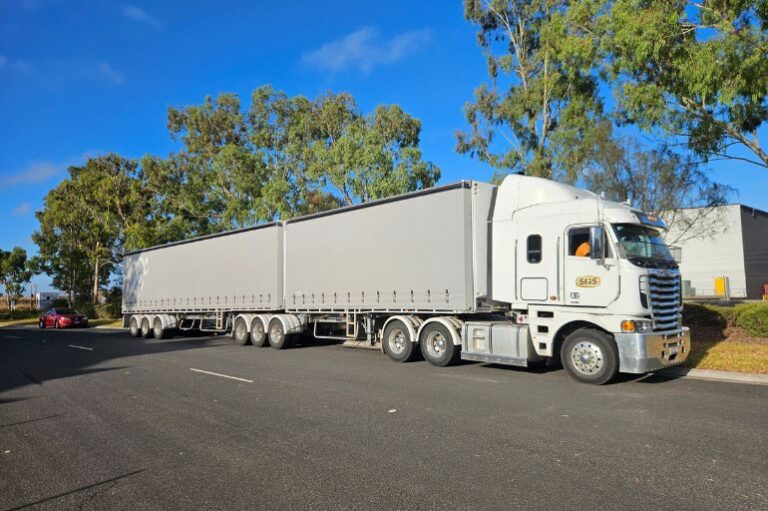
For an industry often characterised by tight margins and relentless pressure on costs, one transport operator believes the sector may be focusing on the wrong numbers.
Speaking at Sustainability Business Live in Melbourne, Luke Sadler, Director at SGS Logistics, challenged the traditional transport mindset that prioritises short-term profitability over long-term investment in technology, people and customer service.
According to Sadler, many operators spend so much time chasing today’s margin that they miss opportunities to build stronger and more sustainable businesses for the future.
“I think there’s a mistake to only focus on margin. By focusing on margin you take shortcuts, you’re looking to cut things rather than to invest.”
Luke Sadler, Director at SGS Logistics
SGS Logistics operates dedicated transport fleets across Australia, providing customer-specific vehicles, drivers, technology and operational support. The company works across a diverse range of sectors including waste management, container deposit schemes, facilities management and specialised collection services.

Having attended TruckShowX earlier this year, Sadler said the event reinforced his view that transport businesses need to become more proactive in adopting new technology and operational practices if they want to remain competitive.
While he acknowledged that technologies such as artificial intelligence, telematics and vehicle electrification are changing the industry, he believes the real opportunity lies not in inventing these technologies but in understanding them and applying them effectively.
“What I realised is that when it comes to being innovative, unless you’re designing that yourself, I’m not sure you’re innovative by using it,” he said.
“The innovators are the people who invent it. I think where you can perhaps make that stuff a point of difference is by making yourself an expert in it, by understanding what’s available and then knowing how best to use it.”
Sadler believes parts of the Australian transport industry have been slow to embrace change compared with international markets.
“I think in Australia, at least, the logistics industry has traditionally been quite behind that sort of stuff,” he said. “You hear people talking about China being years ahead. When it comes to things like safety, people talk about Europe being miles ahead.”
For Sadler, investing in new technology, safety systems and operational improvements should not be viewed purely through the lens of immediate return on investment. Instead, he encourages transport operators to think in terms of years rather than months.
“Technology might be expensive to implement now, but be prepared that you might not get a return on it for three years, five years, seven years,” he said. “But if you know you’re going to get a return on it eventually, then rather than pocketing that money now, invest that money now.”
He argues that this long-term approach ultimately delivers stronger customer relationships, lower operating costs and a more resilient business.
“Play the long game, and that’ll make you a better business long term,” Sadler said. “I think it’ll help you keep your customers. I think it’ll help you cut your costs. It just takes longer because you’ve got to make that initial investment.”
Sadler also warned against creating workplace cultures where cost reduction becomes the sole focus of management.
“I know people that work for some really well-known transport companies and they work really long hours, they’re short-staffed, their bosses are on them every single day asking, ‘What’s that cost? What’s that cost? What’s that cost?'” he said.
“I don’t really see what the long-term investment is in running your business like that.”
Instead, he believes businesses that invest in people, service quality and innovation will be better positioned to attract customers and talent.
For smaller operators, that approach can create opportunities to compete against larger organisations.
“That fortunately for us allows operators like us, who are a little bit smaller and a bit more agile and a bit more forward thinking, to hopefully come in and fill that gap,” he said.
As the transport industry navigates growing expectations around safety, sustainability and technology adoption, Sadler’s message is straightforward: chasing margin alone is not a growth strategy.
The businesses that succeed over the next decade may be those willing to sacrifice a little profit today in exchange for a stronger, more competitive business tomorrow.