




When linehaul fleets look for fuel savings, attention often turns first to the prime mover.
Engine specification, cruise control settings, driver behaviour, aerodynamic packages and route planning all matter. But a TruckShowX case study has highlighted another area that can quietly undermine efficiency: the trailer.

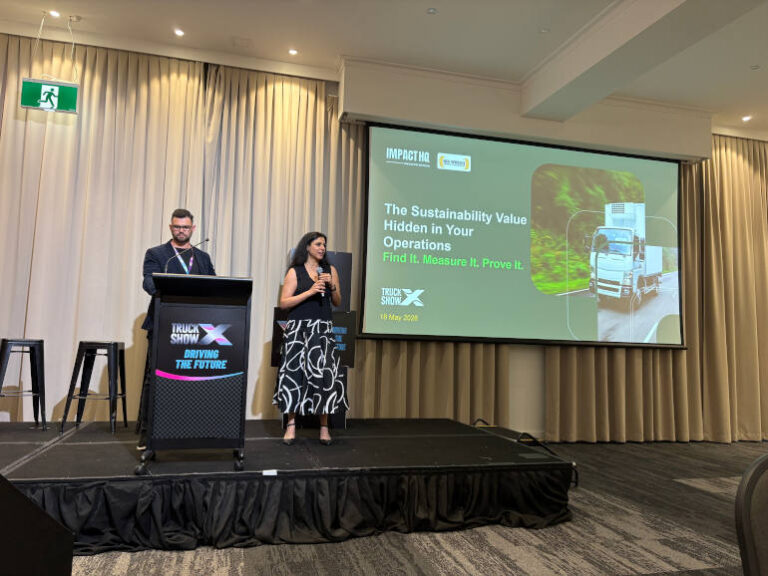
Speaking during a practical TruckShowX session, Lachlan Van de Haar, CEO of Big Wheels Truck Alignment, said linehaul combinations need to be treated as one rolling system rather than a prime mover towing a trailer that is largely left to its own devices.
“For the trailer, we didn’t just let them follow in the breeze,” Van de Haar said.
“We adjusted the axle square and the toe for all three trailer axles to ensure the whole unit was tracking perfectly — like a full 360-degree approach.”
The message is straightforward. A precisely aligned prime mover can still be working harder than necessary if the trailer is scrubbing tyres, running out of square or creating drag across its axle group.
A linehaul case study
The case study involved a Hawk Logistics operation running frequent Melbourne-to-Sydney services with three-axle prime movers towing three-axle refrigerated trailers.
Big Wheels Truck Alignment identified the configuration as particularly sensitive to tracking issues, given the distance travelled, the high-frequency work and the combination’s multiple axles.
Using the same before-and-after data approach applied in an earlier urban-delivery study, the team adjusted both the truck and trailer to suit the linehaul task.
On the prime mover, the work included camber, caster and toe settings, along with correction of the drive-axle thrust angle.
“Critically, we corrected the out-of-square alignment and the thrust angles of the drive axles,” Van de Haar said.
The trailer received equal attention. Axle squareness and toe were adjusted across all three trailer axles so the complete vehicle combination tracked in the intended direction.
The reported outcome was a 10.1% reduction in fuel use and associated emissions, equal to a stated saving of about 7.3 litres of diesel per 100 kilometres.
The trailer can create fuel drag
Poor alignment is often discovered through tyre wear. But by the time tyres show obvious signs of scrub or irregular wear, the vehicle may already have been wasting fuel for thousands of kilometres.
“Poor alignment introduces drag into a vehicle,” Van de Haar said. “If you’re seeing excessive tyre wear and things like this, then obviously something is dragging, which is also going to cause an inefficiency.”
For a linehaul fleet, that inefficiency can be magnified by distance.
A trailer that is not tracking squarely behind the prime mover can add rolling resistance across multiple tyres and axles. The combination may appear to operate normally, but every kilometre can involve added drag, higher fuel use and accelerated tyre wear.
That is why a basic wheel alignment check on the steer axle is not enough for a multi-axle combination.
The trailer’s axle geometry, tracking path and relationship with the prime mover all need to be considered.
Treat the combination as one vehicle
The case study reinforces a broader maintenance principle for heavy vehicles: fuel efficiency is not only determined by what happens under the bonnet.
The entire combination contributes to the result.
For linehaul operators, that means alignment programs should consider:
- prime-mover camber, caster and toe;
- drive-axle thrust angle and axle squareness;
- trailer axle alignment and toe;
- tyre wear patterns across every axle group;
- tyre pressures and tyre condition;
- the specific duty cycle, load profile and operating roads.
Van de Haar said the approach needs to be based on the truck’s real work, rather than applying one generic setting across every vehicle.
“It’s purpose-building the vehicle setup based on what it’s doing,” he said.
“We sat down and listened to the customer’s specific needs and their pain points regarding tyre life and what the vehicle was doing.”
For a refrigerated linehaul combination travelling between Melbourne and Sydney, that is different from a rigid truck undertaking stop-start metropolitan deliveries. The settings, risks and performance measures should reflect the task.
The business case extends beyond diesel
Dr Richa Vijayraj, founder of Impact HQ Australia, said the case study also shows how practical maintenance work can support a wider operational and sustainability strategy.
“Fuel and tyres are two of the highest costs for running a business,” Vijayraj said. “When you have your tyres running for longer, it’s also a huge benefit for the environment, because tyre recycling itself is a huge challenge.”
That combination of lower diesel consumption, longer tyre life and reduced waste gives fleets more than a workshop saving.
It can support customer sustainability discussions, tender responses and Scope 3 emissions reporting requirements, particularly where transport operators are being asked to show measurable improvements in their supply-chain footprint.
The TruckShowX lesson is that linehaul efficiency cannot be judged solely by the prime mover’s fuel report.
A trailer that is not tracking properly can become an ongoing fuel penalty. Aligning the entire combination may be one of the more practical ways fleets can reduce cost, tyre waste and emissions without changing vehicles or waiting for new technology.