
Small specification choices across tyres, axles and tare weight can add up to meaningful fuel and productivity gains, according to Hendrickson Asia Pacific Executive Manager – Engineering Andrew Pendlebury.
The path to a more efficient freight task is not always a new powertrain or an entirely new vehicle platform. For many operators, the gains are already available through better decisions about the tyres, axle configuration, driveline and components selected for a truck and trailer combination.

Speaking at TruckShowX, Pendlebury said fleets should look beyond individual components and consider how every specification decision affects rolling resistance, tare weight, fuel burn and tyre life.
“Everything that we spec on that vehicle has an impact on the fuel that we burn, the tyres and how quickly or slowly that we wear our tyres,” Pendlebury said. “The bigger the fleet, the bigger the impact.”
Tyres are an efficiency issue, not just a maintenance issue
Pendlebury said tyre pressure management remains one of the most immediate opportunities for fleets to improve operating efficiency.
He pointed to North American studies that found one in five trailer operators had tyres underinflated by 20 psi compared with the tyre manufacturer’s recommendation. One in four also had dual tyres with a pressure mismatch of five psi or more.
That mismatch matters because tyres with different pressures operate at different rolling circumferences, creating drag and increasing wear.
“When you start to mismatch tyres, you start to introduce drag,” Pendlebury said. “Under-inflation impacts our rolling resistance. Thirty to 40 per cent of the energy generation within a combination is to overcome rolling resistance.”
A five-psi difference between dual tyres can create an eight-millimetre circumference difference, he explained. While that sounds minor, the tyres are forced to travel different distances despite being mounted together.
The result can be irregular wear, increased rolling resistance and higher fuel use.
“As we are under-inflated, or as we’ve got mismatches, it’s an efficiency loss straight off the bat,” he said.
Over-inflation creates a different problem, accelerating tyre wear. Pendlebury said tyre life can be reduced by between seven and 15 per cent, depending on the degree of over-inflation.
The lesson for fleet operators is that tyre pressure should be managed against actual load, duty cycle and application—not simply set once and forgotten.
Weight savings deliver benefits even when the truck is empty
Tare weight is often discussed only in terms of payload. A lighter vehicle can carry more freight, reduce the number of trips required for a task, or create more operational flexibility.
But Pendlebury said the benefit continues when the vehicle is empty or partially loaded.
“If you’ve taken tare weight out of the vehicle, it’s still lighter,” he said.
Using a 500kg weight reduction as an example, Pendlebury said the saving could equate to around 1.5 per cent lower fuel use. For a truck travelling 1,200 kilometres a week, that could represent seven to eight litres of fuel per week, or about 360 litres per combination each year.
That may sound modest in isolation, but the fleet impact grows quickly.
“You do that every week of the year, you’re looking at 360-odd litres of fuel per combination,” he said. “Run that in a 10-combination fleet and you’re into the thousands of litres. It makes a big impact.”
Is every 6×4 really necessary?
Axle selection was another area Pendlebury identified as an overlooked opportunity.
He said lift axles and 6×2 configurations can reduce rolling resistance and driveline losses in applications where full tandem-drive traction is not required.
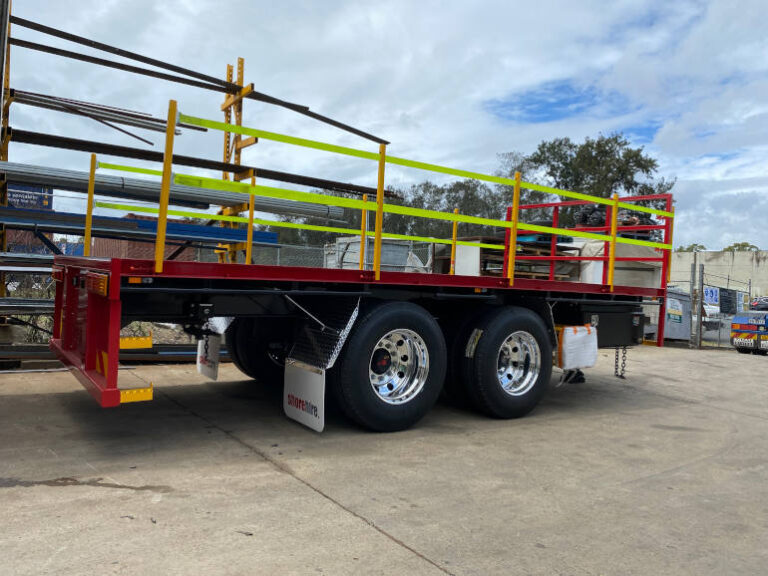
For a conventional general-freight operation, shifting from a 6×4 to a 6×2 can reduce weight and remove some of the losses associated with an additional driven axle.
“If we go from 6×4 to 6×2, now we’re talking something in the realm of three-and-a-half per cent fuel saved because we’ve removed all of our losses from our driveline,” Pendlebury said.
“When we’ve got gears rubbing against each other, there’s loss there.”
A lift axle can add another layer of benefit. When an axle is raised, its tyres are no longer contributing to rolling resistance or wear.
The decision will not suit every application. Traction requirements, road conditions, load distribution, route profiles and operating environments all matter. But Pendlebury’s point was that many fleets may default to conventional specifications without reassessing whether they remain appropriate for the work being performed.
“Do we really need that 6×4? Could the job be done with the 6×2?” he said.
The value is in the accumulation
Pendlebury’s central message was that fleet efficiency does not always depend on a single breakthrough.
A correctly managed tyre, a lighter component, a more suitable axle layout and a lift axle can each appear to be small decisions. Across an entire combination, however, their gains can compound.
“Chasing those one-per-centers and chasing some of those small improvements does give us a great efficiency gain,” he said.
“It’s not always about making that big leap. Sometimes the one-per-centers do add up and make a big difference.”
That is particularly relevant for large combinations and high-utilisation fleets, where incremental reductions in rolling resistance and tare weight are repeated across thousands of kilometres every week.
A glimpse of the next generation
Pendlebury also used his presentation to outline Hendrickson’s Electrax e-axle system, developed with Dana for medium-duty electric trucks.
The system has been designed as a purpose-built electric drive axle rather than an electric motor attached to a traditional driveline. Pendlebury said that approach can improve efficiency by removing some conventional driveline losses and allowing engineers to optimise the axle, suspension, braking and traction package as one integrated system.
But the future-focused technology reinforced rather than replaced his broader message.
Fleet efficiency can be improved through new electric architectures and advanced component design. Yet operators do not need to wait for the next generation of vehicles before making progress.
The opportunity begins with a more rigorous question at the specification stage: what does this truck or trailer actually need to do?
For fleets, the answer may be found not only in the engine bay or battery pack, but underneath the chassis.