

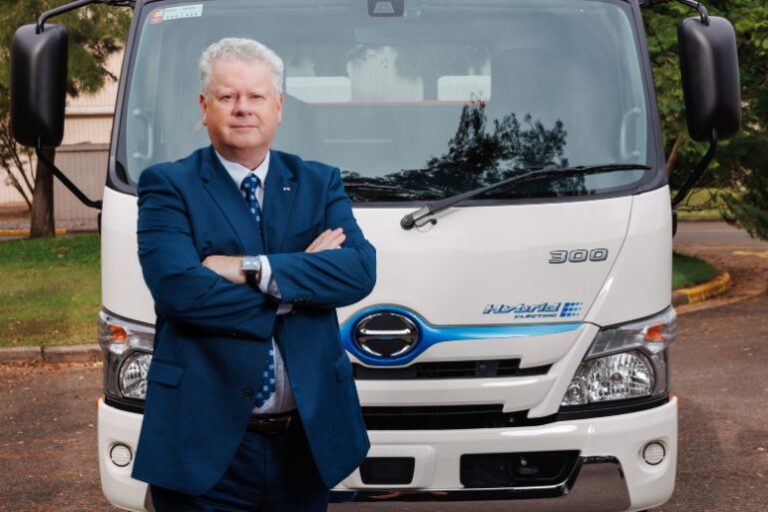
Hino Australia President and CEO Richard Emery has called for a more balanced approach to transport policy, arguing that government cannot focus solely on emissions reduction without considering freight productivity, fleet renewal and inflation.
Speaking at Hino Australia’s media business briefing, Emery said the truck industry needed stronger representation in government and a policy framework that recognised the economic role of road freight.
“I think it’s about time that the industry calls for renewed focus on the transport portfolio,” Emery said. “For me, the best way to do this is via a dedicated Transport Minister in Cabinet.”

Emery said the current transport portfolio was too broad for the sector to receive the attention required across safety, emissions, efficiency and productivity.
“We really need a stronger voice at the table in government than we currently have — a Minister who can oversee the industry and really start to acknowledge and give focus to the industry is what’s required, whether it’s safety, emissions, efficiency or productivity.”
The comments come as governments consider how to accelerate the move to low- and zero-emissions heavy vehicles, while freight operators continue to face higher operating costs, driver shortages and an ageing national truck fleet.
Emery said the transition to cleaner trucks was necessary but warned against policy settings that could make replacement vehicles less practical or less affordable for operators.
“We need a practical and balanced regulatory transition to low and zero emissions vehicles that potentially goes off the rails if the government takes an overly aggressive stance,” he said.
“The reality is, because of the added cost and the loss of load or payload capacity, many operators will keep their old trucks longer than they normally would if the government forces a change too early.”
That, he said, could worsen rather than improve the age profile of Australia’s truck fleet.
“We all understand that an ageing truck fleet is less safe, is less efficient and is less productive than a younger fleet,” Emery said.
His comments align with wider industry concern that fleet renewal needs to be treated as a productivity measure, not only as an emissions policy. Newer diesel, hybrid, battery-electric and hydrogen trucks can offer improved safety technology, lower maintenance exposure and better fuel efficiency, but the business case varies significantly by application.
For freight operators, payload remains central. A truck that carries less freight or costs substantially more to operate can increase the cost of moving goods, particularly where operators work on thin margins.
Emery said the Federal Government faced a difficult balance between productivity, inflation and transport decarbonisation.
“There is an emerging dysfunction in the federal level between, on one hand, controlling inflation, you have a drive for productivity, and then also managing the emissions transition in transport,” he said.
“If we push the transition too fast with added cost and less productivity, then that’s going to be inflationary.”
He said a faster-than-practical transition could result in higher transport costs being passed through supply chains.
“The transport industry is not going to absorb that added cost. It can’t, as we’ve seen, very tight margins in our industry,” Emery said.
The argument is not that the heavy vehicle sector should delay emissions reduction indefinitely. Rather, Emery’s position is that policy should support a staged transition that helps operators renew ageing vehicles with the technology that is practical for their work today.
That includes hybrid trucks, newer low-emissions diesel models and zero-emissions vehicles where duty cycles, infrastructure and payload requirements make them viable.
Hino has seen growing interest in its Hybrid Electric range, according to Emery, while he said fully electric truck uptake had not yet reached a level that suggested broad market readiness across all applications.
“We’ve seen a solid month-on-month increase in interest in our hybrid electric product,” he said.
For fleet buyers, the policy debate has direct implications. The pace and design of emissions policy will influence vehicle replacement timing, residual values, payload decisions, operating costs and the ability to maintain service levels.
Emery’s message is that transport policy needs to create outcomes across all of those areas: a younger and safer fleet, lower emissions, stronger productivity and freight costs that do not add unnecessary pressure to the cost of living.