





A faster transition to low- and zero-emissions trucks could have the unintended effect of extending the life of Australia’s ageing truck fleet unless government policy also addresses cost, payload and productivity.
That is the view of Hino Australia President and CEO Richard Emery, who used the manufacturer’s recent business briefing to argue for a more practical approach to freight decarbonisation.

Emery said the truck industry accepted that it needed to reduce emissions, but warned that policy settings focused only on accelerating zero-emissions vehicle uptake could make replacement decisions harder for many operators.
“We need a practical and balanced regulatory transition to low and zero emissions vehicles that potentially goes off the rails if the government takes an overly aggressive stance,” Emery said.
“The reality is, because of the added cost and the loss of load or payload capacity, many operators will keep their old trucks longer than they normally would if the government forces a change too early.”
The concern is particularly relevant for small operators and fleets working in applications where payload, range, charging access and duty cycle make battery-electric alternatives difficult to justify today.
A higher purchase price, combined with reduced payload in some heavy-duty applications, can change the economics of replacing an older diesel truck. Rather than moving into a new low- or zero-emissions vehicle, operators may decide to keep existing equipment in service for longer.
Emery said this could worsen a problem that already affects the industry.
“We all understand that an ageing truck fleet is less safe, is less efficient and is less productive than a younger fleet,” he said.
The Truck Industry Council has also made fleet age a central policy issue. Its March 2026 report said Australia’s truck fleet had a median age of 14.8 years and projected that one-third of trucks could be more than 23 years old by 2030 under a business-as-usual scenario.
For fleet buyers, the debate is less about whether emissions reduction is necessary and more about how the transition is designed. A policy framework that supports only the end-state technology may overlook the immediate benefits of replacing older vehicles with newer Euro 6 diesel, hybrid or zero-emissions trucks suited to the task.
Emery said a narrower emissions focus risked overlooking the relationship between fleet renewal, freight productivity and inflation.
“The government seems to be unable to tackle this topic by bringing the average age of trucks down, because they’re so fixated on a direct leap to zero emissions,” he said.
“The reality is the government does not have the budget flexibility or capacity to make fundamental shift in adoption of low or zero emissions vehicles at this point.”
He argued that government needed to balance three priorities: transport productivity, inflation control and the emissions transition.
“There is an emerging dysfunction at the federal level between, on one hand, controlling inflation, you have a drive for productivity, and then also managing the emissions transition in transport,” Emery said.
“If we push the transition too fast with added cost and less productivity, then that’s going to be inflationary.”
The logic is straightforward. Freight operators work on thin margins. If replacement trucks cost more, carry less freight or require expensive new charging and depot infrastructure, those costs are likely to flow through the supply chain.
“The transport industry is not going to absorb that added cost. It can’t, as we’ve seen, very tight margins in our industry,” Emery said.
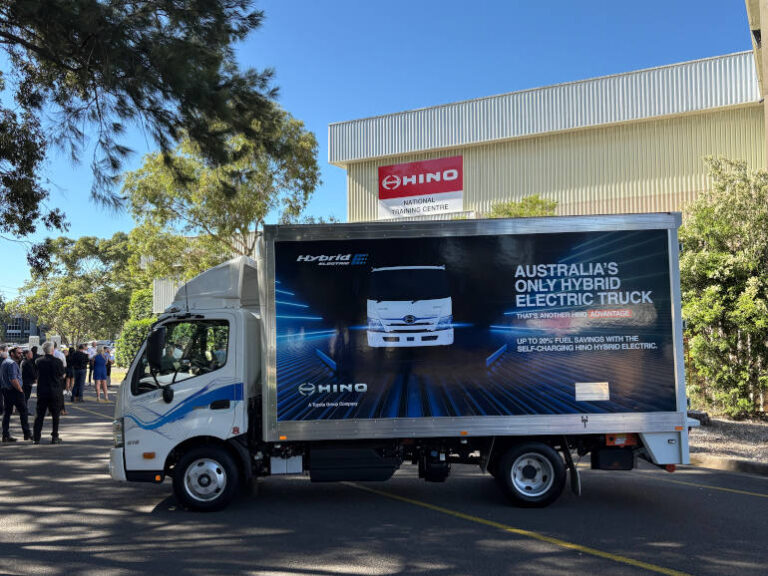
Hino’s position is not a case for delaying all investment in low- and zero-emissions trucks. Emery said the company had seen steady interest in hybrid-electric models, particularly where the operating profile suits the technology.
“We’ve seen a solid month-on-month increase in interest in our hybrid electric product,” he said.
The more practical policy question is whether emissions programs should also support fleet renewal across a range of technologies. That could include newer diesel trucks with lower emissions and modern safety systems, hybrids for stop-start urban work, and battery-electric or hydrogen vehicles where their operational case is established.
For government, the risk is that an emissions strategy without a fleet renewal strategy may leave more older trucks on the road for longer. For operators, the challenge remains finding a pathway that reduces emissions without sacrificing the payload, uptime and cost control that freight tasks require.