




Volvo Group Australia has built the first OEM electric trucks in Australia, marking an important manufacturing milestone at its Wacol plant in Queensland.
For some heavy vehicle operators, the news will not trigger an immediate move to battery-electric trucks. Many fleets are still working through range, charging, payload, route flexibility, capital cost, resale values and operational disruption.

But the significance of Volvo’s announcement extends beyond the first vehicles rolling off the production line. For diesel truck customers, mixed fleets and operators still watching the electric truck market from the sidelines, local production points to a broader shift in manufacturing capability, workforce skills, product support and long-term OEM commitment in Australia.
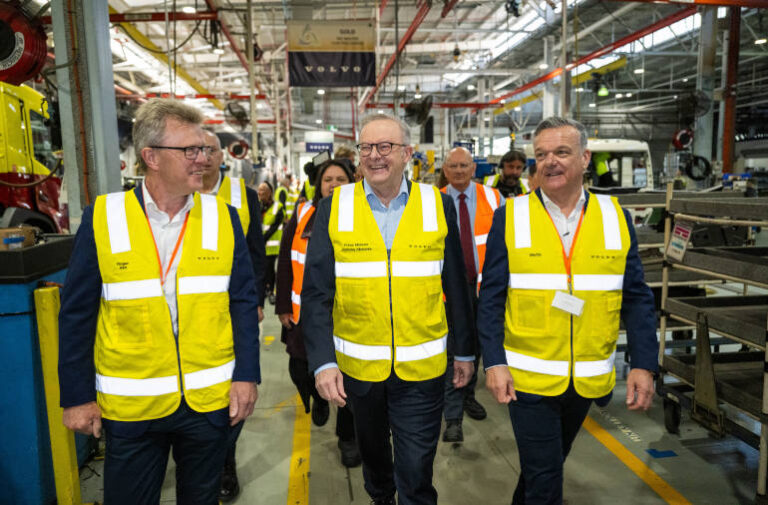
The first Australian-made Volvo electric trucks were built at the same Wacol facility where Volvo has manufactured trucks for Australian conditions for more than 50 years. The event was attended by Prime Minister Anthony Albanese, Roger Alm, Executive Vice President of Volvo Group and President of Volvo Trucks, Volvo Group Australia President & CEO Martin Merrick, Linfox CEO Mark Mazurek, Australian Made Campaign Chief Executive Ben Lazzaro, and Electric Vehicle Council CEO Julie Delvecchio.
Australia was selected by Volvo as the first country outside Europe to manufacture electric trucks. To prepare the local team, Volvo brought in international experts to train and upskill Australian workers, with the aim of building zero-tailpipe emissions heavy vehicles to the same standard as Volvo factories worldwide.
For fleet buyers, that matters because it shows the transition is no longer only about imported demonstration vehicles or small pilot programs. It is now connected to local manufacturing, local skills and local aftersales capability.
“This is a proud day for Volvo Trucks and for Australian manufacturing. For more than 50 years we have built Volvo trucks for Australian conditions here in Wacol, and today we have built the first electric truck ever manufactured by an OEM in this country,” said Martin Merrick, President & CEO, Volvo Group Australia.
“It proves what our people and our facilities are capable of. These trucks were built right here by an Australian team we have trained to a global standard. This is proof of concept, and a foundation we are ready to build on.”
For many operators, the practical question is not whether electric trucks are coming. It is when they will make sense for a specific route, contract, depot, payload and customer requirement.
Urban distribution, return-to-base operations and high-profile customer contracts are likely to move first. Long-haul, regional and specialist applications will take longer, particularly where charging infrastructure, axle weights, turnaround times and payload sensitivity are still unresolved.
That means diesel will continue to do the heavy lifting across much of the transport sector for some time. However, the skills and infrastructure being developed for electric trucks can still benefit customers running conventional heavy vehicles today.
Local training, a deeper technical workforce, stronger parts systems and greater investment in dealer support all improve the operating environment for Volvo customers, regardless of powertrain.
Volvo’s Wacol milestone is also part of a larger Australian investment program. The company will open its new National Parts Distribution Centre in Sydney this week, a 21,000 square metre facility and the first Volvo distribution centre globally to introduce automated storage and retrieval technology.
Together with the acquisition of Truck Centre WA in 2025 and construction of the new VCV Gold Coast Dealership, Volvo says these three investments represent approximately $400 million committed in Australia over the past 18 months.
For a Fleet Manager, that investment may be just as relevant as the electric truck announcement itself. Parts availability, dealer reach, workshop capability and uptime support remain key decision points when selecting heavy vehicles. The powertrain may change over time, but the need to keep trucks on the road does not.
Roger Alm, Executive Vice President of Volvo Group and President of Volvo Trucks, said local production reflected Volvo’s long-term commitment to the Australian market.
“Australia is an important market for Volvo Trucks, and building electric trucks here is a clear sign of our long-term commitment. It reflects Volvo Group’s confidence in Australian manufacturing and in the people behind it,” said Alm.
“We are convinced that electric trucks will play a key role in the future of transport. Producing them in Australia will help drive the sustainability transformation, while bringing us even closer to our customers and their needs.”
The first Australian-made Volvo electric trucks will be deployed by Linfox, giving the program a real-world fleet application from day one.
“As an Australian owned company, Linfox is proud to support the local economy deploying the first Australian made electric trucks into our fleet. We have been an early adopter of electric vehicles, beginning our sustainability journey more than a decade ago,” said Mark Mazurek, CEO, Linfox Australia and New Zealand.
“Today’s milestone is a prime example of what the industry can achieve in partnership with local manufacturers and government. These Australian made electric prime movers will ensure we continue to service our customers with a reliable fleet that is safe, secure, efficient and sustainable.”
For other heavy vehicle operators, the Linfox deployment will be watched closely. Early adopters will help prove where the technology works, what operating changes are required, and how electric prime movers perform under Australian fleet conditions.
That learning will be valuable even for fleets that are not ready to place orders. It will help shape future procurement decisions, contract discussions, depot planning and conversations with customers that are setting emissions targets in their supply chains.
Prime Minister Anthony Albanese said the project demonstrated the potential for local manufacturing linked to clean energy.
“My Government is backing a future made in Australia – investing in local jobs, manufacturing and industry,” said Albanese.
“We have all the resources to be a clean energy superpower – under the ground and in the sky – and projects like this show just what’s possible. Electric-made trucks built right here in Brisbane will keep Australia moving now and into the future.”
Volvo Trucks has said wider adoption will require more than vehicle availability. Supportive policy settings, harmonised road weight rules across states, procurement commitments, and investment in charging and grid infrastructure will all influence how quickly electric heavy vehicles become viable for more operators.
That is the important point for fleets not yet ready for electric trucks. The transition is not a single purchasing decision. It is a staged process involving vehicle suitability, infrastructure, energy supply, customer requirements, workshop capability and whole-of-life cost.
For now, many operators will continue to run diesel trucks while monitoring the development of electric options. Volvo’s Wacol milestone gives those fleets a clearer view of where the market is heading, while its broader investment in parts, dealerships and local capability is likely to be relevant to all Volvo customers.
The first Australian-made OEM electric trucks may not change every fleet replacement plan immediately. But they do show that heavy vehicle manufacturing in Australia is entering a new phase, and that future procurement decisions will increasingly need to consider more than one powertrain pathway.