

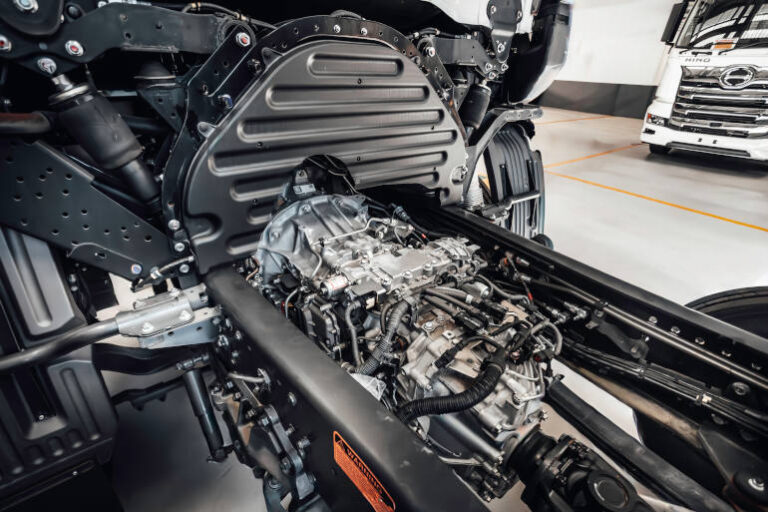
Power take-off systems are a critical part of many heavy vehicle applications, providing the power needed to operate tippers, cranes, hook lifts, refuse bodies, concrete agitators, vacuum units and other specialist equipment.
But not all PTO systems work the same way. The location of the PTO — and whether it needs to operate while the truck is moving — can have a major impact on productivity, safety, fuel use, maintenance and bodybuilder design.
For Fleet Managers and operators, the key question is not simply whether a truck has a PTO. It is whether the PTO configuration matches the work the truck is expected to do.
Gearbox PTO: the common option
The most common arrangement is a PTO mounted to the transmission or gearbox.
This type of PTO is usually used to drive a hydraulic pump, which then powers body equipment such as a tipping body, crane, hook lift, skip loader or tail lift.
For many applications, a gearbox PTO is a practical and cost-effective solution. It is widely available, relatively straightforward for bodybuilders to integrate and well suited to equipment that is normally operated while the vehicle is stationary.
However, gearbox-mounted PTOs can have limitations. Depending on the truck and transmission configuration, power may be interrupted when the clutch is engaged or during gear changes. That can make them less suitable for equipment that needs continuous hydraulic power while the vehicle is moving.
Engine PTO: for continuous power
An engine-mounted PTO takes its drive directly from the engine rather than through the gearbox.
Because it is independent of the transmission, it can generally continue operating when the truck is moving, stopped or changing gears. This makes it a better option for heavy-duty vocational applications where body equipment must work continuously.
Typical examples include:
- Concrete agitators
- Refuse collection bodies
- Fire appliances
- Road maintenance equipment
- High-demand hydraulic systems
- Specialist crane and recovery applications
The advantage is consistent power delivery. The body equipment is not affected by gear changes in the same way as a conventional gearbox PTO.
For fleets, this can improve productivity where the truck is required to carry out work while travelling slowly through a worksite, collecting waste, operating an agitator or supporting emergency-response equipment.
Flywheel-driven PTO: a third mechanical option
A flywheel-driven PTO is sometimes grouped with transmission PTO systems because it is mounted around the bellhousing or transmission area.
However, it is different because it takes its drive from the engine side of the driveline, ahead of the gearbox.
That means it can operate more like an engine PTO, providing continuous power without being interrupted by transmission shifts or clutch operation.
This type of configuration can be useful for high-power applications where the equipment needs to operate while the truck is moving. It is often considered for demanding vocational roles where a conventional gearbox PTO may not provide the required drive continuity.
Transfer-case PTO: for specialist and off-road trucks
Another option is a PTO driven from the transfer case.
This is more common on all-wheel-drive, off-road, construction, defence and specialist vehicle platforms. The transfer case can provide an alternative location for body equipment drive where a gearbox or engine PTO is unsuitable due to vehicle layout, driveline design or operating requirements.
It is not usually the first choice for a conventional highway truck, but it can be an important option for fleets operating in remote, construction or off-road environments.
ePTO: the electric vehicle alternative
As battery-electric trucks enter more vocational applications, electric PTO systems are becoming increasingly important.
Rather than taking mechanical power from an engine or transmission, an ePTO uses energy from the truck’s high-voltage battery to operate body equipment. This may involve an electric hydraulic pump, electric motor or body-mounted power unit.
An ePTO can be used for applications including:
- Refrigerated bodies
- Refuse collection vehicles
- Hydraulic cranes
- Hook lifts
- Concrete agitators
- Municipal and utility equipment
The main benefit is that body equipment can operate without idling a diesel engine. This can reduce noise, eliminate tailpipe emissions during stationary work and improve suitability for urban, depot and night-time operations.
However, fleets need to account for the energy used by the body equipment. PTO demand can have a direct impact on driving range, charging requirements and battery sizing.
Can a truck have more than one PTO?
Yes. Some heavy vehicles can be configured with multiple PTO outputs or separate PTO systems.
A truck may use an engine PTO for a high-demand hydraulic body function and a gearbox PTO for another auxiliary system. Some transmissions can also be specified with dual-output PTO arrangements to operate more than one hydraulic pump.
This can be useful where the vehicle has multiple pieces of body equipment or needs separate hydraulic circuits for different functions.
The final design should be agreed between the truck manufacturer, bodybuilder, hydraulic supplier and fleet operator. PTO selection needs to consider power demand, duty cycle, hydraulic flow, vehicle operating conditions, driveline limits and maintenance access.
Selecting the right PTO
The right PTO depends on how the truck works.
A tipper operating mainly while parked may only need a conventional gearbox PTO. A refuse truck, agitator or specialist vocational vehicle that needs continuous power while moving may need an engine or flywheel-driven PTO. An electric truck will generally require an ePTO system designed around the body equipment and available battery energy.
For Fleet Managers, PTO specification should be part of the vehicle procurement process rather than a late-stage bodybuilder decision.
The wrong PTO configuration can limit productivity, create operating restrictions and add cost. The right one can improve uptime, reduce driver frustration and ensure the truck is capable of doing the job it was purchased to perform.