




For many councils, developing a street-sweeping schedule is still a highly manual process.
As road networks grow, new suburbs are added and community expectations change, existing schedules can become increasingly difficult to manage. In some cases, the original program is simply expanded over time rather than rebuilt around the current road network and service requirements.
Geosecure is looking to change that with Optimize, an AI-powered route optimisation platform designed to help transport and operations teams build and continually adjust fleet schedules using live operational data.
One of its first applications is street sweeping, where Geosecure National Fleet Consultant Travis Weir says councils can face a surprisingly complex planning challenge.
“I asked how one council how long would it take you to build a four week schedule? They said between 12 and 18 months because you’ve got to work out length, you’ve got to work out volume. You’ve got to work out tree species and tree maturity and the volume that they drop.”
According to Weir, the same scheduling exercise can be processed by Optimize in a matter of minutes.
“Within two and a half minutes, it’ll give us the optimal routing solution to take for each day and how many roads we can achieve.”
Street sweeping is more complicated than finding the shortest route
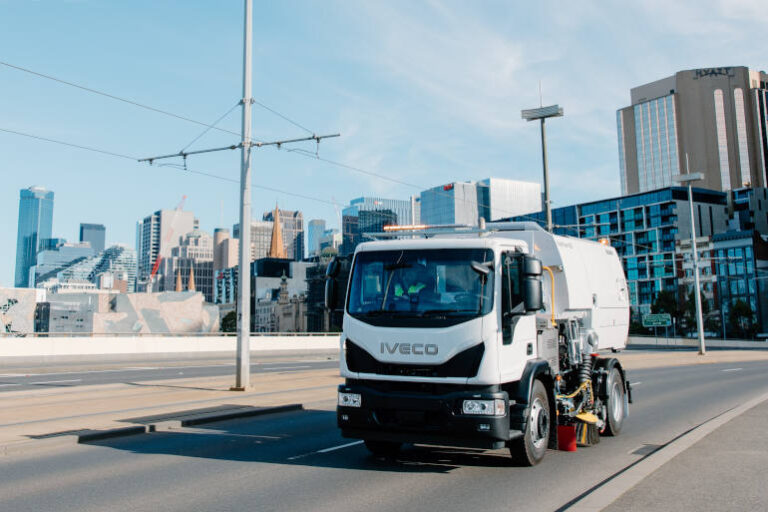
A street sweeper cannot simply follow the shortest route around an LGA. The schedule needs to reflect what actually has to be serviced and how frequently.
Weir said the process starts with council GIS information.
“We’re taking the GIS data. So the reason why we want sealed and unsealed is if customer requests come in, we can quickly differentiate between whether the street sweeper can achieve that customer request or not.”
Geosecure then looks at the serviceable network, including kerb and guttering, whether servicing is required on both sides of the road and features such as median strips, islands and roundabouts.
The council’s existing service program is another important input. Some areas may need daily or weekly attention, while others may only need to be swept fortnightly, monthly or annually.
Depot locations and dump sites also affect the route, as does the capacity and operating speed of the street sweeper.
Building a schedule that can change
The larger problem with static route planning is that the plan can quickly become outdated. A vehicle breaks down. An operator calls in sick. A road is closed. A new customer request arrives.
Optimize is designed to account for those changes rather than requiring the operations team to manually rebuild the schedule.
Weir demonstrated the example of a council operating six sweepers.
“If you had six street sweepers and you set the schedule for six street sweepers, and then the next day, one breaks down or an operator calls in sick. Optimise allows you to make one of those vehicles unavailable, and then re-optimise very quickly.”
The objective is to redistribute the remaining workload while continuing to work towards the council’s required service level.
As Weir put it:
“So then you’re not missing your service level.”
That dynamic capability reflects the broader Optimize proposition.
The platform is designed to connect with a transport management system and, where required, telematics data, allowing it to use information such as job details, vehicle capacity, driver shifts, time windows and changing road conditions.
When circumstances change, jobs and routes can be reoptimised and updated rather than relying on transport teams to manually rebuild the day’s plan.
Telematics can show whether the work was actually done
For street sweeping, Geosecure is also using telematics to help distinguish between a vehicle travelling and a vehicle actually sweeping.
Weir said PTO data can potentially identify whether the left, right or centre broom is engaged. That creates a much stronger measure of operational performance than vehicle movement alone.
The information can then be compared against the planned schedule to identify which streets were completed, which were missed and whether some parts of the network were being serviced more often than required.
This becomes particularly important when councils are trying to measure performance against community service levels.
Weir provided an example where a council aims to cover its network within a four-week period. Historical data could then be compared with that target.
“We can backdate their data to show how compliant they are to that contract or that SLA, and then we can show what streets they’ve missed very quickly and highlight it.”
The value in that information isn’t simply identifying a missed street.
It provides evidence about whether the current schedule, fleet capacity and operating model are actually capable of delivering the expected service.
Customer requests can become part of the schedule
Street-sweeping programs also need to accommodate work that wasn’t on the original plan. Residents may request a street be swept, while road closures or other events can make scheduled locations temporarily inaccessible.
Weir said one of the objectives for Optimize is to make those requests part of the same planning process.
“There’s street sweeping platforms, but there’s nothing to allow you to be dynamic and feed the customer requests in.”
For councils, that potentially avoids treating scheduled work and reactive customer requests as two completely separate processes.
Instead, an additional request can become another constraint for the optimisation system to consider alongside the existing service program.
More than a Fleet Manager tool
While street sweepers are fleet assets, the issue Optimize is trying to address extends beyond the fleet department.
Fleet may own and maintain the vehicle, but operations determines where it works, customer service receives community requests and another part of the organisation may be responsible for the service budget.
That makes route optimisation an organisational issue as much as a fleet one.
For Fleet Managers, however, the additional operational visibility could help answer questions about vehicle utilisation, maintenance, fuel consumption and ultimately fleet size.
It may also help determine whether poor service performance is actually caused by a lack of fleet capacity or simply by inefficient scheduling.
Initial council rollout planned
At the time of the interview, the street-sweeping application was still being trialled.
Weir said Geosecure was working towards an October 2026 launch into councils, with a regional NSW council expected to be the first implementation after assisting with the development process.
Street sweeping is a relatively specialised application, but it demonstrates a problem that exists across many fleet operations. A schedule can be accurate when it is created and outdated minutes later.
The potential benefit of AI-powered route optimisation is therefore not simply producing a faster initial plan.
It is being able to continually adjust that plan as vehicles, drivers, jobs and operating conditions change throughout the day.
- Rain, traffic and a truck on the back: a real-world test for the Hino 700 Series tilt tray
 Truck launches often happen on sunny days with empty vehicles and ideal driving conditions. My day in the Hino 700 Series FY 3036 tilt tray was the opposite. Sydney delivered persistent rain for most of the drive, the roads were slippery, traffic was heavy, and the tilt tray was carrying a Hino 300 Series dual-cab
 - Hino FS 2845 proves big tippers don’t have to be hard workHeavy-duty tippers are often judged by their payload, body strength and engine output. Those things matter, but after spending a day behind the wheel of the Hino 700 Series FS 2845 tipper, what stood out most was how easy it was to drive. The route was far from ideal testing conditions. It included Sydney traffic,
- First drive: Scania’s Super 11 shows that performance is about smooth torque, efficiency and driver behaviour — not just horsepowerThe launch of Scania’s new Super 11-litre engine in Australia is not just about adding another engine size to the range. It is also a reminder that truck performance is changing. For many years, performance was measured in simple terms: horsepower, torque, displacement and how quickly a truck could pull a load up a hill.
- Two Hino 700 Series trucks, two very different personalitiesSpending a full day in the Hino 700 Series was a reminder that a truck is never just a truck. The badge might be the same, and both vehicles shared the same broad 700 Series DNA, but the two models I drove had very different roles, engine characteristics, handling traits and body applications. The first
- Truck Review – Hino 700 SeriesThe Hino 700 Series is Hino’s heavy-duty truck range, and in this drive review, Marc takes a closer look at why it matters for fleet operators. From tipper and dog applications to prime movers, curtain siders and cattle trucks, the Hino 700 Series is designed to cover a wide range of heavy-duty fleet needs. In