





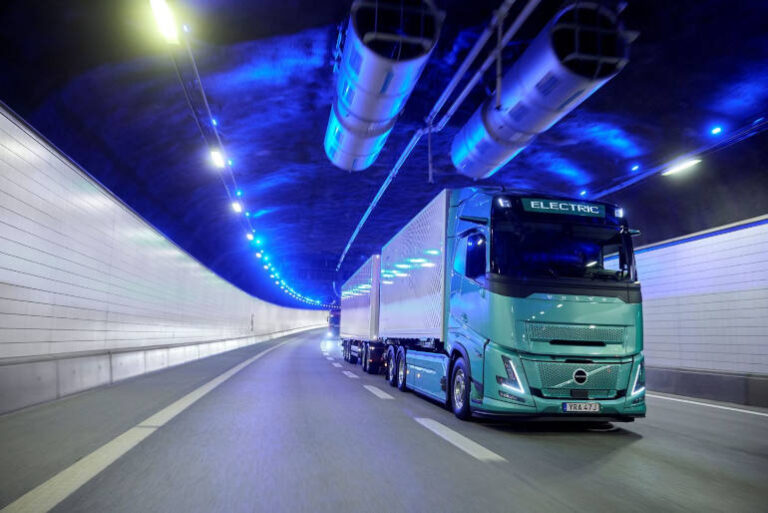
Volvo Trucks is extending the capability of its latest electric heavy-duty range with a new truck and trailer combination designed to operate at gross combination weights of up to 80 tonnes.
The new configuration builds on the next generation Volvo FH, FM and FMX Electric trucks launched earlier this year and targets some of the most demanding heavy transport applications, where payload, range and charging time have traditionally made electrification more difficult.
At a gross combination weight of 64 tonnes, Volvo says the new combination can travel up to 450 kilometres on a single charge. At 74 and 76 tonnes, the claimed range is up to 420 kilometres.
“We are proud to introduce yet another fantastic zero tailpipe emission truck, tailormade for really heavy loads and long distances,” said Jan Hjelmgren, Senior Vice President Product Management at Volvo Trucks.
“Combined with fast-charging capabilities, we believe many customers will be interested in this new truck.”
The configuration is based around an FH Electric rigid truck towing a trailer and has been developed primarily for markets where higher combination weights are permitted.
Initial sales will begin in Sweden, Norway, Finland, Denmark, the Netherlands and Switzerland, with the FH Electric rigid truck scheduled to progressively enter those markets from early 2027.
For Australian fleet operators, the development is significant even though local availability has not been announced. Heavy vehicle electrification is increasingly moving beyond metropolitan distribution and rigid truck applications into combinations requiring higher payloads and longer operating distances.
Volvo says operating heavier combinations can improve freight efficiency by allowing more goods to be moved per vehicle movement.
“High total weights in truck transport lower both transport costs and environmental impact,” Hjelmgren said.
“If we also electrify these transports, we take an important step towards more sustainable transport.”
640kWh usable battery capacity
The new FH Electric uses the powertrain introduced with Volvo’s latest generation electric trucks, supported by updated batteries providing 640kWh of usable energy.
Battery monitoring has also been revised, while improved insulation is designed to help maintain battery efficiency and energy availability in colder operating conditions.
Charging capability is an important part of making the combination suitable for longer-distance transport.
Using a 680kW Megawatt Charging System connection, Volvo says the battery can be charged from 20 to 80 per cent in approximately 36 minutes.
A 360kW CCS2 charger can complete the same 20-to-80 per cent charge in around 70 minutes.
That level of charging performance potentially allows charging to be incorporated into scheduled driver breaks or loading activities, although actual fleet suitability will continue to depend heavily on routes, payloads and access to high-capacity charging infrastructure.
New axles support demanding applications
Volvo is also introducing hub-reduction axles with the new combination.
The design provides additional ground clearance and improved startability at higher gross combination weights, making the truck suitable for applications including on-road timber transport and lighter construction work.
Volvo says the higher technical axle load rating can also provide payload advantages when the truck operates predominantly on sealed roads.
The specification includes an eight-speed transmission developed for electric motors, with both standard FH and aerodynamic FH Aero cabs available, excluding the XXL cab.
An electric power take-off is also available, allowing equipment such as refrigeration units to operate without requiring a separate diesel generator.
For fleets assessing heavy-duty electrification, the significance of the new FH Electric is less about one particular range figure and more about the continued expansion of the operating envelope for battery-electric trucks.
Payload, charging infrastructure and utilisation will remain central to the business case, but electric heavy vehicles are increasingly being engineered for applications that only a few years ago would have been considered firmly outside the practical limits of battery power.