

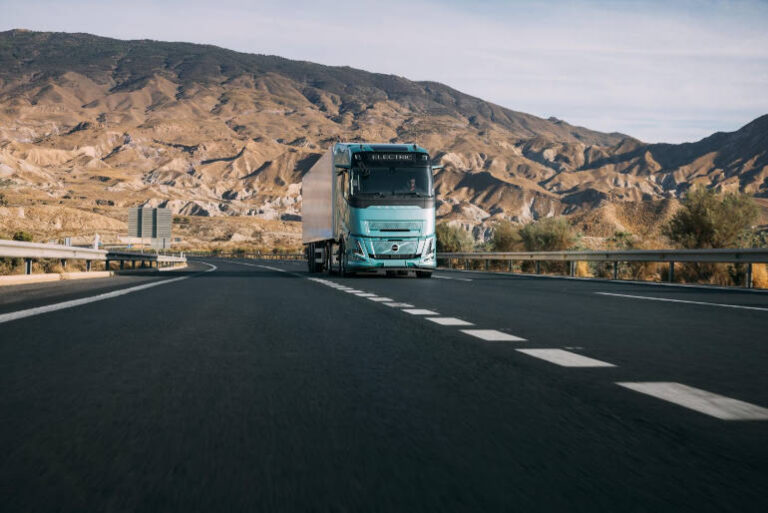
Volvo Trucks has started series production of its latest generation of electric heavy trucks, bringing models with ranges of up to 700 kilometres into regular manufacturing.
The first trucks have now rolled off the production line at Volvo’s Tuve plant in Gothenburg, Sweden, following the global launch of the new electric range in April 2026.
For fleet operators, the production milestone is significant because the latest trucks are designed to expand the number of transport applications that can realistically be completed using battery-electric vehicles.
The flagship Volvo FH Aero Electric uses a new e-axle architecture that frees up space for additional battery capacity, allowing a claimed driving range of up to 700 kilometres on a single charge.
Volvo says the combination of longer range, high payload capacity and megawatt charging capability is intended to make electric trucks suitable for routes that have traditionally remained firmly within diesel territory.
Roger Alm, President of Volvo Trucks, said the production start was an important step in Volvo’s broader electrification strategy.
“We are now turning groundbreaking technology into industrial reality,” Alm said.
“Starting series production of our new electric trucks is a clear proof of our commitment to lead the transformation to more sustainable truck transport.”
The updated range also includes new-generation Volvo FH, FM and FMX Electric models.
These trucks use a redesigned electric driveline intended to improve energy efficiency, productivity and driving performance, with claimed driving ranges of up to 470 kilometres.
For fleets, the broader model spread is just as important as the headline 700-kilometre figure.
The FH is aimed at long-haul and heavy transport tasks, while the FM and FMX platforms open electric options across regional distribution, construction, infrastructure and other vocational applications.
“The response from customers is very positive and we see a high interest in ordering the new trucks,” Alm said.
“With longer ranges, maximum flexibility across different applications and excellent drivability, it’s easier than ever to go electric.”
The move into series production also shifts the conversation around electric heavy vehicles from prototype capability towards fleet deployment.
Range remains only one part of the equation. Charging access, route planning, vehicle utilisation, payload, energy costs and depot infrastructure will continue to determine whether an electric truck works operationally and financially for a particular fleet.
However, trucks capable of travelling several hundred kilometres between charges significantly increase the number of routes that can potentially be electrified without major changes to daily operating patterns.
Megawatt charging could further improve that equation by allowing larger battery packs to be replenished during scheduled driver breaks or turnaround periods, particularly as high-power charging infrastructure becomes more widely available.
The start of production represents another step towards making electric heavy vehicles part of mainstream fleet replacement planning rather than a solution limited primarily to short-haul or depot-based applications.