

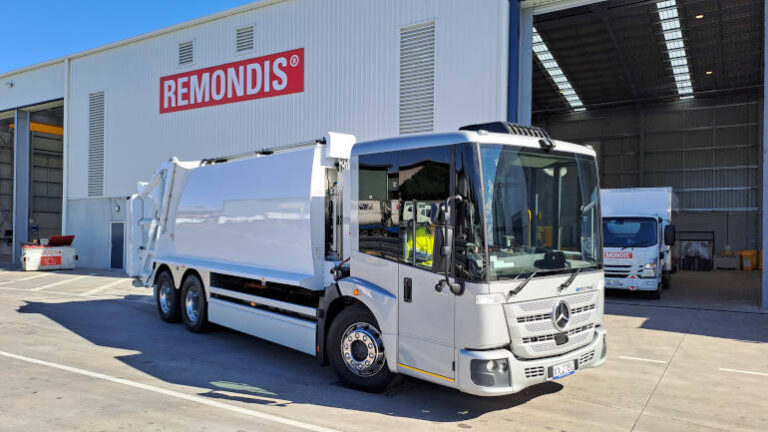
REMONDIS Australia has trialled a Mercedes-Benz eEconic electric waste collection truck in Brisbane, exploring how the technology could support emissions reduction across its 600-truck Australian fleet.
The battery-electric eEconic 6×2 undertook commercial waste collection duties during August 2026. Built to comply with Australian truck mass and dimension requirements, the trial vehicle combined Mercedes-Benz’s electric drivetrain with a waste collection body designed by Superior Pak.
The next stage will involve analysing and sharing trial information to assess the truck’s suitability for local operations.
Testing electric technology on local routes
The eEconic uses electric motors integrated into the drive axle, removing the need for a traditional driveshaft. It produces zero exhaust emissions and operates in near silence.
Regenerative braking recovers energy during deceleration, making the technology well suited to the repeated stopping and starting of urban waste collection.
REMONDIS Australia Technical Executive General Manager Conor Flynn said the trial vehicle had been developed specifically for Australian conditions.
“Plenty of effort and cooperation has gone into delivering a bespoke model fit for Australian climates and terrain,” Flynn said.
“Amongst other things, Brisbane was chosen for the trial because of its diverse operational landscape.”
Flynn said the next steps were sharing and analysing information with Mercedes-Benz and other participants, including Superior Pak.
A 600-truck opportunity
REMONDIS Australia CEO and Managing Director Björn Becker said the trial built on longstanding relationships between REMONDIS, its parent company RETHMANN and Mercedes-Benz.
“We’ve used Mercedes-Benz trucks globally, including in Australia, for many years,” Becker said.
“It’s a natural progression that REMONDIS would be first to trial eEconic technology on Australian roads.”
For REMONDIS, the trial forms part of a broader investigation into alternative powertrains across its national fleet.
“Given that we operate 600 waste collection trucks across Australia, there’s significant scope and appetite for us to cut emissions more broadly, be it through electric, hydrogen or hybrid technology,” Becker said.
“We’re working with multiple truck suppliers and other stakeholders to progress that journey.”
Battery capacity for collection duties
The eEconic has three battery packs providing 300kWh of usable capacity, with a stated range of up to 150 kilometres including waste compaction.
Drive output reaches up to 400kW, while maximum speed is 100km/h. According to the supplied specifications, the batteries can be recharged in as little as 2.5 hours using a 120kW charger, typically at a fleet depot.
For waste fleet operators, the trial provides an opportunity to assess how electric propulsion performs alongside the energy demands of compaction and the operational requirements of collection routes.
Mercedes-Benz Trucks Australia Pacific Sales and Marketing Vice President Andrew Assimo said the vehicle’s European experience provided a foundation for its introduction here.
“We know it can allow REMONDIS to deliver its customer-first waste solutions in near silence while producing zero exhaust emissions,” Assimo said.
“The track record of these trucks speaks for itself in Europe, and we’ll be working closely with REMONDIS with a view to them succeeding in Australia.”
Safety remains central
The eEconic builds on the diesel-powered Econic, which Mercedes-Benz developed nearly 30 years ago as a purpose-built urban waste vehicle.
Safety equipment includes an Advanced Emergency Braking System, panoramic windows, and mirrors and cameras designed to improve visibility around the truck.
A low, two-step entry also reduces the climbing required when drivers repeatedly enter and exit the cab during collection duties.
The Brisbane trial follows other electric truck trials undertaken by REMONDIS in Australia, as well as the introduction of a hydrogen-powered residential waste collection truck to its Illawarra operations in New South Wales in 2023.
For fleet managers, the next point of interest will be the trial findings: how the eEconic’s range, charging requirements and collection performance translate into everyday Australian waste operations.