

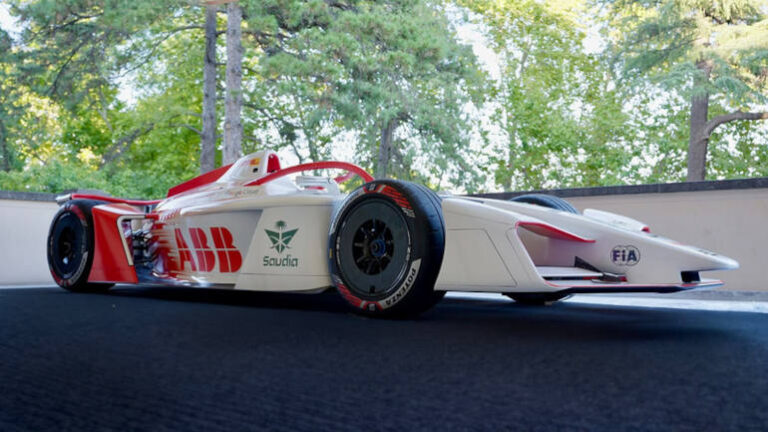
Bridgestone will use its return to FIA world championship motorsport to advance tyre technology with potential benefits for commercial vehicle fleets, becoming Formula E’s sole tyre supplier from the 2026/27 season.
The company unveiled its new POTENZA GEN4 racing tyres in Rome, highlighting developments in grip, durability and the use of recycled and renewable materials.
For heavy vehicle operators, the relevance extends beyond the racetrack. Bridgestone positions motorsport as a “mobile laboratory”, using the experience gained in competition to support the development of consumer and commercial tyres.
Electric racing raises tyre demands
Formula E’s new GEN4 car will introduce permanent active all-wheel drive, peak power of 600kW and a claimed top speed of 335km/h. Acceleration from zero to 100km/h takes just 1.8 seconds.
Bridgestone says these capabilities place greater demands on the tyres, requiring high grip and consistent performance throughout each race.
Its POTENZA GEN4 tyre has been developed to accommodate different road surfaces and weather conditions. A separate heavy-rain tyre, POTENZA GEN4 for TYPHOON TYRE, is designed to provide grip where substantial water is present on the road.
Racing cars and heavy vehicles have different operating requirements, but both demand predictable tyre performance under challenging conditions. For truck fleets, the value of any technology transfer will ultimately be measured through safety, tyre life, efficiency and operating costs.
Bridgestone says the Formula E programme will help refine its technology and improve its product and manufacturing capabilities.
Recycled materials support tyre development
Alongside performance, Bridgestone is using the programme to advance its approach to materials and production.
The company says its GEN4 tyres achieve a 65% allocation of recycled and renewable materials to each tyre. These include carbon black derived from the pyrolysis oil of end-of-life tyres and silica derived from rice husks.
Bridgestone also says the natural rubber is sourced through supply chains that have undergone due diligence, comply with the Global Platform for Sustainable Natural Rubber Assurance System and have been verified by a third party.
For manufacturing, the company says 100% renewable energy is allocated to both heat and electricity used in production. It is also pursuing lower-carbon logistics and chemical recycling of end-of-life tyres with its partners.
The claims apply to the GEN4 racing tyres. Bridgestone has not announced equivalent material content or production arrangements for its commercial vehicle tyre range as part of this release.
Motorsport feeds commercial tyre innovation
Bridgestone has participated in motorsport for more than 60 years, using racing to develop its technical expertise and operational capabilities.
Global CEO Yasuhiro Morita said the Formula E programme would continue that approach while increasing the focus on sustainability.
“On the supreme stage of Formula E, we will further evolve the balance of performance and sustainability and pioneer a new future for mobility,” Morita said.
The company will supply tyres for every race in the 2026/27 championship and take title sponsorship roles at events in Mexico City, Berlin, Shanghai and Tokyo.
What heavy vehicle fleets should watch
For heavy vehicle fleet managers, the announcement signals a development pathway rather than an immediate change to truck tyre specifications.
Tyres remain a recurring operating expense and a critical safety component. Any advances flowing from motorsport will need to demonstrate value under commercial conditions, including sustained loads, long operating hours and varied road surfaces.
The materials programme also highlights questions fleet buyers can put to tyre suppliers: how much recycled or renewable material is used in the product being purchased, how its service life compares, and what recovery options are available when it reaches the end of use.
As heavy vehicle fleets assess their environmental footprint, tyre procurement and disposal form part of the wider picture. Bridgestone’s Formula E programme offers a testing ground for new approaches, with the commercial benefit depending on how those developments reach working fleets.