

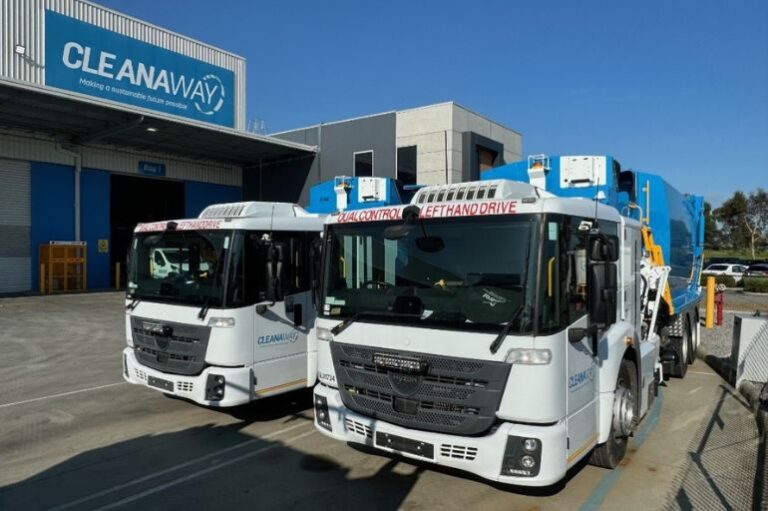
Cleanaway’s half-year FY25 results don’t just show a business delivering strong financials — they reveal a waste industry giant in the middle of a serious fleet transformation. And for fleet managers watching how major operators lift performance during tight market conditions, there’s plenty to take away.
Australia’s largest waste, recycling and liquids collections fleet — now more than6,350 specialist vehicles — is being reshaped through disciplined capital management, improved utilisation, better data, and a clearer operating model across the country.
The goal? Higher productivity, lower operating costs, stronger safety outcomes, and a more resilient fleet supporting Cleanaway’s Blueprint 2030 strategy.
A More Disciplined, Data-Led Fleet
Cleanaway is rolling out a fleet transformation program that takes a centralised, whole-of-business approach to reducing running costs and extending asset value. The company flags this as a key contributor to improving EBIT margins across its operating segments in 1H FY25.
Five focus areas underpin the fleet transformation:
1. Optimising the mix of ownership models
Cleanaway has applied an “ownership model” to each business unit, identifying where vehicles are better owned internally and where 3PL or subcontractor models deliver better value. Owner-Driver and subcontractor agreements are being standardised, with the 3PL rollout already completed in Solid Waste Services across Victoria and Tasmania .
2. Fleet purchasing, sizing and disposal
A branch-by-branch assessment identified 366 vehicles for disposal, with 69% of the program already complete. Removing older or under-utilised assets has reduced repair and maintenance costs, fuel spend, and registration outlays. Cleanaway has also begun standardising fleet specifications and lifecycle management settings to control future replacement cycles and improve consistency across workshops and depots .
3. In-cab technology and low-carbon innovation
Trials of new IVMS platforms are underway, with the goal of standardising in-cab technology across the national fleet. Cleanaway also demonstrated the HV0100 low-carbon fuel solution in partnership with Coles and the City of Casey — a clear nod towards lower emissions transport options emerging in heavy waste operations .
4. Scheduling, routing and network optimisation
Route optimisation tools developed with the Data & Analytics team are being rolled out as part of the Branch-Led Operating Model — helping improve route density, reduce kilometres travelled, and shrink the number of vehicles required to complete the same work. These tools are already embedded in Health Services, contributing to reduced fleet count and lower transport costs in that division .
5. Maintenance, fuel and workshop performance
A new fuel deal has been executed covering bulk tank and fuel card supply, supported by an uplift in preferred supplier compliance. Workshops have undergone efficiency audits and now have a structured program to improve parts ordering, maintenance processes and contractor management. Cleanaway aims to apply a consistent, industry-leading maintenance model across all business units .
Branch-Led Operating Model: The “Drumbeat” for Fleet Productivity
A big part of the uplift is Cleanaway’s shift to a branch-led operating model, rolled out nationally.
By December 2024, 78% of Solid Waste Services branches had established the full operating cadence (up from just 17% at the end of FY24). The model provides:
- near real-time site data
- standardised performance rules
- clearer roles in each branch
- local leadership capability uplift
- a “drumbeat” of tactical and forward-looking decision-making
For fleet performance, this approach is helping depots lift route efficiency, manage labour and vehicle capacity more accurately, and reduce short-notice operational risk. SWOT deployment teams have supported underperforming branches, typically delivering around a 10-percentage-point EBIT margin uplift once improvements are embedded .
Reducing Fleet Operating Costs
Cleanaway reported tangible savings through the fleet transformation program in the first half:
- Lower fuel consumption due to optimised routing and reduced fleet size
- Reduced repair and maintenance costs following the disposal of ageing assets
- Lower registration costs through whole-of-fleet rationalisation
- Improved workshop processes, reducing downtime and parts waste
- Higher route density, especially in Health Services and Solid Waste Services
These improvements form part of the broader operational excellence initiatives that contributed to the company’s 80-basis-point EBIT margin expansion in 1H FY25 .
Fleet Transformation Supporting Network Growth
Several major infrastructure programs have direct fleet implications:
- Western Sydney MRF commissioning is underway, requiring new collection, transfer and transport arrangements across metropolitan NSW.
- Eastern Creek Organics’ transition to full FOGO capacity alters the mix of vehicle types and routes servicing councils.
- Container Deposit Scheme growth in NSW and Victoria has increased transport tasks and vehicle utilisation for high-volume commodities.
- The new Defence waste and resource recovery contract in QLD and WA will also demand tailored heavy-vehicle and specialist fleet capability across remote and secure sites.
All of these projects feed into Cleanaway’s need for a more agile, better-connected fleet across 330+ locations nationally.
A Platform for Continued Transformation
Cleanaway is targeting more than $50 million in operational excellence improvements in FY26, much of which is directly linked to fleet transformation, routing, disposal programs, analytics and the operating model rollout .
The company is also holding FY25 capital expenditure at around $400 million, almost $50 million lower than FY24, reflecting tighter discipline in replacement and growth projects while still enabling upgrades such as the new MRF, organics facilities and CustomerConnect IT transformation .
For fleet managers watching from the outside, Cleanaway’s approach shows how a large and geographically dispersed fleet can lift utilisation, reduce costs, and strengthen operational reliability through:
- standardisation,
- data-driven decisions,
- tighter lifecycle control,
- and a disciplined branch-level operating rhythm.
It’s a reminder that even in heavy-vehicle intensive operations, efficiency and sustainability gains increasingly come from the back office as much as the engine bay.