
Battery and solar-powered trailer refrigeration could give Australian transport operators greater control over energy costs, fleet performance and customer service, according to Sunswap Co-founder and CEO Michael Lowe.
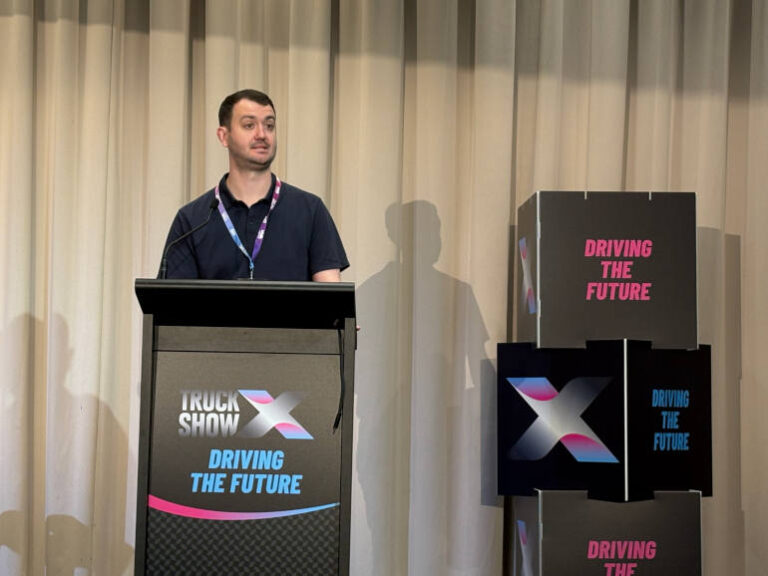
Speaking at TruckShowX, Lowe argued that rapid falls in battery and solar costs have made zero-emission refrigeration commercially viable, creating an opportunity for cold-chain fleets to replace diesel-powered refrigeration units with smarter, data-rich technology.
Sunswap was founded in the United Kingdom in 2020 after Lowe and his co-founders identified that battery and solar technologies had reached a point where they could reliably power refrigerated trailers.
“Battery prices are now down 93% in the last 15 years,” Lowe said. “We’ve seen exactly the same thing happening with solar panels. In the same timeframe, solar panels are now 90% cheaper than they were, and they’re actually the cheapest form of energy in the world.”

Removing diesel from the trailer
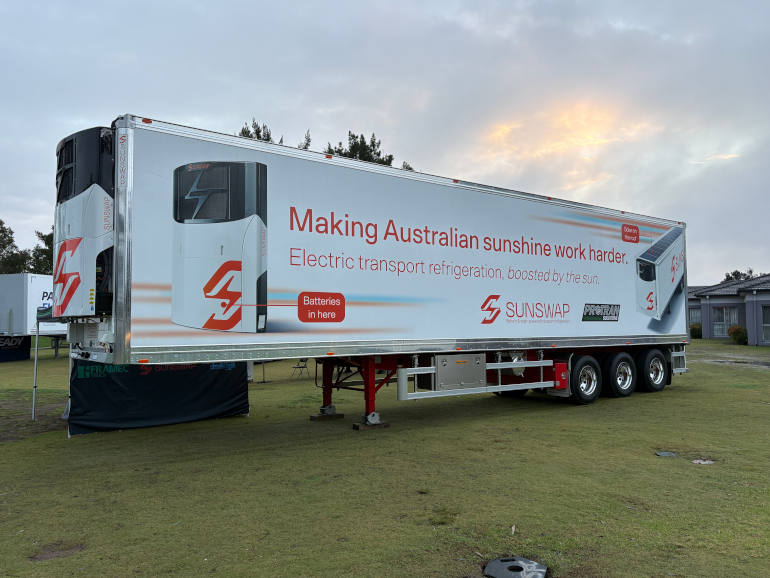
Sunswap’s Endurance refrigeration system uses a battery-powered refrigeration unit that can be charged from the electricity grid and supplemented by solar panels mounted on the trailer.
All major components are located at the front of the trailer, leaving the space beneath it available for axles, pallet boxes and other fleet equipment.
“The best way to think about it is a battery-powered fridge that’s topped up by solar or the grid,” Lowe said. “It’s primarily powered by the battery.”
The company began production in the UK in 2024 and now has more than 150 units operating with paying customers across the UK, Europe and Australia.
While eliminating diesel use is a major benefit, Lowe said operators were finding that the commercial case extended well beyond emissions reduction.
“Operators are able to win more business because of this,” he said. “The sustainability angle primarily drives that, but equally it means that they can have a higher top line, more revenue being generated, and also lower costs.”
Data reveals hidden fleet costs
A central part of Sunswap’s offering is the operational data collected by the refrigeration system.
Through its Elevate platform, the company can monitor refrigeration performance, energy consumption and operating behaviour, helping fleets identify inefficiencies that may otherwise remain hidden.
Lowe said the technology could detect situations where suppliers loaded freight at a higher temperature than expected, forcing the refrigeration unit to consume additional energy to bring the load down to the required temperature.
“We’re able to pick up where a customer may be loading with a warm load and therefore wasting energy,” he said.
“If a supplier is providing warm load, you’re using more energy to pull that produce down.
“We’re able to see that with our fridges, therefore allowing our operators to have those conversations with their suppliers and take more operational costs out of their fleets.”
The system can also use geofencing to automatically change refrigeration behaviour at particular depots.
Lowe cited the example of a major UK fleet that had experienced health and safety issues when trailers arrived at sites without the required refrigeration performance.
Sunswap configured the refrigeration units to behave differently at individual locations, improving operational consistency and reducing site risks.
“We were able to geofence the fridge’s performance and behaviour at certain depots to work specifically for how they needed to operate,” Lowe said.
“Because of that, they’ve now gone on to order more and see other operational insights and benefits.”
Sustainability becomes a sales strategy
One Sunswap customer, UK operator Bannister Transport, has converted its entire fleet of 40 refrigerated trailers to Sunswap technology.
Lowe said the operator had used the transition to reposition its business around electric and solar-powered refrigeration.
The change removed diesel refrigeration costs while also helping the company win additional work.
“They did a whole repositioning around being electric and solar powered,” Lowe said. “They got rid of all of their diesel costs, but with this they’ve actually grown their top line considerably and are increasing their fleet size by 50%.”
The case study demonstrates how emissions technology can become a competitive advantage when it is connected to a broader business strategy.
Rather than treating sustainability purely as a compliance cost, fleets may be able to use cleaner refrigeration to differentiate themselves in tenders, strengthen customer relationships and reduce operating expenses.
Australian trials show strong range
Sunswap has been testing two refrigerated trailers in Australia with Protran since January.
According to Lowe, the technology has performed strongly across a range of local operating conditions.
One trailer completed a return journey between Sydney and Brisbane carrying frozen and chilled freight without being recharged during the trip.
“One of the most impressive routes was Sydney to Brisbane and back again, all on a single charge, frozen and chilled, and we only used 40% of the battery,” Lowe said.
The result suggests battery-powered refrigeration could operate across demanding Australian freight routes without introducing the same range concerns commonly associated with electric prime movers.
It also highlights an important distinction in fleet electrification. Operators may not need to replace the entire vehicle to begin reducing diesel consumption.
Electrifying the refrigeration unit allows fleets to cut emissions and operating costs from the trailer while continuing to use existing prime movers and transport infrastructure.
A practical pathway for cold-chain fleets
TruckShowX 2026 focused on solutions that improve sustainability, productivity, efficiency and safety across the heavy vehicle sector.
Sunswap’s technology demonstrates how those priorities can converge in one fleet application.
Electric refrigeration can remove diesel use, but it can also provide better operational visibility, reduce unplanned downtime, identify inefficient loading practices and help transport operators win customers seeking lower-emission supply chains.
For refrigerated fleets, the transition may therefore be less about replacing one power source with another and more about turning the trailer into a smarter, more productive asset.