For Australia’s heavy vehicle sector, new technology only earns attention when it can meet the same standards as diesel: reliability, payload, range, refuelling speed and uptime. That reality explains why hydrogen fuel cell trucks have been met with both interest and scepticism over the past decade.
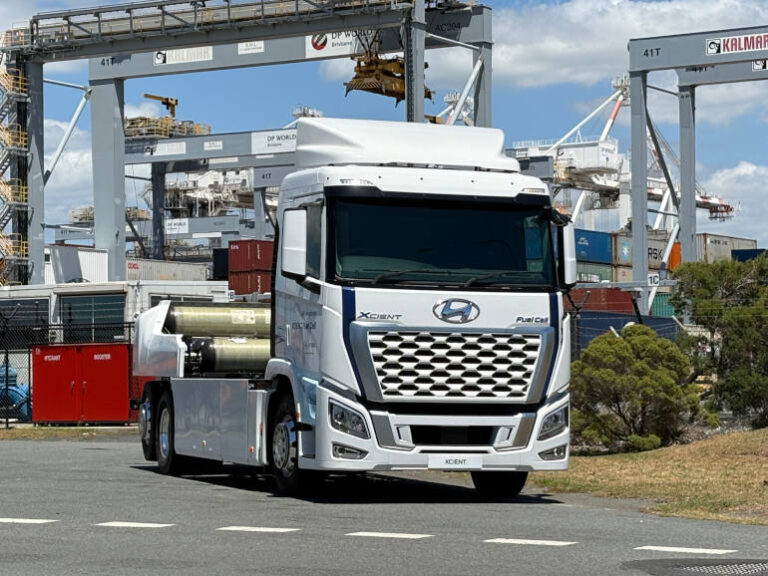
With the local introduction of the Hyundai XCIENT Fuel Cell truck, hydrogen is now being assessed not as a future concept, but as a working heavy vehicle platform designed to operate at scale.
For Hyundai Australia, XCIENT represents a long-term commercial play rather than a short-term demonstration.
Built as a truck first, alternative fuel second
One of the defining characteristics of the XCIENT Fuel Cell is that it was engineered from the outset as a heavy-duty truck. Unlike some low-emission solutions that adapt existing diesel platforms, XCIENT integrates hydrogen fuel cells, batteries and electric driveline components into a purpose-built chassis.
That approach matters to fleet operators who expect predictable performance under load and in demanding conditions.
The Australian-spec XCIENT uses a twin fuel cell system delivering 220 kW of continuous power, supported by a 72 kWh lithium-ion battery that handles peak loads and regenerative braking. A 350 kW electric motor produces up to 2,237 Nm of torque, delivered through a five-speed automatic transmission.
From an operational perspective, the key metrics are straightforward:
Driving range of around 400 km depending on load and conditions
Refuelling times comparable to diesel
Zero tailpipe emissions without sacrificing payload or utilisation
For fleets used to scheduling vehicles around refuelling windows rather than charging dwell times, this is where hydrogen begins to look practical.
Global operating experience shapes confidence
Hyundai’s heavy vehicle hydrogen program is not starting from zero. In Europe, close to 200 XCIENT Fuel Cell trucks are operating in logistics and freight applications, with more than 15 million kilometres logged in live service. These vehicles operate in alpine terrain, cold climates and high-utilisation duty cycles.
New Zealand deployments have added insight into hydrogen supply logistics, driver training and workshop preparedness. In the United States, hydrogen trucks have been tested in port and distribution environments where turnaround time is critical.
According to Martin Him, Head of CV and Fleet at Hyundai Australia, those markets have influenced how Hyundai is approaching Australia.
“We’ve been able to learn from fleets that are already running these trucks every day. That experience feeds directly into how we support customers here.”
For Australian heavy vehicle operators, that global track record reduces the risk typically associated with new technology.
Early commitments from WA fleets
The strongest signal that hydrogen is being taken seriously comes from customer behaviour, not manufacturer claims.
Three fleets based in Western Australia have committed to purchasing XCIENT Fuel Cell trucks as part of the initial Australian rollout. These customers operate in environments where vehicles are expected to work hard, cover distance and deliver consistent productivity.
Western Australia’s freight task, long distances and emerging hydrogen supply infrastructure make it a logical proving ground. Hyundai is working closely with these operators to validate performance, maintenance requirements and real-world operating costs.
“These customers understand their task profiles extremely well,” Him says. “They wouldn’t be committing unless the truck could genuinely do the job.”
Right-hand drive conversion done locally
A major differentiator in Hyundai’s approach is its decision to localise the conversion of XCIENT trucks from left-hand drive to right-hand drive in Australia.
That work is being undertaken by Advanced Manufacturing Queensland at its Brisbane facility. The process involves far more than relocating steering components, requiring detailed engineering validation to ensure the vehicle meets Hyundai’s global standards and Australian Design Rules.
Local conversion capability provides several advantages for heavy vehicle fleets:
Greater control over build quality and timelines
Faster response to Australian operating requirements
Support for domestic manufacturing skills and engineering capability
It also reinforces that XCIENT is not a temporary trial vehicle, but part of a scalable program.
Training, safety and support are central to the rollout
Hydrogen introduces new considerations for workshops, drivers and safety teams, and Hyundai has invested accordingly.
At its head office in Macquarie Park, Hyundai has installed a hydrogen refuelling station and implemented internal training programs covering hydrogen systems, refuelling protocols and emergency response.
This builds on Hyundai’s earlier hydrogen experience in Australia, which dates back to the introduction of the ix35 Fuel Cell passenger vehicle in 2015. While that program was limited in volume, it established foundational knowledge around hydrogen handling, regulation and infrastructure.
“We’ve been working with hydrogen in Australia for nearly a decade, that experience matters when you’re supporting heavy vehicles.”
Martin Him, Head of CV and Fleet at Hyundai Australia
Safety and drivability aligned with modern heavy vehicles
From the driver’s seat, XCIENT behaves like a modern electric truck rather than an experimental platform. Noise and vibration are significantly reduced compared with diesel, and torque delivery is smooth and predictable.
The truck includes a comprehensive range of advanced driver assistance systems, supporting fleet safety objectives and aligning with European heavy vehicle safety standards. Features such as forward collision avoidance, blind-spot monitoring and driver attention warning are designed to reduce fatigue and improve situational awareness.
For fleets already investing in safety technology, XCIENT aligns with current expectations rather than introducing compromise.
Hydrogen’s role in the heavy vehicle mix
Hyundai is careful not to position hydrogen as a universal replacement for diesel or battery electric trucks. Instead, the company views hydrogen fuel cell vehicles as a solution for specific heavy vehicle tasks where charging time, range and payload constraints limit battery-only options.
For Fleet HV News readers, the relevance of XCIENT lies in its ability to maintain familiar operating patterns while delivering zero tailpipe emissions.
With committed customers, local manufacturing involvement and global operating data behind it, the Hyundai XCIENT Fuel Cell enters the Australian market as a serious heavy vehicle platform — one that will now be judged by fleets on the same criteria as any other truck: uptime, productivity and total operating cost.
Whether hydrogen becomes a mainstream fuel or remains task-specific will be determined on Australian roads. What is clear is that the conversation has moved beyond theory, and the XCIENT Fuel Cell is now part of the heavy vehicle landscape.
Fleet News Group has been a trusted source of news and information for the fleet and transport industries since 2011. Our global audience provides services and products to their local communities by moving people and goods from one place to another. We celebrate their contributions to our society by sharing their stories.