

The heavy vehicle industry’s driver shortage is not only a recruitment problem. It is also forcing truck manufacturers and fleet operators to reconsider the working environment they provide drivers.
Hino Australia President and CEO Richard Emery believes the industry needs to do more over the coming years to encourage people to consider truck driving as a career.
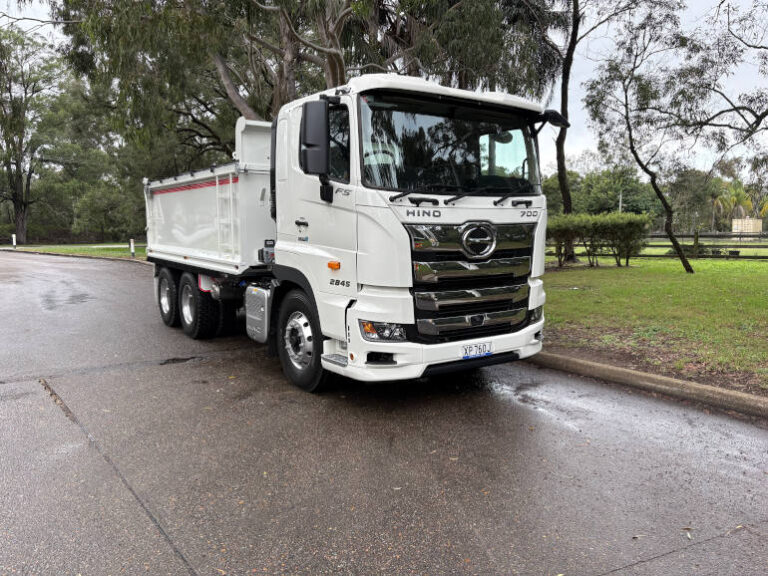
His comments came from an unusual setting for an executive interview — behind the wheel of a Hino 700 Series during a driving event.
Emery holds a heavy rigid licence but said he had spent relatively little time in heavy-duty trucks in recent years. Returning to the driver’s seat highlighted just how much the operating environment has changed.
After completing a five-hour drive in the lead-up to the event, Emery said:
“You get out at the end of the day, and you think, gee, this is pretty comfy.”
That observation matters when fleets are competing for drivers. Modern trucks can offer automatic or automated transmissions, air-suspended cabins, climate control, connectivity and a growing list of active safety systems.
The experience is very different from the heavy trucks many experienced drivers first learnt to operate decades ago.
Driver recruitment becomes a fleet issue
Emery believes making trucks easier to operate is becoming increasingly important because fewer people are choosing driving as a profession.
For Fleet Managers, vehicle specification can therefore affect more than productivity and whole-of-life cost.
Cab comfort, ease of operation and safety technology can form part of the organisation’s ability to attract and retain drivers.
It is particularly relevant in operations where drivers return home at the end of the shift rather than spending extended periods away.
The challenge for the industry is communicating what a modern truck-driving career actually looks like rather than relying on perceptions formed around older vehicles and working practices.
Safety expectations have changed
Safety technology is another area where Emery believes fleet attitudes have shifted. Lane warnings were regularly audible during the interview, giving the conversation a real-world example of the interaction between the driver and active safety systems.
Emery acknowledged that some warnings can be irritating, but said they still have an important role.
“Are they annoying sometimes? Yes.”
That did not lessen his support for the technology.
“I think a lot of people are still very surprised when they hop in a big truck like this and discover what range of safety features they’ve got,” he said.
Features that became common in passenger vehicles over the past 10 to 15 years are increasingly expected in heavy trucks as well.
For businesses operating trucks, the discussion has also moved beyond whether an experienced driver believes they personally need the technology.
Chain of Responsibility obligations and broader workplace safety expectations mean organisations need to consider whether they are providing employees with an appropriate working environment and available safety technology.
Emery said customer attitudes towards paying for safety features had changed considerably over the past five years.
Technology still needs training
Adding technology to a truck does not automatically mean fleets receive the full benefit. Drivers need to understand how vehicle systems operate and how to use them effectively. That applies to safety systems but also to fuel consumption.
During the drive, Emery noted how the truck’s transmission programming could select a higher gear than a driver accustomed to older vehicles might instinctively choose because the powertrain was trying to optimise fuel use.
Driver inputs can still change the result. Fleet Managers can use telematics to identify those differences and turn them into coaching opportunities.
Hino Connect, for example, can provide fuel consumption information that allows operators to compare similar vehicles or drivers. Emery illustrated the point with a simple example.
“Fred over there is 10% better than you. What’s what’s his technique, or what’s he doing differently?”
The value is not in creating a league table for its own sake. The data can help identify techniques that reduce fuel use and then share those practices across the driving workforce.
The truck is part of the employment proposition
Driver shortages cannot be solved by vehicle technology alone. Pay, working hours, management, training and career opportunities will remain central to whether people enter and stay in the industry.
But the truck is the driver’s workplace.
For Fleet Managers considering their next replacement cycle, comfort, safety, ease of operation and access to useful driver data therefore deserve consideration alongside payload and purchase price.
A modern truck may not solve the industry’s workforce challenge.
It can, however, help make the job more attractive — and give existing drivers a safer and more efficient place to work.