




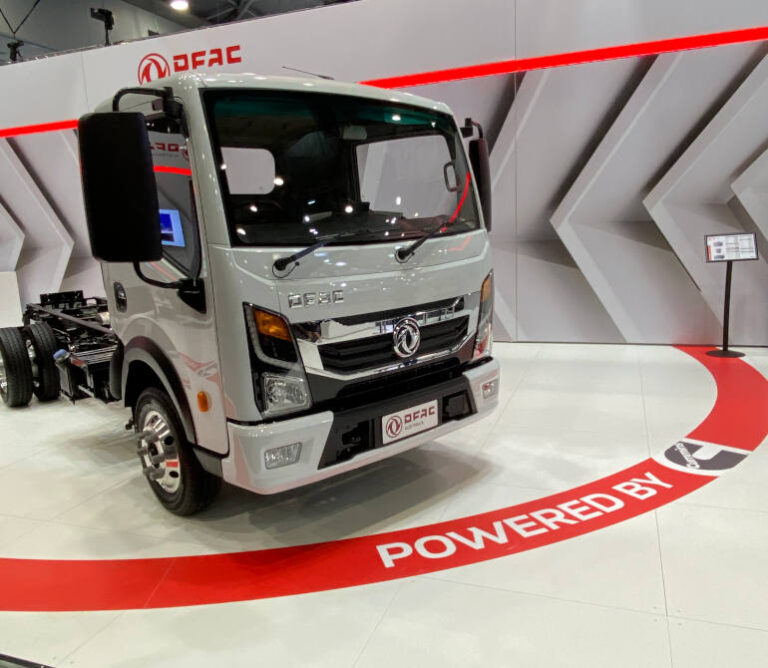
Chinese truck brands are becoming an increasingly visible force in the Australian truck market, adding a new layer of disruption at a time when operators are already dealing with cost pressure, supply constraints and changing emissions standards.
Over the past two years, a growing number of China-sourced heavy and medium-duty trucks have entered the market, often positioned on aggressive upfront pricing. For some operators, particularly those focused on capital cost, that has made them hard to ignore.
Price resets expectations — but not the full equation
The most immediate impact of Chinese brands has been on price perception. In segments such as eight-wheelers and selected heavy-duty applications, lower entry pricing has reset conversations between fleet buyers, dealers and established OEMs.
However, fleet decision-makers are weighing more than purchase price alone. Whole-of-life cost, parts availability, dealer coverage, resale value and uptime remain central to most fleet procurement frameworks — particularly for council, construction, waste and logistics operators.
This has created a clear divide in the market between buyers prepared to trial new entrants and those prioritising long-term asset certainty.
Established OEMs hold firm on value
Rather than chasing headline pricing, established brands have largely maintained their value-based positioning. The focus remains on safety systems, emissions compliance, service support and proven reliability, especially for fleets operating across multiple sites or jurisdictions.
This approach reflects a broader industry view that competing purely on price carries risk — particularly where vehicles are expected to remain in service for 10 to 15 years.
Where Chinese brands are gaining traction
Chinese trucks are finding traction in specific use cases:
- Price-sensitive applications with shorter replacement cycles
- Fleets with in-house maintenance capability
- Operators trialling vehicles for secondary or non-critical tasks
In these scenarios, the risk profile is different, and buyers are more willing to experiment.
At the same time, established brands continue to dominate higher-utilisation, safety-critical and compliance-driven fleets, where downtime carries a higher operational cost.
A more complex buying environment for fleets
For Fleet Managers and Procurement Managers, the arrival of more Chinese brands has made the buying environment more complex — but also more competitive.
It has sharpened scrutiny of specifications, service agreements and residual assumptions, while reinforcing the importance of application-fit rather than badge or price alone.
The disruption is real, but uneven. Chinese brands are changing conversations, not yet rewriting the entire market.
The takeaway
Chinese truck brands are adding pressure at the lower end of the price spectrum and challenging traditional assumptions around cost. But for most fleets, the decision still comes down to reliability, support and long-term value.
As the market moves through 2026, the presence of new entrants is likely to keep pricing tight — while reinforcing why fleet buyers continue to look beyond the sticker price when making critical asset decisions.
- Halton Joinery Finds the Right Fit with Isuzu NQR
 For Hobart-based Halton Joinery, choosing its latest truck was about more than adding carrying capacity. The business wanted to reduce manual handling risks, protect high-value finished products and make deliveries easier to plan. The family-owned joinery business has added an Isuzu NQR 88-190 fitted with a fully enclosed van body and hydraulic tail-lift, replacing a
 - Cascadia Joins a Heavyweight FleetHeidelberg Materials has added five Freightliner Cascadia 126 day cabs to its Australian fleet, with the new trucks set to operate from depots around the country. Formerly known as Hanson in Australia, Heidelberg Materials selected the Cascadia 126 for truck and dog operations, where payload capacity and tare weight are important considerations. Daimler Truck says
- Kinetic Funding Gets Communities MovingKinetic has announced the recipients of its 2026 Moving Communities Fund, with 43 grassroots organisations across Australia and New Zealand sharing more than $180,000 in grants and in-kind transport support. The Australasian bus operator said more than 1,200 organisations applied for support this year, up from more than 700 in 2025, highlighting growing demand for
- NatRoad Connect 26 Tackles Trucking PressuresAustralia’s trucking industry will head to the Gold Coast in November for NatRoad Connect 26, with this year’s conference focused on helping operators navigate rising costs, changing regulations and growing commercial pressures. The National Road Transport Association’s annual conference will be held at The Star Gold Coast on 5 and 6 November 2026, bringing road transport operators
- ATA Calls Time on Late Payments to Trucking OperatorsThe Australian Trucking Association is calling for mandatory 30-day payment terms across the road transport industry, arguing trucking businesses should no longer be forced to bankroll customers while waiting for invoices to be paid. ATA CEO Mathew Munro said the Fair Work Commission should require customers to pay trucking invoices within 30 days as part