

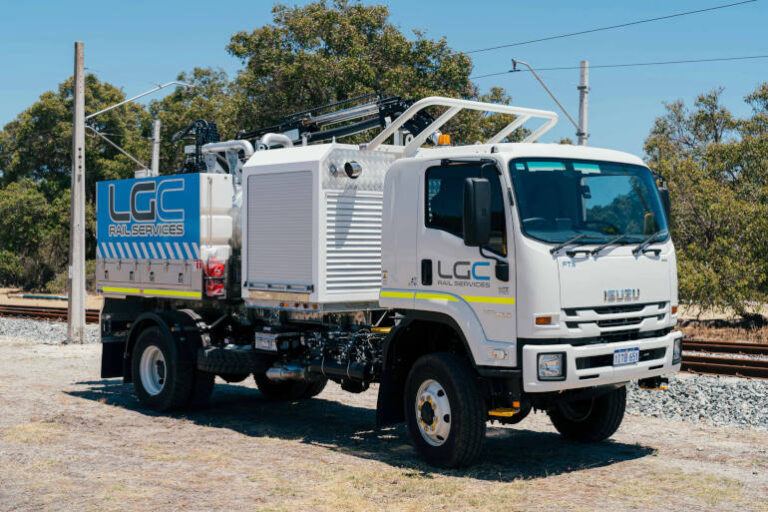
In the Pilbara, reliability is more than a selling point — it is a prerequisite. Extreme heat, remote project sites and unforgiving terrain demand equipment that can operate consistently with minimal downtime. For LGC Rail Services, that reality has shaped both its growth strategy and its fleet choices.
Originally established in 2000 as Aus Civil Utilities, the business began with communications installations, laying fibre optic networks across regional Western Australia. In 2025, it joined LGC Group and rebranded as LGC Rail Services, aligning with sister operations LGC Traffic Management and LGC Equipment Hire.
From a team of four in 2019, the company has expanded to more than 50 staff and operates around 35 vehicles and pieces of equipment, servicing major rail and mining clients including Wabtec, DT Infrastructure, John Holland and BHP .
Carving out a niche
Director Max Line said the company’s growth accelerated after identifying a gap in the market between signalling expertise and civil construction capability.
“A lot of the signalling companies had expertise in equipment and electrical installation but very little experience in civil construction,” he said .
By combining signalling, civil works and track maintenance, LGC positioned itself as a broader rail infrastructure provider rather than a specialist subcontractor.
Fleet built around dependability
Fleet selection has been guided by operational practicality. An early investment in an Isuzu Giga prime mover helped establish confidence in the brand under harsh operating conditions.
“Originally, we had an Isuzu Giga, and that was the main truck that used for everything… proving its dependability,” Max said .
Today, the fleet includes crane trucks, vacuum excavation units, crew cabs and tippers configured for mining and rail site requirements. Modifications such as rollover protection frames and emergency stops complement standard safety systems, reflecting the expectations of Tier 1 clients.
“The team really like the Isuzus, and they love the automatic range, which is very comfortable to get around in,” Max said . “We generally go for something easy to operate rather than a truck with too many bells and whistles. There’s less that can go wrong, meaning more time on-site and reduced downtime.”
Balancing cost and lifecycle
While competitive pricing remains a factor, durability and warranty support weigh more heavily in procurement decisions.
“We try to avoid getting anything that’s poor quality, unproven, or that we know doesn’t have the warranty for the duration we need it,” Max said . “Pricewise, Isuzu is pretty competitive, but the big thing for us is purchasing gear that is going to last.”
Dealer support in Western Australia has also played a role, particularly given the distances involved in regional operations.
Looking ahead
With expansion into Karratha and plans to broaden track maintenance services, LGC Rail Services is positioning itself for continued growth alongside Western Australia’s infrastructure pipeline.
The approach appears consistent: identify a gap, build capability, and support it with equipment that can withstand the environment. In the Pilbara, that formula remains as important as ever.