
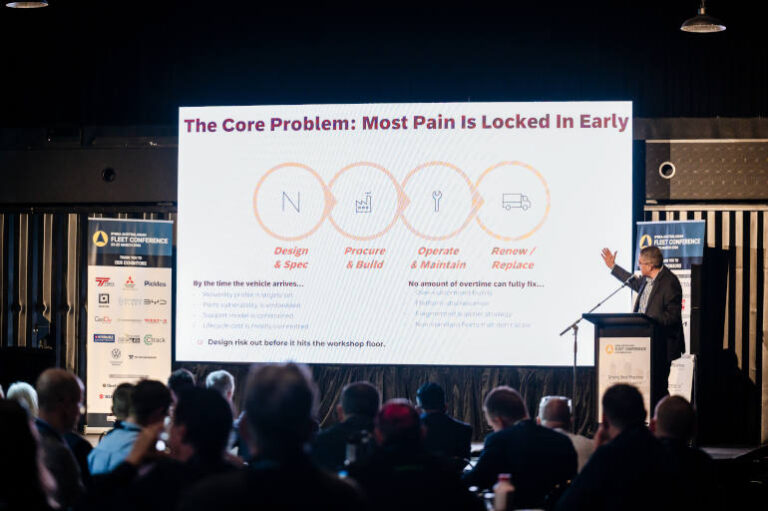
One of the strongest messages delivered at the 2026 IPWEA Fleet Conference in Melbourne was a reminder that many of the costs fleet managers struggle with today were determined long before the vehicle entered service.
In a practical session that resonated with fleet professionals across local government, utilities, and emergency services, Emad Loka, Director – Fleet Management at Fire and Rescue NSW, challenged delegates to rethink where maintenance costs really begin. His message was clear: the most important maintenance decisions are made during specification and procurement—not in the workshop.
For those who couldn’t attend the conference, this insight captured a central theme of the event—fleet performance is shaped by lifecycle decisions, and the earlier those decisions are made well, the easier the fleet will be to manage.

The Hidden Moment When Costs Are Decided
Fleet Managers often focus on controlling maintenance budgets after vehicles are delivered. But Loka explained that by the time a vehicle arrives in the fleet, most of its future maintenance cost has already been determined.
“By the time I already procured my vehicles, the cost of maintenance has already been locked in. The cost you will pay for the generation to come for the next 10 or 20 years has already been locked in—you just don’t know it.”
This concept shifts the conversation from reactive maintenance to proactive design and procurement. It also reinforces a principle familiar to mature fleet organisations: reliability and cost control start at the beginning of the asset lifecycle.
Why Specification Matters More Than Repairs
The specification stage is where fleet leaders make decisions about platform selection, configuration, and supplier relationships. These decisions determine how easy—or difficult—a vehicle will be to maintain over time.
Key factors that influence long-term maintenance cost include:
- Level of customisation
- Availability of spare parts
- Standardisation across the fleet
- Supplier capability and support
- Compatibility with workshop skills
- Lifecycle planning assumptions
Poor decisions in any of these areas can create ongoing operational challenges. Loka highlighted that maintenance teams often carry the consequences of these earlier choices.
“Whilst the people who are left to solve this problem—the maintenance in the workshop—really, it’s the asset that was not designed ever to be managed.”
This observation resonated strongly with delegates who manage ageing fleets or highly specialised equipment.
The Lifecycle Starts Earlier Than You Think
One of the key lessons from the presentation was that lifecycle management begins well before procurement. In fact, the most critical decisions are made during planning and design.
Loka encouraged fleet leaders to spend more time and effort in the early stages of the lifecycle, where decisions have the greatest impact.
“We need to spend the maximum time in design and specification so we can control the cost of operation and maintenance.”
This approach mirrors practices in infrastructure sectors such as rail, road, and utilities, where maintainers are involved in asset planning from the outset. By contrast, fleet operations have traditionally focused on maintenance after the asset is delivered.
The shift toward asset management maturity requires bringing maintenance expertise into the planning phase.
Why Maintenance Teams Need a Seat at the Table
One of the practical implications of Loka’s message is that maintenance teams should be involved earlier in procurement decisions.
Technicians and workshop managers understand the realities of operating and maintaining vehicles. Their insights can help identify risks that may not be visible to procurement or finance teams.
This collaboration can improve:
- Reliability
- Safety
- Availability
- Whole-of-life cost
- Service continuity
It also reduces the likelihood of unexpected maintenance challenges later in the asset’s life.
The Long-Term Impact of Today’s Decisions
For many organisations, fleet assets remain in service for 10 to 20 years or more. That means the decisions made today will shape operational performance for decades.
Loka reminded delegates that lifecycle planning is not just a financial exercise—it is a responsibility to future fleet teams and the communities they serve.
“Our decisions today will affect positively the service and reliability and sustainability for decades to come.”
This perspective aligns closely with the broader theme of the conference: fleet management is evolving from a technical function into a strategic stewardship role.
A Practical Shift for Fleet Managers
The message from the session was not about reducing maintenance capability. Instead, it was about strengthening the link between planning, procurement, and operations.
Fleet Managers can apply this principle immediately by asking a simple question during every procurement decision:
How easy will this vehicle be to maintain over the next 10 to 20 years?
If that question is answered early—and honestly—the organisation is far more likely to achieve reliable, cost-effective fleet performance.
Because in modern fleet management, the workshop doesn’t determine maintenance cost. The specification does.
- Geotab adds mass management to heavy vehicle telematics
 Geotab has expanded its Australian heavy vehicle compliance offering by adding Smart On-Board Mass capability through a certified integration with Airtec Corporation, allowing heavy haulage operators to manage telematics and mass data through a single platform. The certification means Geotab can now support Telematics Monitoring Application schemes both with and without Smart OBM requirements, as
 - Bridge Strikes Start Before the Truck Reaches the BridgeA bridge strike may happen in seconds, but the circumstances that lead to it can develop much earlier in the journey. That is one of the key fleet-management implications to emerge from HoustonKemp Economists’ report, The economic costs of bridge strikes in Australia, prepared for HERE Technologies and the Australian Logistics Council. The report estimates
- Electric Trucks and Vans Join the Spotlight at Everything Electric SydneyThe transition to electric transport is moving beyond passenger cars, and fleet operators will get a closer look at the growing range of electric trucks, vans and commercial vehicles when Everything Electric returns to Sydney in September. The three-day event, held at Sydney Showground from 18–20 September 2026, is expected to attract more than 40,000
- Truck Access, PBS and EV Rules Targeted in Major Reform ReportAustralia’s road freight productivity has stalled for more than a decade, and the Productivity Commission says regulatory reform is needed if the industry is to capture the benefits of safer, more productive and lower-emission heavy vehicles. The Commission’s Impacts of heavy vehicle reform study examines five areas where changes to road access, permits, zero-emission vehicle rules, charging
- Active safety: what fleet buyers should ask for when purchasing trucksWhen buying trucks, it is easy to focus on engine output, payload, cab comfort, service intervals and price. But one of the most important procurement decisions is the active-safety specification. Active safety technologies are designed to prevent a crash or reduce its severity before impact. They use cameras, radar, sensors, braking systems, steering assistance and