
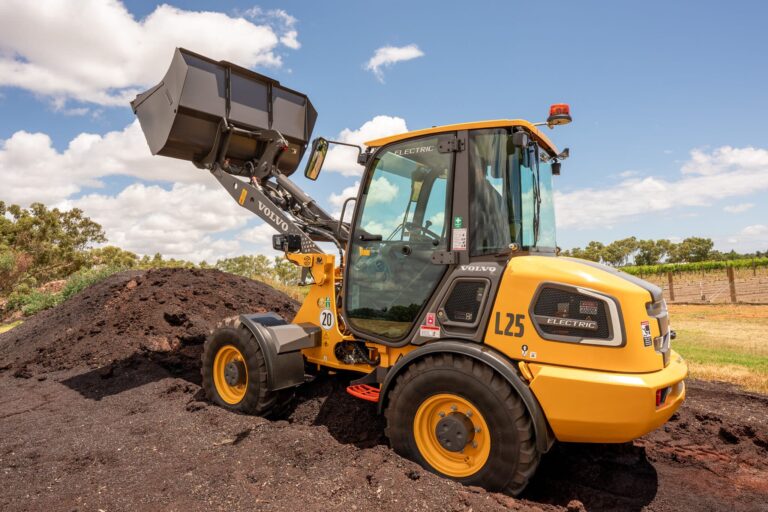
CJD Equipment is preparing its national operations for a future where electric and hybrid heavy machinery play a larger role in customer fleets.
As the dealer for Volvo Construction Equipment and a national supplier of heavy vehicles and construction equipment, CJD is already working with customers that want lower-emission machinery. To support that shift, the company needed charging infrastructure that could do more than power a single demonstration unit.
It needed a scalable system that could support electric equipment sales, branch operations, customer demonstrations and off-site deployments.
“We faced some challenges at our existing branches,” Simon Bycroft, National Commercial Sales Manager at CJD Equipment, said. “We had to gear up the existing infrastructure to be able to handle charging of the machinery.”

Preparing branches for electric machinery
For CJD, the challenge was not simply to install chargers at its Perth and Brisbane sites. The business needed to prepare branch infrastructure for a different operating model.
Electric construction equipment and heavy vehicles bring new requirements for power capacity, charging speed, load management and site planning. Branches need to support machines used for demonstrations, customer trials and operational movements, while continuing normal day-to-day activity.
That meant CJD required a charging solution that was practical now, but capable of being replicated across its broader national network as demand increased.
The infrastructure also needed to support flexibility. Demonstration equipment does not always remain at one branch. Customers may need to see machines operating off site, and CJD needed the ability to support those deployments without being constrained by fixed charging infrastructure.
Why CJD chose EVSE Australia
CJD Equipment selected EVSE Australia to design and install charging infrastructure across its Perth and Brisbane sites.
A key factor was EVSE’s experience delivering charging projects in complex heavy vehicle and truck environments. The solution needed to include high-power charging, portable charging capability and electrical upgrades that could support the demands of heavy machinery.
EVSE’s national footprint also played an important role. With local teams across Australia, the company could support CJD at multiple branches and help create a model that could be repeated at other sites in the future.
“We relied on local partners like EVSE to give us advice on how to install charging infrastructure and the power needs that each branch is going to need to handle,” Bycroft said.
With teams on the ground in Perth and Brisbane, EVSE worked through the design and installation requirements for each location, with the aim of supporting CJD’s current operations while leaving room for future growth.
The charging solution
EVSE delivered a tailored charging ecosystem at CJD’s Perth and Brisbane sites.
Each site was equipped with a 180kW Ocular Atlas DC fast charger to support rapid charging of electric heavy vehicles and machinery. A 22kW IQ Commercial AC charger was also installed at each location to support fleet and staff vehicles.
To provide greater flexibility, each site also received a 30kW Ocular Roam portable DC charger. This gave CJD the ability to support on-demand charging, customer demonstrations and off-site equipment deployments.
The charging system also included tailored charging heads to suit a range of heavy vehicle and equipment requirements.
Active load management was used to protect each site’s available electrical capacity and support efficient use of power. In Brisbane, EVSE completed a major power upgrade that included custom switchboards, a new transformer and upgraded infrastructure. This gives the site capacity to support current electric machinery requirements and future expansion.
Supporting demonstrations and customer adoption
One of the practical benefits of the project is that CJD can now showcase electric machinery with greater confidence.
For suppliers and dealers, charging infrastructure is becoming part of the customer experience. Buyers assessing electric construction equipment want to understand not only the machine, but also how it charges, how long it takes, and what infrastructure may be required in their own operations.
By installing fixed fast charging and adding portable DC charging capability, CJD can support demonstrations at its own branches and in customer environments.
That flexibility is important as more fleets, civil contractors and construction operators consider electric and hybrid machinery. Demonstrations and trials are often a critical step before purchase, particularly when customers need to understand charging, turnaround times and daily operating impacts.
Faster turnaround times
CJD Equipment is already seeing the operational benefit of the charging rollout.
“These chargers allow us to fast-track our L120 in around 90min,” Bycroft said.
That faster turnaround helps reduce downtime and makes electric machinery easier to incorporate into branch operations, demonstrations and customer support activity.
For CJD, the charging infrastructure is not just an environmental investment. It is an operational enabler that allows the business to support electric machinery in a practical way.
A scalable model for future sites
With charging infrastructure now installed at Perth and Brisbane, CJD has a model that can be expanded across other locations as customer demand grows.
The combination of high-power DC charging, AC charging, portable DC charging and site-level electrical upgrades gives the company flexibility across different use cases. It can support internal fleet needs, customer demonstrations, off-site deployments and future electric machinery growth.
For Fleet Managers, Procurement Managers and organisations considering electric heavy equipment, the CJD project highlights a key point: electrification requires planning beyond the machine itself.
Charging speed, site capacity, load management and portability all affect whether electric machinery can be used efficiently in daily operations.
CJD’s investment shows how dealers and suppliers are starting to build the infrastructure needed to support the next stage of heavy vehicle and construction equipment electrification.