
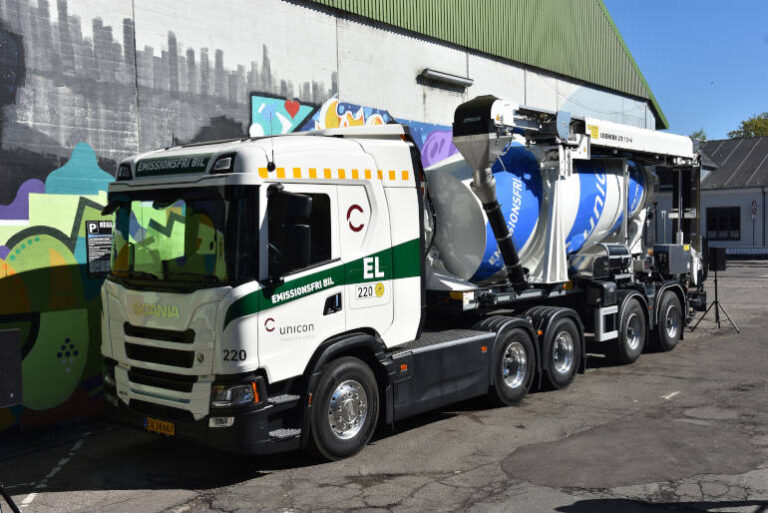
Scania, Unicon and Liebherr-Mischtechnik have demonstrated a fully electric concrete transport solution designed for real-world construction logistics, showing that electrification can extend beyond standard freight and urban delivery applications.
The project combines a battery-electric Scania truck with a fully integrated electric concrete mixer system, creating a zero tailpipe emission solution for one of the more complex transport tasks in the construction sector.

Concrete transport has traditionally been considered difficult to electrify because of high energy demands, variable site conditions, off-road operation and the need to power auxiliary equipment such as the mixer drum. The partners have addressed this through a systems-based approach that integrates the vehicle, mixer application and energy use.
A key part of the solution is an electric power take-off system, or ePTO, which powers the concrete drum directly from the truck’s battery system. This removes the need for a separate combustion-powered auxiliary system and allows both driving and mixing to be completed electrically.
Tobias Ejderhamn, Global Manager, Transformation & New Business at Scania, said the project showed electrification was not limited to simple or standard transport applications.
“This project shows that electrification is not limited to standard applications. It can be applied where it matters most,” said Ejderhamn. “By combining our modular electric platform with deep application expertise and close customer collaboration, we are demonstrating a viable path towards zero-emission transport, even in the most demanding use cases.”
The vehicle has been developed over three years and is intended for daily operations rather than as a limited demonstration unit. It has an installed battery capacity of up to 400kWh and an operational range of around 200 kilometres, with the configuration developed using route simulations and energy modelling.
For Unicon, Denmark’s leading producer and supplier of ready-mixed concrete, the project is part of a broader move to reduce emissions from construction logistics.
Christian Elleby, Supply Chain & Procurement Director at Unicon, said the deployment had been designed with scalability in mind.
“This is not a pilot, it is a solution designed for daily operations and future scale,” said Elleby. “We are taking solid steps to reduce emissions in construction logistics, and this collaboration shows what is possible when the right partners and technologies come together.”
Scania and Unicon are already preparing to expand the deployment, with another 10 electric vehicles on order and planned for operation in coming years. By 2027, Unicon aims to operate a significantly larger electric fleet as it works towards its ambition of emission-free concrete transport by 2035.
The project is significant because it targets an application where the energy demand is not limited to vehicle movement. In concrete transport, the truck must also support continuous mixing and handle demanding building site environments, making the integration of vehicle and body equipment central to the business case.
While electric trucks are increasingly being deployed in urban delivery, waste, municipal and depot-based operations, construction logistics has presented a more complex pathway because work patterns are less predictable and payload, site access and auxiliary power demands can vary significantly.
Ejderhamn said the industry now needed to move beyond demonstration projects and towards scalable applications.
“As the transition accelerates, the industry must move beyond pilots and into scalable solutions,” said Ejderhamn. “This project shows how electrification can deliver real impact – reducing emissions, improving working conditions, and enabling more sustainable cities.”
For construction fleets, the deployment provides another example of how electric heavy vehicles are beginning to move into more specialised applications. It also highlights the importance of matching the vehicle, application, charging strategy and operational routes before introducing electric equipment into daily use.
The Scania, Unicon and Liebherr collaboration shows that the electrification of construction transport will depend on more than the truck alone. The body, auxiliary systems, route planning and operating model all need to be considered together if fleets are to reduce emissions without compromising productivity.