

Transport for NSW is looking to Performance Based Standards (PBS) vehicles as a practical way to lift road freight productivity, reduce emissions and lessen the impact of heavy vehicles on the road network.
Speaking at TruckShowX in the Hunter Valley, Scott Greenow, Executive Director Freight at Transport for NSW, said the agency was changing the way it thinks about heavy vehicle access and productivity in NSW.
Greenow said the challenge for government was no longer just about whether freight could move more safely, but whether it could also move more sustainably and productively without placing unsustainable costs on operators or taxpayers.
“We need to be able to do it more sustainably. So environmental outcomes are critical now,” Greenow said. “We also need to continue productivity, so cost of living, economic activity, our competitiveness worldwide, all of these things are critical from a New South Wales government point of view, as well as it is for you guys.”

The message to industry was that NSW is beginning to view higher-productivity heavy vehicles as part of the solution, rather than simply as a risk to be managed.
Greenow acknowledged that PBS vehicles have been talked about positively by road managers for many years, while operators have often found the access process difficult.
“You’ll hear road managers like myself come up here and say PBS are fantastic, and then you’ll go up and try and get a PBS vehicle onto our roads, and we will do everything in our power to stop you. Well, that’s what it feels like,” he said.
According to Greenow, the issue has been traditional thinking. Transport for NSW is now aiming to apply a different lens based on safer, more sustainable and more productive freight movements.
“What we’re saying is, let’s toss that aside. Let’s go with the principles of safer, more sustainable, more productive in a way that reduces the impact on industry and on government,” he said.
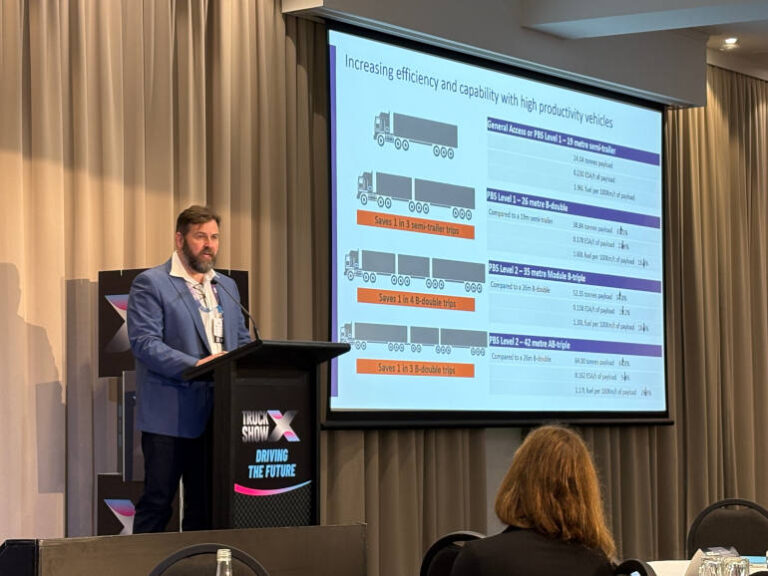
A key example is the potential use of smarter vehicle combinations that can achieve PBS Level 2 performance, equivalent to the current 26-metre B-double network. Greenow said that network currently covers around 60,000 kilometres of approved state and local roads in NSW.
That creates a substantial opportunity if newer combinations such as AB-triples or modular B-triples can be assessed against the same performance standard.
“Imagine if you could start using an AB triple or a Module B triple on those networks,” Greenow said.
He cautioned that not every kilometre would automatically be available, with some rail level crossings, bridges and local constraints still needing assessment. However, he said the existing B-double network should be the starting point for considering access.
One of the advantages of some modular combinations is that they can use existing trailers from 26-metre B-doubles. Greenow said this matters because operators need productivity reform that does not strand existing equipment or undermine investment decisions.
“If you pair them with smarter design vehicles, so we leverage steerable axles to be able to achieve the outcomes, then all of a sudden you have a vehicle that is also able to perform at PBS level two with significant uplift in productivity,” he said.
The productivity gains discussed were significant. Greenow pointed to an AB-triple offering nearly 65 per cent more payload, with fuel savings of around 26 to 27 per cent less fuel per tonne of payload.
For government, those gains are not just about operator efficiency. Fewer truck trips can mean lower fuel use, fewer kilometres travelled, reduced exposure to fatigue risk and less wear on the road network.
Greenow used the Hume Highway between the Victorian border and Sydney as an example. He said about 5,000 heavy vehicles make that journey each day in both directions, and if half were B-doubles that could be replaced by 53.5-metre B-quad combinations, the fleet task could be cut significantly.
“If you were to change those vehicles from B-doubles to 53 and a half metre BOD quads, you pretty much cut the fleet in half and you save 9 million ESA,” Greenow said.
Equivalent Standard Axles, or ESA, are used as a measure of pavement wear. Greenow said the calculated saving was not annual, but weekly.
“Every week, 9 million less ESA on the road, so the pavement wears out much slower, less potholes, less safety issues,” he said.
The same example pointed to 1.9 million litres of fuel saved each week and 4.4 million fewer kilometres travelled.
Greenow said the barrier to these vehicles has historically been government, not industry.
“The barrier for all of these have not been you in the past, they’ve been us,” he said.
Transport for NSW has had its current policy position in place since September 2024, but Greenow said it takes time for policy, bridge assessments and access networks to align.
The agency is also considering how low and zero-emission heavy vehicles can be supported. Greenow said NSW currently has notice access for a two-year trial of zero-emission vehicles with increased axle mass settings, and Transport for NSW is looking at extending that into a longer-term position.
He also pointed to interest in powered trailer axles, wide single tyres and harmonised settings with other states where possible.
For freight operators, the presentation signalled a shift in how NSW may approach productivity reform. The direction is not simply about allowing bigger trucks. It is about using smarter vehicle design to move more freight with fewer trips, lower emissions and less road wear.
As Greenow put it, “We are here to look at whatever is a smarter way of doing things in New South Wales.”